

November 2021 – Volume 25, Number 3
| Title | English Listening and Speaking |
| Website | http://speakenglishdaily.com/ |
| Type of Product | Mobile-assisted language learning application |
| Hardware Requirements | Smart-device (phone or tablet) and access to an Internet connection |
| Operating System | Android and iOS app |
| Registration | Not required |
| Price | Free |
Incorporation of digital technology into education seems to have become inevitable in most learning contexts. As a key component of education, second language (L2) learning and teaching can also benefit from technological support, particularly from mobile applications (Kukulska-Hulme, 2009). In fact, mobile-assisted language learning (MALL) is a flourishing field of inquiry with promising implications for L2 teaching and learning (for reviews, see Persson & Nouri, 2018). Mobile applications are appealing, particularly to young L2 learners, as they allow users to try to learn and practice almost everywhere and at any time, an experience which has been described as ubiquitous learning (Godwin-Jones, 2011). These portable tools also offer opportunities to improve L2 learners’ listening and speaking skills (Demouy & Kukulska-Hulme, 2010) by providing them with authentic materials and engaging them in communicative interactions. This review, therefore, focuses on a mobile language learning application, namely English Listening and Speaking, and examines the opportunities the app provides for improving English language listening and speaking skills. The review ends with a conclusion that summarizes the major features of the app and makes some recommendations regarding its utilization for language teaching and learning purposes.
Description
To use the English Listening and Speaking application, learners can download it from the Google Play Store and App Store for free. After the installation, learners can access all of the app’s contents without having to register. The app’s homepage offers many options to learners: learners can save their favorite lessons, have access to the lessons they have previously downloaded, and check the meanings of new words through an online dictionary.
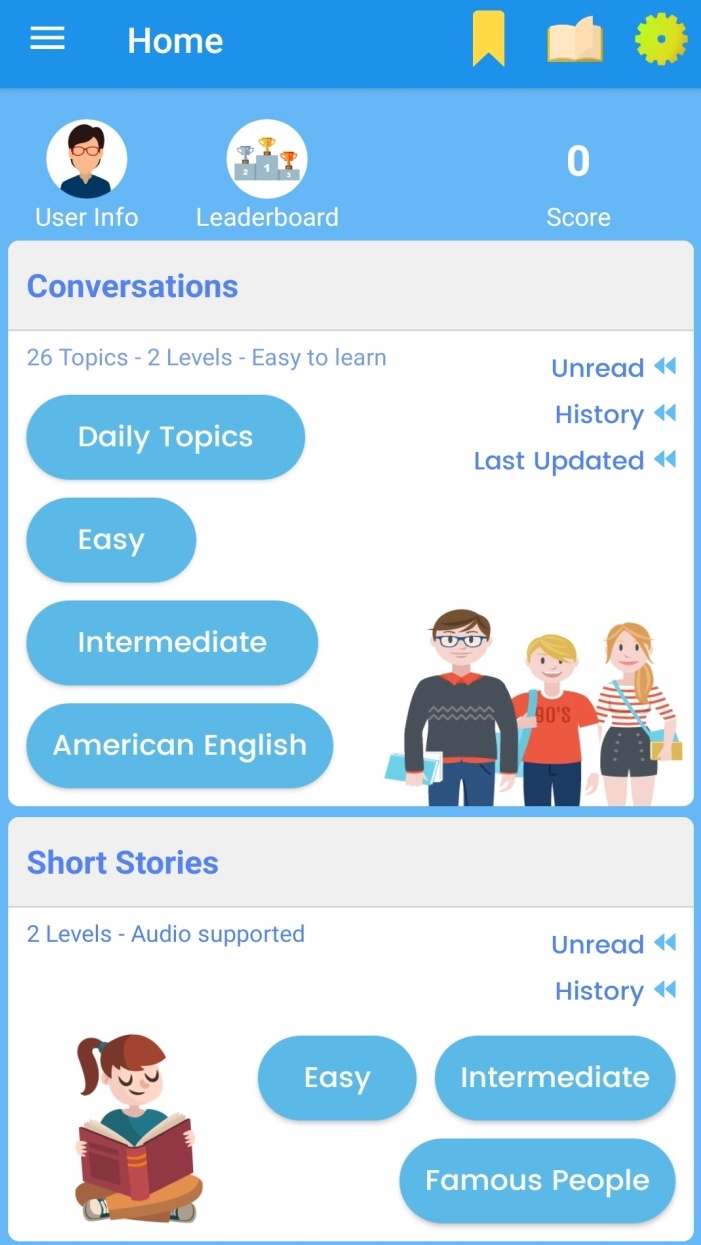
The homepage comprises seven different sections (Figure 1). Each of those sections will be described below.
Conversations
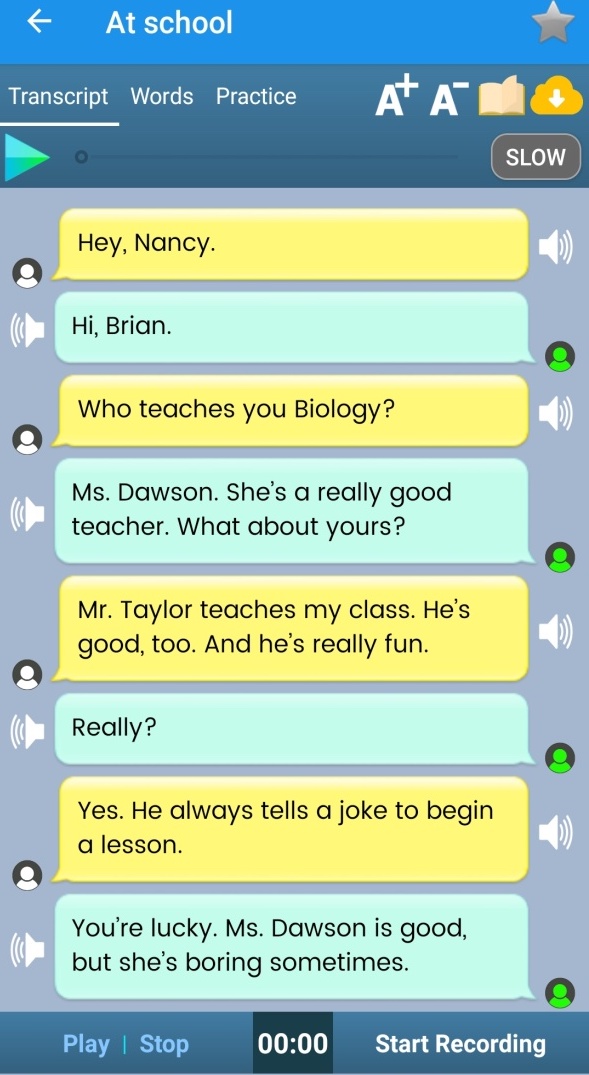
This section contains conversations about daily topics, American English conversations, and conversations appropriate for learners at low and intermediate proficiencies. Learners can select from various conversation topics (e.g., education, shopping, small talk, and media) by clicking on each of these topics (Figure 2). Upon selecting and clicking on a topic, learners are provided with the transcripts, which can be played. They can also pause and slow down the speed of the conversations. Additionally, learners can check the meaning of the words in the conversations online by clicking on the target words. Furthermore, they can record their voice if they wish to practice the conversations. At the end of each American English conversation lesson, learners can take a quiz to assess their listening comprehension. This quiz is in multiple-choice items format in which learners must listen to an audio file and then respond to five to ten questions. There is no time limit for answering the questions, and once the answers are submitted, learners can see which items they answered correctly and incorrectly. The only feedback provided in this quiz is whether the learners have selected the correct answer or not.
Short Stories
This section includes stories divided into levels from elementary to advanced. Stories classified as easy are relatively short in length and do not contain difficult words. Intermediate and advanced level stories are longer in length and are lexically and grammatically more difficult. All the features mentioned in the conversation section are also available in this section.
Vocabulary
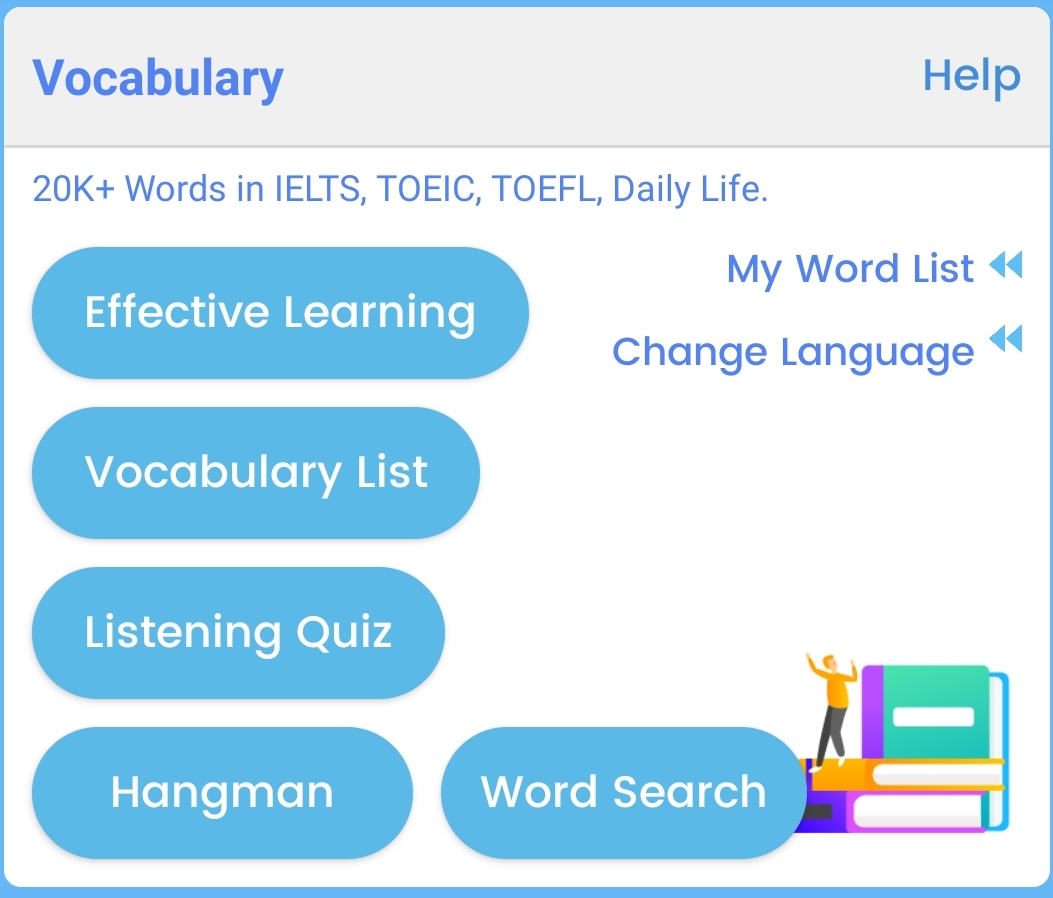
Learners can access this section to learn core words (the most commonly used vocabulary in the English language accompanied by some information on their use), IELTS, TOEIC, TOEFL words, and vocabulary for young learners. Learners can also choose a vocabulary list, hangman (a vocabulary game in which learners should think of a word by suggesting letters with a limited number of guesses), a listening quiz, and word search (Figure 3). Furthermore, learners can use Google voice recognition on their phones to check their pronunciation.
Sentences and Verbs
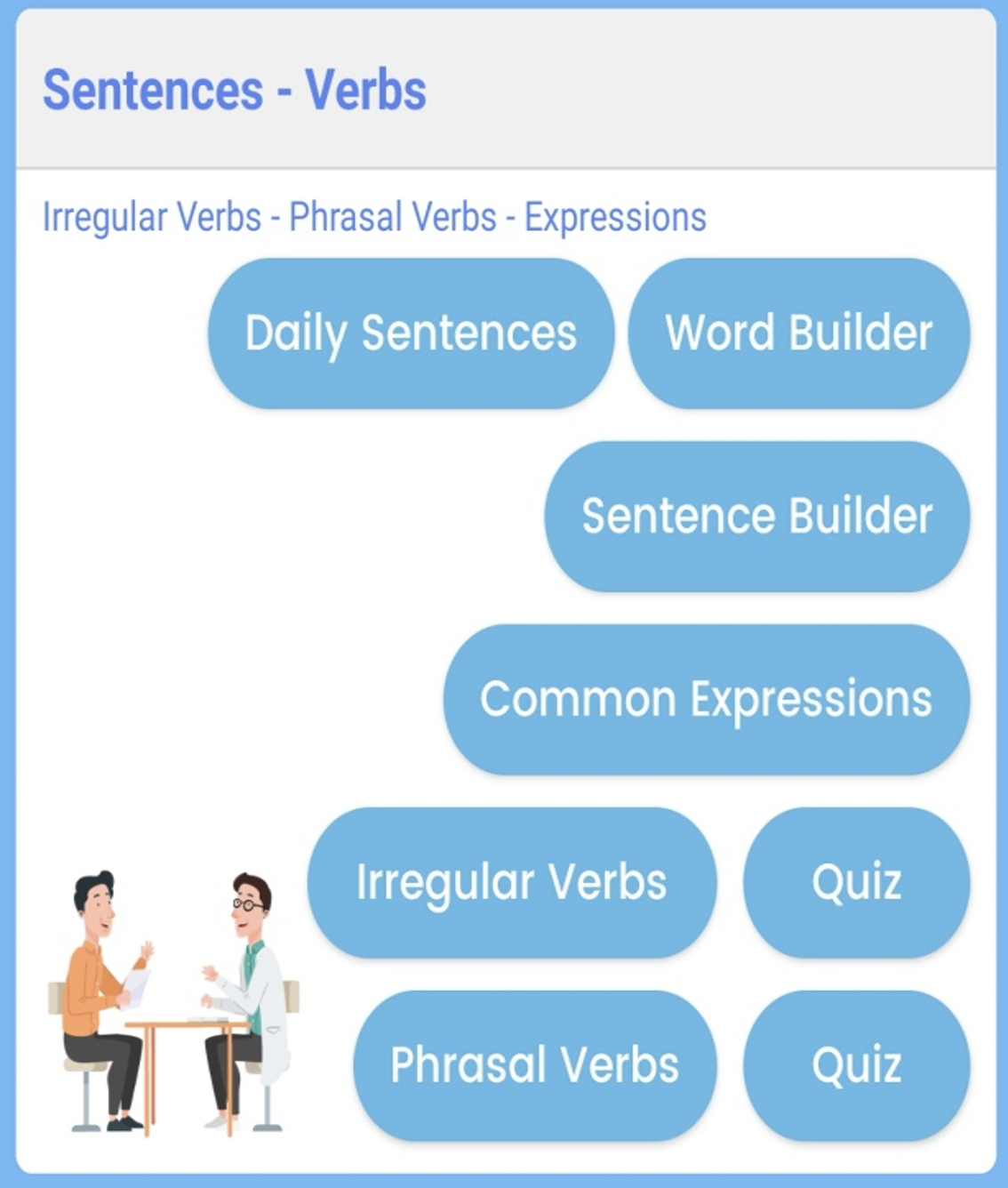
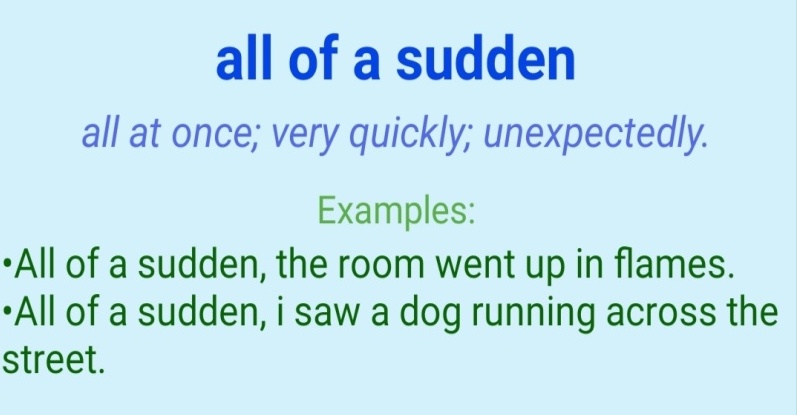
This feature provides learners with various practice opportunities for daily sentences, word builder, sentence builder, common expressions, irregular verbs, and phrasal verbs (Figure 4). Moreover, learners can listen to sentences covering a variety of topics and view the meaning and example uses of the daily expressions, irregular verbs, and phrasal verbs employed in those sentences (Figure 5). Learners can then take a quiz on irregular verbs, and phrasal verbs; this quiz is in the multiple-choice items format in which learners are given a definition or meaning of an irregular verb or phrasal verb and then asked to choose the answer from a list of possible answers.
English Pronunciation
This part provides important information (e.g., articulation features, spelling, examples) about each vowel and consonant in English. Learners can hear these vowels or consonants by clicking on the words that contain those sounds and the app will then play the words’ pronunciation. Learners can use this option to improve their pronunciation and listening skills.
Quick Lessons
Learners can practice utilizing ‘measure words’, (e.g., a box of, a cup of, a piece of) with pictures in this section and alternative ways of saying a sentence such as “I am sick of it” or “I am not into it,” rather than “I don’t like it.” Likewise, learners can practice grammar using the app’s English tenses chart.
IELTS Practice
In this section, learners can practice their IELTS writing in two parts, including IELTS Writing Task 1 and essays (IELTS Writing Task 2). The app includes excellent sample writings for each IELTS task, and learners can check the definitions of words in the sample texts by clicking on them.
Others
This section contains English names, tests, and games that encourage learners to improve their English proficiency in a more enjoyable manner. English names are those names that are popular in countries where English is the native language. Learners can listen to how these names are pronounced by downloading the corresponding audio files. Moreover, the tests and games are mostly related to testing the knowledge of vocabulary, daily expressions and listening skills.
Evaluation
The English Listening and Speaking app is rather easy to work with and has an attractive interface that utilizes colorful layouts to make language learning more appealing to users. It can serve as an assistant for both language learners and teachers to facilitate the process of learning the skills through exposure to engaging, authentic content and elements of gamification. The pragmatic and straightforward methodology of the app along with various practice tests and quizzes lend themselves optimally to self-study and homework for the students. Pedagogically speaking, the app appears to have been designed on the notion that a new language can be acquired through exposure to authentic language learning materials (e.g., short stories). It best suits those autonomous learners who already have some level of motivation or curiosity for language study and are looking to reinforce the fundamental skills of listening and speaking in English.
The users of this app can find useful materials, most of which are audio supported, that they need for learning English, including idioms and phrases, vocabulary, single sentences, short stories, essays, grammar, games, IELTS writing tests, and TOEIC vocabulary tests. Research has demonstrated that audio (and visual) aids can motivate L2 learners, improve the effectiveness and engagement of teaching methods, maintain learners’ attention, reinforce key concepts of lessons, and help learners understand the content of lessons more clearly (Bahrani & Tam, 2012; Maniruzzaman & Rahman, 2008). Authentic materials have been shown to be more motivating for learners because they expose students to real-world situations and create a link between the outside world and the English classroom (Rao, 2019). Moreover, once learners download the lessons, they can access them without being connected to the Internet.
Despite the app’s helpful features, it includes some drawbacks that should be addressed in future updates by the app designers. Learners may get confused by the abundance of available options, and they may even lose focus. This can be troublesome for those learners who are not tech-savvy. As pointed out by Lawrence et al. (2020), the issue may not be providing learners with more technology but with more effective technology. Another significant weakness of this application is that it does not engage learners in real-life situation interaction. While learners are practicing their listening skills through this app, they may develop an illusion that they have mastered listening and speaking skills, which is the opposite in real-world situations. Illés and Akcan (2017) state that using language in real-life interactions and situated contexts is critical in L2 learning because it allows learners to experience unplanned communication, thus fostering their spontaneity and creativity in language use. In real-life situations, learners converse with one another and provide responses based on what the other(s) communicates, but there is no such possibility in this app.
Conclusion
The English Listening and Speaking app can be highly beneficial for both L2 learners and teachers as a supplement to classroom activities or as a standalone learning tool outside the classroom. It furnishes intermediate and advanced English language learners with many resources; learners have a variety of options, topics, and lessons to choose from based on their interests. The app also allows learners to practice their listening and speaking skills, and they can assess their progress through various quizzes. Learners can also save the audio of conversations and lessons on their phones and learn or practice the language, especially where there is limited or no Internet connectivity. Moreover, teachers can utilize the lessons and conversations in the app to supplement classroom teaching; they can introduce the app to learners for additional practice outside of the classroom. Learners must also be aware of the app’s limitations and avoid losing their focus or spending an excessive amount of time on a single lesson. Learners should concentrate on the sections that are designed for the speaking and listening skills (e.g., conversation, grammar, and vocabulary sections).
References
Bahrani, T., Tam, S. S. (2012). Audiovisual news, cartoons, and films as authentic language input and language proficiency development. The Turkish Online Journal of Educational Technology, 11(4), 56-64.
Demouy, V., & Kukulska-Hulme, A. (2010). On the spot: Using mobile devices for listening and speaking practice on a French language programme. Open Learning, 25(3), 217–232.
Godwin-Jones, R. (2011). Emerging technologies: Mobile apps for language learning. Language Learning & Technology, 15(2), 2-11.
Illés, É., & Akcan, S. (2017). Bringing real-life language use into EFL classrooms. ELT Journal, 71(1), 3-12.
Kukulska-Hulme, A. (2009). Will mobile learning change language learning? ReCALL, 21(2), 157-165.
Lawrence, G., Ahmed, F., Cole, C., & Johnston, K. P. (2020). Not more technology but more effective technology: Examining the state of technology integration in EAP programmes. RELC Journal, 51(1), 101-116. https://doi:10.1177/0033688220907199
Maniruzzaman, M., & Rahman, M. M. (2008). The use of audio aids in the EFL class at the tertiary level: A plus or a minus? Daffodil International University Journal of Business and Economics, 3(1), 121-137.
Persson, V., & Nouri, J. (2018). A systematic review of second language learning with mobile technologies. International Journal of Educational Technologies in Learning, 13(2), 188–210. https://doi.org/10.3991/ijet.v13i02.8094
Rao, P. S. (2019). The effective use of authentic materials in the English language classrooms. Humanities, 7(1), 1-8.
About the Reviewers
Musa Nushi is an assistant professor in TEFL at Shahid Beheshti University in Tehran, Iran. His research interests focus on the interface of instruction and English as a Foreign Language (EFL) learning, with particular emphasis on the role of technology and corrective feedback. <m_nushi sbu.ac.ir>
Ali Momeni holds an MA in TEFL from Shahid Beheshti University in Tehran, Iran. His research interests lie in the interface of testing and assessment, L2 teacher education, computer-assisted language testing, computer-assisted language learning, and educational technology. <ali.momenniiigmail.com>
To cite this article
Nushi. M. & Momeni, A. (2021). English Listening and Speaking: A Review. Teaching English as a Second Language Electronic Journal (TESL-EJ), 25(3). https://tesl-ej.org/pdf/ej99/m2.pdf
| © Copyright rests with authors. Please cite TESL-EJ appropriately.Editor’s Note: The HTML version contains no page numbers. Please use the PDF version of this article for citations. |