

April 2001 — Volume 5, Number 1
New Dynamic English, Professional Version
DynEd International, Inc.,
1633 Bayshore Highway, Suite 120
Burlingame, CA 94010
USA
Phone: +1 (650) 259-0670
E-mail: sales@dyned.com (Sales Info)
Web: http://www.dyned.com
Site licenses:
| Package: | Price (U.S.) |
|---|---|
| Single-Level (2 CDs) | $395 |
| Complete Set (8 CDs) | $1,295 |
| Professional Version (11CDs: complete class set + Records Manager, Placement & Mastery Test CDs, and Teacher and Study Guides CD) | $1,695 |
System requirements
| Win 95, 98, NT or 2000 | Memory | CPU | Colors | CD-ROM | Sound | Network Interface Card |
|---|---|---|---|---|---|---|
| Standard Course | 32 MB | Pentium 90 | 256 | 2X | 16 Bit | 10Base-T |
| Course with Video | 32 MB | Pentium 100 | Hi Color | 4X | 16-bit | 10/100Base-T |
| MacOS Power PC | Memory | CPU | Colors | CD-ROM | Sound | Network Interface Card |
| Standard Course | 32 MB | Any PPC | 256 | 2X | 16-bit | 10Base-T |
| Course with Video | 32 MB | PPC 100MHz | Thousands | 4X | 16-bit | 10/100Base-T |
Introduction
New Dynamic English is a comprehensive interactive-multimedia course designed for beginning- to advanced-level students. The four-part series (four levels, two discs per level) is based primarily on listening and speaking activities (with an underlying grammatical syllabus), which present material in context, followed by exercises intended to check comprehension, increase fluency, and help students develop mastery of the presented grammar, vocabulary and functional language skills.
The course includes animation, video and speech-recognition exercises among others. Along with the software, DynEd also offers placement and mastery tests for presentation units, and a records-manager program, as well as student and teacher manuals. The course is available by level (two discs per level), as a full set (eight CDs covering all four levels), or in its Professional Version, which includes the placement and mastery tests, a detailed teacher’s guide, and the records manager. [-1-]
This review focuses on New Dynamic English, Professional Version, and is based on an English-language program’s implementation of New Dynamic English at Zayed University, United Arab Emirates, during the past two-and-a-half years Æ primarily with lower-level students who are generally communicative in English, but have low vocabularies and little control of grammatical structures. The student body of Zayed University is composed entirely of national women whose native language is Arabic. As part of the university’s English “readiness” program, which focuses heavily on English-language instruction as it prepares students for study at the university level, a course has been included in which its instructors use New Dynamic English as a primary source, fully employing all aspects of the program — which include suggested study plans from its Instructors’ Manual — and also use of supplementary materials tailored to individual students’ needs. In recent semesters the course has been scheduled for four hours a week. Needless to say, the software has been found to be very useful, but instructors have had to do quite a bit of learning to get to the point where it is felt that the language program is truly being used effectively.
The program
DynEd Incorporated’s New Dynamic English (NDE) is, to say the least, a large and complex program. Due to its size, and the amount of research and development that has gone into its production, the course is both extremely beneficial to students (especially in the lower levels) and a very involved undertaking for instructors wishing to use it.
From the students’ perspective, NDE offers a simple interface with graphics and animation that, while they may seem simple in comparison to what some students are exposed to through video games, are high quality and professional. The students’ screen features a four-part pull-down menu, the presentation screen, and control buttons which would be recognizable to any student who has used a VCR or cassette player. There are also microphone and headphone buttons which allow students to record and listen to themselves repeating sentences from the lessons (an integral part of the program), and an “abc” button which brings up the text of the sentence presented with links to the program’s glossary. Students interact with the program through mouse-clicks on the buttons or on images in the presentation screen, and through speech recognition. [-2-]

NDE is presented to learners over four levels. The first is directed towards what the publisher calls “false beginners” with a spoken vocabulary of 0-400 words and “little or no knowledge of basic grammar.” Each successive level is aimed at progressively higher students, with the highest deemed “appropriate for upper-intermediate and advanced level students whose vocabulary approaches a 1,500-2,500 word spoken vocabulary and a need to express more complex ideas.” Therefore, the complete courseware set is appropriate for programs with a wide range of student abilities. Teachers looking for software aimed at only lower- or higher-proficiency students may purchase individual parts.
Each level follows a general pattern of three presentation units followed by Review Exercises and Video Interactions. Presentation Units at the lower levels expose students to contextualized introductory and personal information, which feature basic grammatical structures and vocabulary. As the course progresses, themes become increasingly content-related, with units focusing on topics such as environmental and health issues, a biography of Albert Einstein, and even a mini industrial-espionage mystery which students must solve. These thematic units are one of the advantages of this program because while they present more and more complex grammar and vocabulary, they serve to hold the students’ interest and provide teachers with meaningful content for follow-up assignments. They also provide a focus on higher-level skills such as listening for main ideas, note taking, and analyzing arguments.
The presentation units, regardless of level, are based on spoken texts. Students have an option of clicking on the button which will show them the spoken text in written form, and visuals in each exercise aid comprehension, but information is primarily presented in spoken English (bilingual versions have a “translation” button, but this was not available in the version reviewed). As students move through the presentations, they are presented with periodic comprehension checks.
Each unit also features separate exercises to check understanding and reinforce grammatical structures. Formats for these exercises are, for the most part, varied. [-3-]
This can be best illustrated by looking at the following screenshot:
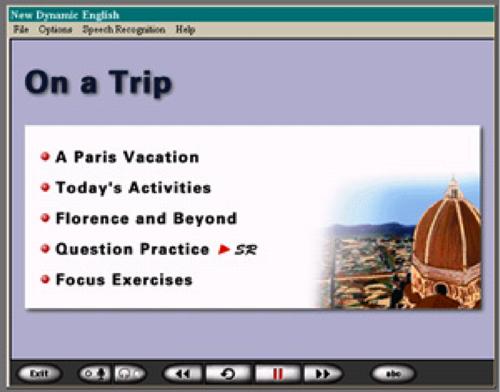
Level 3, Disc 1, Unit 1 is titled “On a Trip” and presents the present perfect tense (along with other grammar points and vocabulary) through the context of a woman’s trip to Europe. In the first three sections of the unit, the student will learn why Kathy is going to Europe, whether she has been before, and what she plans to do on the trip.
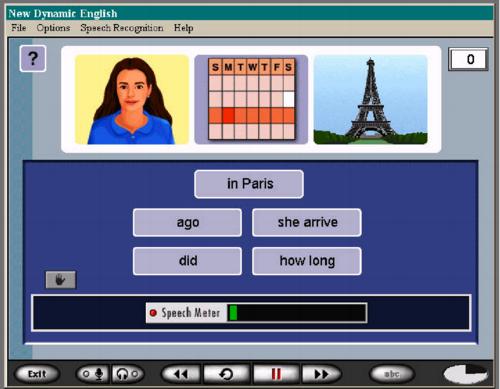
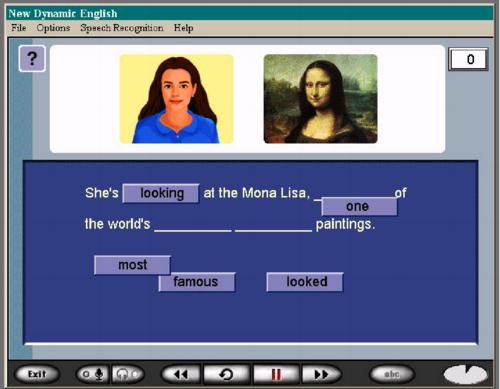
Periodically, the program will stop and check the student’s comprehension (“When did her friend get married? Has her friend gotten married yet? Who did Kathy’s friend marry?”). The final two sections are exercises based on the material and grammar presented. Question Practice will present the student with four boxes that must be rearranged to form a question. Students have the option of clicking on the boxes in order, or using the speech-recognition feature of the program and speaking the question, then receiving feedback from the program. Focus Exercises gives students sentences with gaps which must be filled by dragging tiles to complete the sentences.
[-4-]
The speech-recognition (SR) exercises provide one of NDE’s most interesting features. While students might initially have a problem getting the program to understand them, the employment of the technology is very creative. In addition to rearranging tiles orally, students are given the opportunity to use language meaningfully (albeit virtually) to interact with characters on video, fill in gaps in sentences (orally) and other original and innovative uses of the technology. In other words the program uses its SR capabilities for more than simple pronunciation practice.
Overall, the students at Zayed University have enjoyed working with NDE. At the beginning, there was some difficulty as students learned to enter and move through the program and figure out how to do some of the exercises. This was remedied with later classes by including a more thorough introduction to the program, more closely following DynEd’s suggestions from the Instructor’s Manual, and simply allowing students to spend an hour or two exploring the program without having their records affected. Additionally, there was usually some frustration with early attempts at using the speech recognition as students were getting the exercises “right” (ordering a question correctly, for instance), but not being acknowledged by the computer because it didn’t recognize what they said. Once these hurdles were overcome (two or three sessions with the program at most), and students began to see progress, they looked forward to working with the program and responded positively. Instructors who gained an understanding of how the courseware works and how to successfully employ it began to see real improvements in students’ language, particularly in their improved vocabulary, grammatical accuracy, listening and speaking.
Mini-tests, placement tests, and study paths
Teachers determine where a student should begin the program by administering an electronic placement test which is included as part of the professional version package. The test comes in two parts. The first places students in the lower levels. If a student scores above level 1.2 (Dynamic English level 2, Disc 1), she is instructed to go on to the second test. Determining the appropriate starting point for a student may seem at first glance to be a bit confusing because the test is meant to be used for several DynEd titles, but a simple chart allows teachers to easily place students based on their score. We found that the suggested placements were accurate even with “false beginners” and students who had a high vocabulary but little control or understanding of grammatical structures. DynEd also provides a correlation between their placement scores and the TOEIC and TOEFL exams. While the publisher makes no claim as to the accuracy of the placement score as a measure of overall proficiency, such a relation is helpful to teachers who are familiar with those tests in that it provides some indication of students’ general proficiency. [-5-]
For the most part, once placed, students move sequentially through the individual units and lessons. Upon completing each unit, they take a mini or “mastery” test. Access to the tests, which take around 10 minutes to complete, is controlled by the teacher, who “unlocks” each test with the Records Manager program, or sets tests to be unlocked once a designated completion percentage is achieved. The item selection and the order in which they are presented are randomly selected, so two students may have different items, although they are taking the same test (or they should at least see them in a different order). This feature is also helpful, for in case a student doesn’t pass a test (the publisher recommends a score of 80 as passing), she will see different items on subsequent tries. The items are all related to the content presented in the units, and require that the student has learned the information from the unit as well as acquiring the grammar and vocabulary.
The study path students follow and the depth of study is up to the teacher. The program includes manuals (in PDF format) which have excellent suggested classroom activities and tips for using the program, whether it is as the main course material, as a supplement, or in a self-access environment. Through the Records Manager, the instructor can determine whether a student has made satisfactory progress and whether they are ready for a mini-test. This is the point where the program can become a bit difficult to administer due to the complexities of the Records Manager, the complicated “completion percentage,” and students’ own aversions to multiple repetitions of the same lesson.
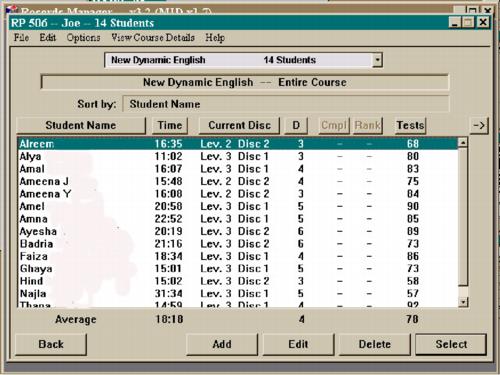
Records Manager, completion percentage and recommendations from DynEd
The testing and evaluation guide provided by DynEd recommends that students take mini-tests when they have “sufficiently mastered the language in a unit.” This mastery is said to be attained when a student’s records show she has accomplished an 80% completion percentage (a complicated indicator based on exposure to the presentation sentences and the student’s employment of different features of the program along with successful attempts at speech recognition and comprehension checks). To reach 80%, students will usually have to repeat lessons within a unit several times. During these repetitions, the authors recommend that the student look at the lesson in a variety of ways and make use of the program’s features, including recording her voice, consulting the program’s glossary, and clicking on the repeat button to hear sentences again (Focused Listening exercises from the Instructor’s Guides provide some direction for repeating exercises). The authors consider this repetition “overlearning,” which they consider a requirement for “successful language learning.” [-6-]
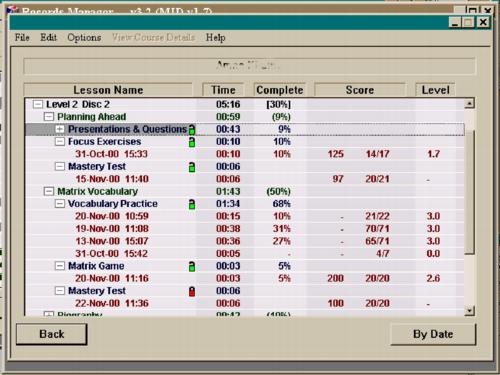
When students repeat lessons, they are not viewing identical material over and over. NDE features what is called a shuffler mechanism. This feature adjusts the difficulty of a lesson as the student answers questions and completes activities. Therefore, if a student does poorly on a lesson, the shuffler level will remain low and will repeat the same information and questions. As a student gains an understanding of the material and begins to answer more questions correctly, the program will present her with more information, more vocabulary and more difficult comprehension questions. According to the NDE Instructor’s Guide, “this dynamic nature of the program also helps maintain student interest even as they go through a lesson several times.” Additionally, as the shuffler level rises (the range is from 0 to 3 and is included in the students records), the completion percentage increases at a greater rate. These aspects, along with the Listening Focus tasks from the teacher’s guide are meant to keep students from being overburdened with too much material and from burning out on the individual lessons.
According to the authors, the more a student repeats a single lesson over time, and the more she employs the different features of the program, especially if she is focused on a specific task, the more she should acquire the language skills presented as opposed to memorizing them short term. However, in our experience, it is difficult to persuade even the most motivated student to repeat a lesson for the third or fourth time (not to mention the fifth or sixth), especially after she feels she has understood everything and has possibly demonstrated such by completing written exercises or other follow-up activities. The administrator has the option of setting a “recommended study time” through the Records Manager, which will increase or decrease the number of repetitions needed to achieve the desired completion percentage. Nevertheless, we found that the recommended setting for our students (70%) required more repetitions than the students were willing to undertake. [-7-]
Even with the shuffler mechanism, changes to the lessons can be very subtle so that a student doesn’t realize she is seeing something new or different. Also, it would seem that if a student is getting each comprehension question right, the shuffler could automatically “open up” the program until she misses one or two (without overburdening her with too much information) and allow her completion percentage to rise more rapidly. Finally, even with the Focused Listening tasks, students become resistant to the idea of repeating lesson after lesson, whether it is during the same session or during a different class period.
Overall, the Records Manager which presents students’ progress and allows the teacher to control the study path is a good, practical tool. As most CALL software is sadly lacking in records-management capabilities, it’s tempting to simply applaud DynEd for their efforts alone. However, there are some particulars which might make it more user-friendly. For example, choosing to view student records by date will show the lesson name and time spent on it, but will not give the results achieved on those lessons. Additionally, it would be convenient if a teacher could lock and unlock tests or lessons from the same screen used to view the records as opposed to having to switch to another view to edit the study path.
For instructors who don’t have much confidence in their technical skills, the Records Manager can be somewhat difficult to get a handle on. That said, once a teacher gains a basic understanding of how the program works (the user’s manual is very helpful), features such as an ability to import and export student names and records, transfer students between classes, switch between courses (in case a program has more than one DynEd title), and view records by lesson or by date give the instructor or administrator a very handy tool for managing the course. Another beneficial feature of the program is the ability to e-mail student records and import e-mailed records (in case a student is working on a computer attached to a different network). Additionally, through the Records Manager administrators can e-mail the technical log file directly to DynEd in the event of a problem or to solicit advice about administration of the program.
DynEd, the producer of the program, has continued to update and refine both the program and the Records Manager. These updates have been substantial improvements, showing that the company has continued to look into ways to improve the program based on user feedback. Additionally, our experience with them has been that they are extremely helpful and communicative when it comes to technical support and suggesting ways to improve our use of NDE, and they have been consistently receptive to our constructive criticism and suggestions. [-8-]
Conclusion
The complexity and depth of New Dynamic English is what makes the program so beneficial for students. Unfortunately, at the same time this is what can cause difficulties for teachers and administrators. Nevertheless, we have found that the courseware is very helpful to our students, especially in the lower levels. This has been evidenced not only in student feedback, but also in marked improvements in their language proficiency. It is engaging enough to allow us to use it several times a week, and comprehensive and multi-leveled, so we can use it with students of different proficiencies (or allow the same student to continue with the program over semesters). More importantly, students show progress in the form of improved grammar, speaking, and listening skills. Additionally, the company provides excellent materials and user manuals, and their tech support is truly supportive.
There are some basic criticisms that can be made to the package. For instance, the glossary which students can refer to is not always helpful to low-level students and would be improved greatly with some graphics (for instance, a picture of a man, as opposed to the definition “adult male person”). Also, the student study guides could be improved by tailoring the language to make them more accessible to students, providing additional Focused Listening exercises (giving them guidance on what to look for when repeating lessons), and improving the Follow-up Practice by including more extensive tasks. Nevertheless, it is obvious that DynEd has spent a great deal of time and effort researching and developing this program and the ways in which teachers can employ it more effectively.
As a result, when used correctly, is a powerful teaching-tool for programs looking for courseware which will focus on multiple skills (speaking, listening, and language use) and structures as opposed to isolating one area, and at the same time is suitable for many proficiency levels. Additionally, it is appropriate as primary courseware, as a supplement to an existing course. NDE might also be useful as a self-access program, but it would require some instruction before students could begin really using it as such. It is certainly not easy to begin using, and the administration can be difficult at times. We found that it was best to isolate a few teachers who were willing to work extensively with the program and have them lead sessions with students, or work closely with other teachers who were interested in using it.
It is advisable, therefore, that any program that considers adopting it should seriously consider the magnitude of the undertaking, look closely at the technical abilities of the teachers who will administer it, and inquire as to the training courses available from Dyned. That said, once students and instructors come to understand the program and how it works most effectively, its value will soon become evident.
Joseph Rowland
Zayed University, Dubai, United Arab Emirates
|
© Copyright rests with authors. Please cite TESL-EJ appropriately. Editor’s Note: Dashed numbers in square brackets indicate the end of each page for purposes of citation. |
[-9-]