

May 2021 – Volume 25, Number 1
Academic Word Lists: What Every Teacher Needs to Know |
|||
| Author: | Keith S. Folse (2020) | 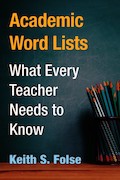 |
|
| Publisher: | Ann Arbor: U. of Michigan Press | ||
| Pages | ISBN-13 | Price | |
|---|---|---|---|
| Pp. 97 | 978-0-472-12567-8 (ebook) | $3.99 U.S. | |
Keith Folse’s (2020) eBook, Academic Word Lists: What Every Teacher Needs to Know, offers a comprehensive overview of the historical development of word lists for English language teaching, such as the ubiquitous Academic Word List (AWL; Coxhead, 2000). This book also sheds light on some common misconceptions about teaching vocabulary in second language (L2) classrooms. In addition to the recent research on the development and effectiveness of word lists in L2 learning, this work has a critical focus on both language teaching and language learning. According to Folse, the purpose of Academic Word Lists is two-fold: firstly, to expand teachers’ knowledge about useful academic vocabulary lists (such as the AWL); and secondly, to learn the most practical and effective ways for using these lists to facilitate and improve vocabulary learning. For too long, teachers have been told that word lists are useless or detrimental, a myth that Folse debunked with solid research findings in an earlier work (Folse, 2004). Teachers who believe that explicit vocabulary teaching is pointless, frustrating, or boring can certainly learn a lot from Academic Word Lists: What Every Teacher Needs to Know.
In the brief introductory section, Folse uses his own extensive language learning and teaching experiences to explain the many benefits of teaching and learning with word lists. As Folse explains, the inconsistencies and limitations of early word lists that teachers may have used is not a mark against word lists in general, and there are, in fact, many excellent corpus-based word lists for both general use and specific genres (e.g., business, law, and secondary school science). The introduction is followed by nine chapters that can be divided into three parts based on their focus.
Part I contains the first two chapters which emphasize the importance of knowing productive vocabulary teaching techniques for meeting students’ lexical needs. In Chapter 1 (“Why Are Word Lists Useful in Language Learning”), Folse explains why the Natural Approach (perceived to be commonly used) is not a truly viable option for teaching vocabulary, as it requires “lots of input and lots of time” (p. 14). The Natural Approach focuses on communication activities and tends to neglect aspects of formal instruction such as grammar, spelling, and vocabulary. It was an attempt to replicate what native speakers do in acquiring their first language in the L2 classroom. However, L2 acquisition is extremely complex and not the same as acquiring a first language. Therefore, students are in great need of explicit vocabulary instruction, which requires educators to put more effort into choosing appropriate word lists. Chapter 2 (“How Serious Is Our Students’ Lexical Gap”) introduces the idea of ESL students’ academic lexical gaps. Instead of relying heavily on randomly generated lists, L2 teachers should use corpus-based word lists that include frequent academic words and phrases to better prepare their students for academic success.
Within Part II, Chapter 3 (“A Timeline of the AWL”) provides a timeline of the AWL. First, Folse briefly describes word lists that existed prior to the development of the groundbreaking AWL. Next, he explains why researchers and educators began to seriously question the effectiveness of the Natural Approach and became advocates for “more grammar instruction and error correction” (p. 24). Finally, the timeline ends with the enormous growth in L2 vocabulary research that was sparked by the publication of the AWL in 2000. Chapter 4 (“Which Words Are on the AWL”) offers a thorough description of the AWL, including the number and type of words included in it (570-word families), and how the list is organized. The AWL words are presented in four ways, and teachers should use the option that fulfills their students’ English needs. These four ways include presenting words alphabetically by (1) headword, (2) headword with family members, (3) headword with family members and most frequent word italicized, and (4) only the most frequent member of each word family by sublists. Folse recommends the fourth option because learners may not always have sufficient time to study the whole word family, and focusing on the most frequent words can make learning more efficient. Chapter 5 (“How Were the 570 Word Families on the AWL Selected”) details the complicated process that Averil Coxhead (2000) went through to produce the AWL, including creating a corpus, operationalizing a “word,” and then deciding which words are academic.
Chapter 6 (“How Do Other Word Lists Differ from the AWL”) is of particular interest to teachers, because Folse describes how other corpus-based word lists differ from the AWL and reviews studies that compare the coverage of the AWL and the Academic Vocabulary List across multiple corpora. Folse’s main point is that, while the AWL is indeed a very good list and is important to the field, many other lists have been developed that include better coverage for students’ actual language needs.
Part III includes the last three chapters (Chapter 7-9), which introduce useful practices and suggestions for language learners and teachers regarding the use of the AWL, as well as the needs for future vocabulary research. Some tips from this section include using notebooks and teaching vocabulary learning strategies. L2 teachers must encourage their students to become “aggressive vocabulary hunters” (p. 62) by using notebooks and learning essential practices that keep them interacting with these notebooks. They should also start with a small corpus-based word list that matches students’ needs, and, most importantly, teach students vocabulary-learning strategies to alleviate the arduous task of learning so many new words.
Overall, the major strength of Academic Word Lists: What Every Teacher Needs to Know lies in its focus and presentation of a fundamental teaching tool for learning English vocabulary—a word list. Besides offering several available corpus-based word lists, the author provides clear, practical guidelines and strategies for language teachers and learners on how to gain ultimate benefits from using these academic word lists. Furthermore, the book is easy to read because of the author’s organization of topics and use of language that facilitates understanding of concepts. In addition, Folse describes recent vocabulary studies that compare the effects of using different word lists, which can provide a starting point for future research.
One oversight of Academic Word Lists is the lack of information about different types of vocabulary apps and their effects on vocabulary development; however, Folse does address this issue and guides readers to online resources (p. 74). Generally speaking, the book provides valuable options and strategies for teaching vocabulary in the EFL classroom. It is a useful and practical resource for English teachers and learners worldwide, one that I can recommend to fellow teachers interested in research-based teaching and learning strategies.
References
Coxhead, A. (2000). A new academic word list. TESOL Quarterly, 34(2), 213-238.
Folse, K. (2004). Vocabulary myths: Applying second language research to classroom teaching. University of Michigan Press.
Reviewed by
Abdulmajeed Alotaibi
University of Central Florida, USA
<abdulmajeed knights.ucf.edu>
| © Copyright rests with authors. Please cite TESL-EJ appropriately. Editor’s Note: The HTML version contains no page numbers. Please use the PDF version of this article for citations. |