

November 2020 – Volume 24, Number 3
Educating Emergent Bilinguals: Policies, Programs,
|
|||
| Author: | Ofelia Garcia & Jo Anne Kleifgen (2018) | 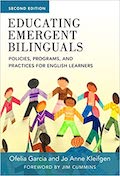 |
|
| Publisher: | Teacher College Press: Columbia University | ||
| Pages | ISBN-13 | Price | |
|---|---|---|---|
| pp. 256 | 978-0807758854 (paper) | $28.99 U.S. | |
Educating Emergent Bilinguals: Policies, Programs, and Practices for English Learners, by Ofelia Garcia and Jo Anne Kleifgen, raises awareness of the inequities in which emergent bilinguals are educated in the United States. The authors use “emergent bilinguals” to describe students who are dominant speakers of a language other than English and who are developing English literacy in school (p. 214). The term also emphasizes that students who speak another first language other than English in the United States deserve to be recognized for what language repertoires they have, not those they lack. According to the authors, when students are labeled as English learners or limited English proficient, this creates a gap in their learning when compared to their English-only peers.
There are ten chapters in Educating Emergent Bilinguals. The first chapter of the book serves as an introduction to the terms used to describe English language learners. These terms include English language learner (ELL), English learner (EL), and limited English proficient (LEP). The following chapters of the book describe emergent bilingual proficiency assessment (Chapter 2), policies and programs used to educate these students (Chapter 3), theoretical constructs (Chapter 4), multilingual pedagogies (Chapter 5), digital technologies and learning (Chapter 6), curriculum and other practices (Chapter 7), family and community engagement (Chapter 8), and assessment (Chapter 9). The last chapter provides recommendations to stakeholders, including teachers, administrators, policymakers, advocates, and researchers on how they can help create change to offer more equitable curriculum to emergent bilinguals.
Chapter 2 discusses in detail how emergent bilingual students’ language proficiency is assessed. States around the country use different assessments to identify English language proficiency. For example, California uses the California English Language Development Test (CELDT) and New York uses the New York State Identification Test for English language learners (NYSITELL). Then, Chapter 3 explains past and present bilingual programs that support a student’s first language development while also building English language skills. This chapter also includes a brief history of policies and bilingual education in the United States.
Chapter 4 reviews cognitive benefits of bilingual education. One benefit is enhanced metalinguistic awareness; students are reported to pay attention to language use and structures found in their first and second language. The benefits associated with metalinguistic awareness for bilingual students include strong reading comprehension; word, sound, and sentence formation knowledge; and the ability to reflect on how skills learned in one language can be transferred to another. The next chapter (Chapter 5) is divided into two sections and describes multilingual pedagogies. The first section focuses on inequitable practices for students learning English. Inequitable practices are found in programs that do not develop the first language of students but expect students to become proficient in English only. The second section of Chapter 5 identifies instructional practices that can be incorporated into the curriculum to provide language support. These include scaffolding, bridging English with the primary language, translanguaging (allowing students to use different languages together to communicate more effectively), and building critical multilingual awareness.
Chapters 6 and 7 elaborate on additional inequitable practices emergent bilinguals face. While the availability of technology exposes these students to other literacies such as videos, digital text, diagrams, and resources that are available in languages that are not English, some ELs from low-income communities may not have access to technology compared to affluent students (Chapter 6). Chapter 7 references the fact that more funding is needed to provide better quality resources and personnel to build effective linguistic and cultural curricula.
Parental involvement is mentioned as a way to help promote school-family-community relationships in Chapter 8. Students are initially exposed to their first language at home, which is also the language used to communicate with others in their community. The school’s role should be to embrace cultural practices of the home language to help create equitable learning experiences. In Chapter 9, the authors call for better construction of fair and valid tests as a means to measure bilingual students’ academic success. For students in bilingual programs, they should be provided with bilingual versions of tests to determine academic achievement in both languages.
Although this book contains the most current research in educating ELs, it would have helped to include specific examples of effective dual language program models. The authors mention that these programs are successful in educating emergent bilinguals in their first language, but do not elaborate on the models’ structure and implementation. Educators and other school leaders interested in bilingual education would benefit from this information, as it aligns with best practices for emergent bilinguals.
Overall, the book is easy to read, with each chapter containing critical key points, study questions and visuals of the information. A major strength in this second edition is the presentation of current issues in bilingual education such as policies, programs, and practices. Educating Emergent Bilinguals is intended for teachers, researchers, policymakers, and practitioners interested in educating bilingual students, and it can serve as a resource to better understand and develop a curriculum that supports emergent bilinguals.
Reviewed by
Xochitl Morales
Chapman University
<xmorales chapman.edu>
| © Copyright rests with authors. Please cite TESL-EJ appropriately. Editor’s Note: The HTML version contains no page numbers. Please use the PDF version of this article for citations. |