

November 2020 – Volume 24, Number 3
The Hopes and Experiences of Bilingual Teachers of English:
|
|||
| Author: | Melinda Kong (2019) | 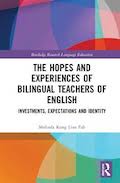 |
|
| Publisher: | New York: Routledge | ||
| Pages | ISBN | Price | |
|---|---|---|---|
| Pp. 198 | 9780367484101 (paper) | $47.95 U.S. | |
The globalization of the English language and increasing emphasis on internationalization in higher education has led to a rising demand for English medium education. In connection with this trend is an increase in the number of bilingual English teachers who choose to pursue degrees or further professional training in core anglosphere nations. Through empirical work presented in The Hopes and Experiences of Bilingual Teachers of English: Investments, Expectations, and Identity, Melinda Kong (2019) posits the importance of understanding the dynamic identities and lived experiences of eight Asian bilingual teachers of English from Brunei, China, Indonesia, Taiwan, and Vietnam. These participants took a brief pause from teaching English to further their teacher education in graduate programs in Australia. Kong suggests that these teachers’ individual hopes, expectations, and investments in seeking postgraduate training from an English-dominant country had a significant impact on their ever-evolving identity as English language teachers and users. The teaching constraints in each teacher’s home context predicted the way some participants taught upon repatriation.
While not officially divided into sections, Kong’s study seems to span three major topic areas: a) an introduction to the topic and rationale behind the study’s theoretical approaches (Chapters 1-3); b) a presentation of each individual participant’s story through personal interviews and correspondences (Chapter 4), and c) a conclusion that ties together strategic investments drawn from the eight participants’ individual experiences (Chapters 5-6).
The first chapter contains an introduction to Kong’s motivations for the study, as well as observations about the importance of research on language teachers. Kong undertook research into bilingual English teachers’ study abroad experiences and identity to shed light on successful language teacher preparation and development. An overview of current research on English teacher identities is provided in Chapter 2, highlighting the impact that teacher identity can have on language teaching. Pierce’s (1997) theory of investment, as well as Varghese et al.’s (2005) and Phan’s (2008) theory on language teacher identities are discussed. By referencing these theories, Kong demonstrates how her participants have multifaceted identities as bilingual English users, teachers, and graduate students abroad. In addition, she emphasizes the role that societal and power relations play on learners’ language investment and their identity in both English and their home language. In Chapter 3, Kong explains the source of her data, which is gathered from multiple interviews of each participant at various points of their sojourn in Australia, as well as a final interview four weeks after their repatriation. Here, Kong grounds the study in the theories from the previous chapter, making explicit the connections that she sees between the participants’ identity negotiations in Australia and their sociocultural identity and goals for their time abroad.
Chapter 4 provides detailed descriptions drawn from interview data of the eight participants’ personal histories, highlighting expectations prior to their time abroad and then the experiences that influenced their identities in Australia. Participants found different ways to work towards their language goals while abroad. One participant joined a church in order to socialize with local Australians, while another found work as a waitress at a local restaurant to experience local culture. Participants reported being treated with increased prestige in their home contexts as a result of obtaining a degree from Australia, though a few found it difficult to replicate teaching theories taught abroad due to differences in the home teaching environments.
Chapter 5 is a synthesis of common themes that emerged from participant interviews and correspondences. These included the creative, agentive ways participants invested in English learning outside of classes, and the way their experiences in Australia shaped their language learner/teacher identities. For example, although all participants sought to improve their English in Australia, there were times when they found it much easier to use their native language. In the final chapter, Kong stresses that, while it is important to understand how studying abroad impacts the identity of international English teachers, it is equally important to recognize their out-of-class language experiences. One way Kong does this is by referencing Peirce’s (1995) investment theory to indicate the importance of context in language investment. Despite a high investment in learning English, participants were also invested in their own sociocultural identities. They wished to develop a sense of belonging with those who shared similar backgrounds, and often did this by socializing in their home language. Thus, depending on circumstances, their desire to practice English or to reinforce their sociocultural identity may have directed which language they used.
Kong’s review is valuable to those interested in language teacher identity research. A merit of Kong’s work is how she presents equitable ways of discussing her participants’ lived experiences. Rather than defaulting to binary terminology, such as native or non-native teachers of English that have been increasingly problematized in SLA research (Ortega, 2013), the author consistently uses bilingual teachers of English, representing their experiences as legitimate, well-trained English teachers with multifaceted identities.
However, those hoping to gain an understanding of the impact of study abroad experiences on all bilingual teachers should be aware that Kong’s research is very much grounded in the experiences of bilingual teachers of English from select Asian contexts. The conclusions drawn from their experiences in Australia and the impact their study abroad had on their teaching upon their return to Asia might not apply in non-Asian contexts. Though the study reveals much useful information, many may find its scope limited by its sole focus on Asian participants.
Overall, The Hopes and Experiences of Bilingual Teachers of English will be beneficial to bilingual teachers of English who wonder how pedagogies taught abroad may be beneficial to Asian contexts or who are considering professional training abroad. Similarly, TESOL program educators may find this book useful for a more nuanced perspective on their international students’ experiences outside the classroom, as well as how to better adapt courses to meet student needs. Finally, researchers interested in English language teacher identities should find this work enlightening due to its fresh perspective on the lived experiences of bilingual English teacher experiences outside the classroom.
References
Ortega, L. (2013). Ways forward for a bi/multilingual turn in SLA. In S. May, The multilingual turn: Implications for SLA, TESOL and bilingual education (pp. 32- 53). New York: Routledge.
Peirce, B. N. (1995). Social identity, investment and language learning. TESOL Quarterly, 29(1), 9–31.
Phan, L. H. (2008). Teaching English as an international language: Identity, resistance and negotiation. Clevedon: Multilingual Matters, Ltd.
Varghese, M., Morgan, B., Johnston, B., & Johnson, K. (2005). Theorizing language teacher identity: Three perspectives and beyond. Journal of Language, Identity, and Education, 4(1), 21–44.
Reviewed by
Vashti Lee
Georgetown University, USA
<vl219 georgetown.edu>
| © Copyright rests with authors. Please cite TESL-EJ appropriately. Editor’s Note: The HTML version contains no page numbers. Please use the PDF version of this article for citations. |