

May 2018 – Volume 22, Number 1
Second Language Pragmatics |
|||
| Author: | Naoko Taguchi & Carsten Roever (2017) | 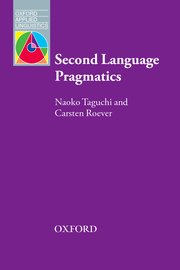 |
|
| Publisher: | United Kingdom: Oxford University Press | ||
| Pages | ISBN | Price | |
|---|---|---|---|
| Pp. viii + 328 pages | 978-0-19-420058-5 (paper) | $53.00 USD | |
Taguchi and Roever’s comprehensive volume titled Second Language Pragmatics (SLP or L2 pragmatics) is a welcome update on all things related to SLP. In their book, Taguchi and Roever approach SLP through the lens of interlanguage pragmatics, which is motivated by the need to better understand pragmatics not only through investigations of the kinds of language learners produce, but also through consideration of learners’ use of strategies, sensitivity to changes in discourse, and understanding of the way agency is expressed in their interaction with others. Thus, the authors focus strongly on the sociopragmatics of language use. Both authors are prolific researchers who are often cited in the field, making this book an opportunity that cannot be missed for those who are interested in SLP. Indeed, this book has been recommended by its authors for a wide range of audience types, including researchers and students in the field, teachers and teacher trainers, and individuals who are looking to “further explore options of pragmatics research and teaching” (p.11).
This book is divided into ten chapters, each serving to efficiently summarize specific topics related to SLP. In Chapter 1, the authors begin by providing a general overview of pragmatics, most importantly the three areas of pragmatics (i.e., cross-cultural, intercultural, and interlanguage pragmatics). They also outline research developments and changes in SLP that are further discussed throughout the volume.
The introductory chapter is followed by discussions of the historical and theoretical underpinnings of SLP, as well as the research methods that have been employed so far to investigate L2 pragmatics. Chapter 2 presents a brief discussion of fields that have contributed to the development of SLP, specifically second language acquisition, general pragmatics, anthropology, and sociology. The discussion of these contributions to SLP provides an effective preface to Chapter 3, which discusses how each field approaches L2 pragmatic competence. Although some discussion of data collection methods was present in Chapter 3, the authors examine L2 pragmatics research methodology in more detail in Chapter 4. In this chapter, the authors categorize the research methods based on the type of data that can be obtained from each specific method and evaluate each one in terms of the data collection procedures, possible issues and limitations, the conclusions that can and cannot be made from the data, and differences among the methods. Interestingly, some discussion related to statistical analyses used to analyze L2 pragmatics data was present but not discussed in enough detail to warrant its own section. Nonetheless, a discussion on the statistical analyses for each type of research methods and data may be beneficial, particularly for graduate students and novice researchers who are unfamiliar with L2 pragmatics research methods.
Chapters 5, 6, and 7 discuss second language learners in relation to their pragmatic competence development. In Chapter 5, the authors mostly focus on utilizing longitudinal research to discuss learners’ development of several target pragmatic features such as speech acts, interactional competence features, implicatures, routines, and specific targets such as humor and terms of address. While Chapter 5 addresses systematic similarities in L2 learners’ pragmatic development, Chapter 6 examines learners’ individual differences to illustrate how these traits affect pragmatic competence development. In this chapter, the authors also consider individual learner characteristics as they interact with learners’ pragmatic behavior, so the focus shifts to the learner and how their pragmatic choices change within a particular context. Chapter 7 describes four pragmatic learning contexts, which are “the study abroad context, the formal classroom, the technology-enhanced learning environment …, and the immigrant context” (p. 177), all of which appear in current SLP literature. Their goal is to point out which characteristics of each context foster pragmatics development.
Chapters 8 and 9 address the more practical applications of L2 pragmatics. Chapter 8 provides an overview of the most recent findings in SLP teaching studies, such as the need to uncover more about the differences between pragmatics teaching in the foreign versus second language context. Additionally, this chapter covers the assessment of L2 pragmatics, with the discussion based on the developmental timeline of pragmatics assessments. In Chapter 9, the authors elaborate on the influence of globalization on pragmatics learning. They argue that recent trends in globalization have had an effect on both L2 pragmatics learning and on the research domain. In Chapter 10, the authors conclude by further emphasizing the context-sensitive nature of pragmatics and how future research should approach pragmatics through interdisciplinary means to provide a more complete understanding of SLP.
As a comprehensive volume covering the developments in SLP so far, it is hard to find what is missing from this book. Each chapter is systematically prefaced with an introduction orienting the reader to the issues discussed in the chapter. Furthermore, Chapters 3 through 9 end with a summary and further comments devoted to pointing out directions for future research. This addition makes the book invaluable for researchers and especially graduate students. Additionally, the authors were particularly detailed in their summary of previous research in the field, occasionally using excerpts from research data to illustrate interesting points being made and also to comment on these data excerpts. This summary serves to contextualize the discussion of issues in SLP in the literature, and I expect it to be especially helpful to readers who are not particularly familiar with the field. Therefore, this book is not only a synthesis of previous research, but also the authors’ expert evaluative comments on the current state in the field.
This book provides many interesting research ideas through its discussion of current research in SLP and the authors’ attempt to identify the gaps and future directions for scholarship. However, it is interesting that corpus methods for L2 pragmatics analysis were barely discussed throughout the book. I would have expected corpus methods to be mentioned in Chapter 4, given that “corpus analyses of pragmatic phenomena have grown into a large body of literature and produced a wealth of new insights” (Rühlemann, 2010). Such insights include a better understanding of learners’ pragmatic acquisition through analysis of learner corpora (e.g., Belz & Vyatkina, 2005; Llanos & Gómez, 2014; Polat, 2011). A discussion of corpus methods for pragmatics analysis may also be connected to the authors’ comments on the issues related to obtaining naturalistic data, as current corpus methods make it possible to obtain and analyze large amounts of authentic data. Additionally, readers seeking to find an updated account of assessment of SLP may be disappointed by its lack of coverage in this volume. Although the history of L2 pragmatics assessment in this book is relatively short, a more detailed description of various item types and how they are rated would be an interesting addition for those interested in the development of pragmatics assessments. Finally, because of the extent to which pragmatics terminology is used in this book, teachers and beginning researchers may benefit from a glossary of SLP-related terms.
Despite these shortcomings, I still would strongly recommend this book for both established researchers and novices, as well as practitioners in second language learning and teaching. Second Language Pragmatics is indeed an invaluable resource from two prominent figures in L2 pragmatics that serves to provide an up-to-date account on the current developments in the field. I believe it will help pave the way to new research in SLP through its synthesis of current work being done in the field.
References
Belz, J., & Vyatkina, N. (2005). Learner corpus analysis and the development of L2 pragmatic competence in networked inter-cultural language study: The case of German modal particles. Canadian Modern Language Review, 62(1), 17-48.
Llanos, L. C., & Gómez, P. G. (2014). Oral production of discourse markers by intermediate learners of Spanish: A corpus perspective. In J. Romero-Trillo (Ed.), Yearbook of Corpus Linguistics and Pragmatics 2014 (pp. 239-259). Springer.
Polat, B. (2011). Investigating acquisition of discourse markers through a developmental learner corpus. Journal of Pragmatics, 43(15), 3745-3756.
Rühlemann, C. (2010). What can a corpus tell us about pragmatics? In A. O’Keeffe & M. McCarthy (Eds.), The Routledge handbook of corpus linguistics (pp. 288-301). New York, NY: Routledge.
Reviewed by
Ananda Muhammad
Iowa State University
<nanda iastate.edu>
| © Copyright rests with authors. Please cite TESL-EJ appropriately. Editor’s Note: The HTML version contains no page numbers. Please use the PDF version of this article for citations. |