

May 2017 – Volume 21, Number 1
Narrating Their Lives: Examining English Language Teachers’
|
|||
| Edited by: | Lia D. Kamhi-Stein (2013) | 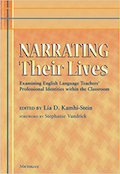 |
|
| Publisher: | Ann Arbor: The University of Michigan Press | ||
| Pages | ISBN | Price | |
|---|---|---|---|
| 168 pages | 978-0-472-03499-4 | $26.95 USD | |
The edited book Narrating Their Lives: Examining English Language Teacher’s Professional Identities within the Classroom presents fascinating autobiographical narratives written by six ESL teachers enrolled in the M.A. TESOL program at California State University, Los Angeles. The book consists of a forward by Stephanie Vandrick, an introduction, and five chapters. The introduction discusses two central topics for the book: language teachers’ identity and narrative research. The editor succinctly reviews prior study in these areas, legitimatizing the use of autobiographical narratives to explore teachers’ professional identities.
The book devotes its first chapter to the editor’s own language learning experiences in an EFL context and how these experiences affect her pedagogical strategies as a teacher educator. The vivid account of these experiences raises the readers’ awareness of the close link between teachers’ language learning experiences and their teaching practices.
The second chapter consists of three autobiographies written by three master students who grew up in the Expanding Circle (Kachru, 1992). Since the number of M.A. TESOL students from the Expanding Circle is burgeoning, the editor’s inclusion of their voices is truly imperative for teacher educators to realize their students’ diverse identities. All of the three autobiographies problematize several entrenched notions in TESOL. The first narrative, written by Veneza Angel Pablico, serves as a convincing example to challenge the notion of ‘native speakers of English’ because such notion silences multilingual speakers like her. Before immigrating to the US, Angel skillfully code-switched between Tagalog and English to suit her communicative needs. After graduating from high school, Angel immigrated to Los Angeles where she fit in well. Nevertheless, Angel later on moved to Oklahoma and was surprised by the local linguistic norms. During her five-year stay in Oklahoma, she gradually developed her pragmatic capability through acculturation. Based on her experience, Angel proposed three implications for language teachers. She advocates for including various Englishes in the curriculum, choosing materials that emphasize successful learners, and valuing students’ first languages. The second autobiographical narrative is written by Hee-Jin Kim, who discusses her language learning experience in South Korea, the US, and Germany. Hee-Jin’s story also questions the notion of ‘native speakers of English.’ In particular, in the job market in South Korea, professionals like her are often discriminated as incompetent teachers. Instead of treating teachers as native speakers or nonnative speakers, Hee-Jin proposes that teachers should be evaluated on their expertise and knowledge. Jessie Chen wrote the third autobiography. Compared to Angel and Hee-Jin, Jessie’s narrative mainly discusses racial discrimination. Jessie reveals her childhood experience of being insulted due to her race as a Korean American, which made her the invisible Asian girl in school. Such an excruciating experience allows her to construct an empowering classroom for marginalized ESL students.
After presenting the narratives by authors from the Expanding Circle, the third chapter includes three narratives written by M.A. TESOL students from the Inner Circle. This chapter convincingly demonstrates that being a native speaker of English does not necessarily guarantee one’s legitimacy in English language classrooms. These challenges include speaking with certain American accents, being marginalized due to Caucasian ethnicity, and being essentialized as monolingual speakers. For example, Jeremy C. Kelley speaks South American English and describes himself as a second language learner of standard American English. In addition to issues such as accents, teachers from the Inner Circle also face the danger of being marginalized in the classroom due to their strikingly different ethnic backgrounds compared with their ESL students. To solve this challenge, Valerie J. Callet reassigns her identity from being a white teacher to a caring teacher for students. In addition, she adopts culturally responsive teaching by selecting reading materials relevant to students’ experience and creating a class library where books are written by authors with various cultural and ethnical backgrounds. Moreover, teachers from the Inner Circle are also confronted with the stereotype that they are monolingual speakers despite their multilingual competence. Although Shannon Ladymon knows multiple languages including Spanish, Latin, and Japanese, her appearance as a Caucasian frequently positions her as an outsider in Japan since people would identify her as a monolingual English speaker.
Chapter four nicely synthesizes five pedagogical practices identified in all the narratives. The first practice is to value students’ first languages as resources and code-switch strategically in multilingual classrooms. The second strategy is to establish classroom communities by incorporating teachers’ own identities. For example, NNESTs serve as role models for students to emulate and they possess first-hand experiences of learning English. The third strategy is to integrate various types of Englishes into curriculum design. This is particularly evident in Jeremy’s class where he teaches students to appreciate the diversity of Englishes and to examine how English is used in students’ own communities. The fourth strategy is to embrace culturally responsive pedagogy by drawing on what students bring into the classroom. For instance, in Valerie’s class, the students are exposed to the novels written by African American and Latino authors. The fifth pedagogy is to teach linguistic identity. For instance, Shannon adopts a three-step approach to exploring identities. The students critically reflect on the influence of social relations in communication and claim their own right to use English.
The fifth chapter discusses how ESL teachers and teacher educators can use narrative inquiry to promote teacher reflection, presenting both advantage as well as challenges of utilizing autobiographies in TESOL. The author discusses the assignment expectations of autobiographies and selected readings, which are very helpful for instructors who would like to use autobiographies.
It is noteworthy that all the autobiographies of the book were chosen from students who are enrolled in an M.A. TESOL course. A follow-up step would be to collect narratives composed by the same students and track their identity formation trajectories. Additionally, there could have been a section addressing the distinction between writing autobiographies for a course and writing autobiographies for one’s own reflection. This distinction is important for teacher educators who would like to incorporate narrative inquiry into their course and for ESL teachers who would like to use narrative inquiry for their own professional development. The potential challenges to implement the five pedagogies recommended for ESL teachers could also have been discussed, such as limited resources and policy constraints.
Overall, the book is worth reading for its comprehensive coverage of experiences narrated by English language teachers. In particular, the intriguing autobiographical narratives demonstrate that being a nonnative speaker of English provides valuable resources for students, and being a native speaker of English does not necessarily entail legitimacy as an English teacher. This book will be most appealing to ESL teachers and teacher educators. For ESL teachers, this book convincingly demonstrates the close link between one’s previous language learning experience and one’s current teaching practices. Examining one’s own personal language learning and teaching history is important for one to become aware of how prior experience may shape current actions in language classrooms. Additionally, ESL teachers may implement the five pedagogical practices recommended by the English language teachers in the book when teaching their own students. They may also think about how to apply an autobiographical approach, to discover their students’ unique linguistic backgrounds as a guide for designing classroom activities that suit their students’ particular needs. For ESL teacher educators, this book offers an excellent example of incorporating autobiographies into the curriculum of TESOL. By asking teachers to craft autobiographies, teacher educators may identify challenges that teachers have encountered due to their prior experience. This will open up space for teacher educators to provide mediation to foster teachers’ professional development.
Reference
Kachru, B.B. (1992). Teaching World Englishes. In B.B. Kachru (Ed.), The other tongue: English across cultures (2nd ed.) (pp. 355-365), Chicago: University of Illinois Press.
Reviewed by
Dingding Jia
The Pennsylvania State University, State College, Pennsylvania, USA
<duj144 psu.edu>
| © Copyright rests with authors. Please cite TESL-EJ appropriately. Editor’s Note: The HTML version contains no page numbers. Please use the PDF version of this article for citations. |