

August 2014 – Volume 18, Number 2
Language Teaching Insights from Other Fields:
|
|||
| Author: | Christopher Stillwell (Ed.) (2013) | 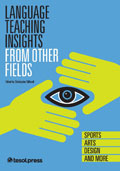 |
|
| Publisher: | Alexandria, VA: TESOL International Association | ||
| Pages | ISBN | Price | |
|---|---|---|---|
| 189 pages | 978-1-931-18507-3 | $52.95 USD | |
While not a traditional text on ESOL methodology, this is nonetheless a collection of ESOL professionals’ best practices brought into focus through experiences outside the classroom rather than pedagogical principles. That is not to say that the principles of language teaching are ignored in this text. They are in fact sprinkled indirectly throughout the work. However, the framework of Language Teaching Insights from Other Fields: Sports, Arts, Design and More is not to produce a principle and explain it. Rather, the edited volume aims to reimagine the classroom from the point of view of professionals from diverse fields and explore how such a synergy of perspectives might mediate teaching practices. Stillwell’s book encourages readers to become more effective, reflective, and creative teachers in the language classroom by considering ideas from outside language teaching. Although it is specifically ideal for ESOL teachers, its tips easily transfer beyond the ESOL classroom to all sorts of classrooms where teachers are looking for inspiration outside their own fields of expertise.
The book is divided into fifteen chapters that comprise four different sections: Recontextualizing the Language Classroom; Dealing with Challenges; Teaching the Four Skills; and Developing as a Professional. A total of 15 different authors have contributed to this volume, and each author merges his or her classroom experience with another area of extensive experience in an attempt to broaden both what can be imagined and accomplished in the language classroom. Every chapter excluding the first, which is the introduction, contains tips for classroom practice based on the way an expert in another field might approach the language classroom. Each chapter further includes an author biography, and many contain a list of “Resources for Further Exploration.” This list of resources is particularly helpful when the authors have taken time (as many have) to provide details on how accessible and relevant each of their recommendations is based on one’s interests.
Of particular importance to any ESOL professional teaching a writing class is Sylvia Whitman’s chapter from the perspective of a restaurant reviewer. Whitman likens the writing teacher’s power over a student’s work to a restaurant reviewer’s power to provoke the flourishing or closing of a reviewed restaurant. That is, language students can shut down after an overwhelming critique of their work but blossom when the teacher is thoughtful about the balance of praise and criticism. Whitman goes on to offer practical guidelines, in the form of a highly usable and adaptable table, for reviewing student writing that includes what the student may produce matched with what a teacher could critique at each stage in the writing process. After all, Whitman notes, a restaurant reviewer would be lucky to get more than just one sampling of the food—and at different stages in the cooking process—before writing a review. ESL/EFL writing teachers who aspire to a more process-oriented approach in their classrooms will find Whitman’s guiding metaphor of offering feedback during the “ingredients” stage, the “cooking” stage, and the “seasoning” stage (p. 72) helpful as they work to guide students successfully through these recursive steps.
One of the most salient tips a developing teacher may encounter is Karen Blinder’s advice on what to keep inside an “Emergency Kit” (pp. 54 – 55). A whitewater rafter should never be caught without one; nor should a language teacher, as those who have watched their exemplary lesson plans fail will attest. The teacher’s kit might include books with no-prep activities, prompts for communicative activities, and even materials for quick and easy games. Blinder offers detailed examples for each of these, and beyond that, she offers sage advice about how to handle currents that take teachers where they were not expecting to go and the best way to take risks in the classroom. This is a chapter about keeping one’s head above water, particularly when things do not go as planned, and given the proliferation of the unexpected in the language classroom, even more experienced teachers are likely to find refreshing ideas for preparing for the tougher days and creating solid backup plans.
A most informative and immediately useful chapter to the teacher who makes his or her own handouts and has not studied design is from Tammy R. Jones and Gabriela Kleckova. Jones and Kleckova have broken down their tips into easily understandable general principles that include things like making certain that students get interested in the material, as well as more specific principles regarding the alignment, contrast, proximity and repetition in the handout. Even with these more specific design concepts, the authors keep their language accessible and provide plenty of visuals to show what those concepts mean. This chapter is particularly relevant because language teachers may spend a great deal of time choosing understandable language and the best content for a document but barely pay attention to how its layout can either encourage or discourage already apprehensive language learners.
While several more thought-provoking perspectives are offered in this text, not every chapter offers the same caliber of advice, and one’s experience in the field will likely affect which chapters appear most pertinent and practicable at the time of reading. For example, while a relatively new teacher may find it helpful to read the chapter from a bartender’s perspective that deals mostly with creating a warm, friendly environment, experienced teachers may gain little from the same chapter. Moreover, some perspectives are more difficult to link to ELT if one is a novice in the other field. For example, it is difficult, being unfamiliar with role-playing games, to make the connection between character sheets and language assessments in the chapter from the point of view of a role-playing game master. Similarly, the chapter from the perspective of an actor seems to be less accessible if one is wholly unfamiliar with the principles of acting and improvisation.
In the end, I walked away from this book with new ideas and plans for my next semester of ESL teaching. I have, for example, more carefully planned paper drafts so that I can offer the best kind of feedback at the best times, I have expanded my own “just in case” file, and I have spent more time and thought on syllabus layout than I ever considered doing before. I found myself filling Stillwell’s book with notes about new activities and methods I want to try out, and from the resources referenced and recommended I have new volumes on my professional reading list. While not every chapter offers what every teacher needs/wants right now, it is worth reading for the tools one can immediately place in one’s work bag (as well as the tools kept in storage for later).
Reviewed by
Ashley Gatens
Jefferson Community and Technical College, Louisville, KY, USA
<agatens0001 kctcs.edu>
| © Copyright rests with authors. Please cite TESL-EJ appropriately.
Editor’s Note: The HTML version contains no page numbers. Please use the PDF version of this article for citations. |