

August 2014 – Volume 18, Number 2
Longman Academic Reading Series 4:
|
|||
| Author: | Robert F. Cohen & Judy L. Miller (2014) | 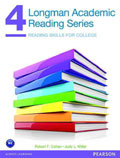 |
|
| Publisher: | White Plains, NY: Pearson Education. | ||
| Pages | ISBN | Price | |
|---|---|---|---|
| 287 pages | 978-0-13-276061-4 | $35.00 USD (catalog), $46.67 USD (retail) | |
The Longman Academic Reading Series is Pearson Education’s recent offering in English for academic purposes (EAP) reading textbooks. The foreword clearly states that the series’ goal is preparation for academic work, suggesting the books might be intended for secondary ESL/EFL classrooms, university EFL courses, or intensive English programs (IEPs) at English-medium universities. The penultimate textbook in the series, written by Robert Cohen and Judy Miller, is linked to the Common European Framework level B2 (high-intermediate). Longman Academic Reading Series 4 (LARS 4) presents a variety of academically-oriented topics in its ten chapters and devotes considerable attention to reading strategies, critical thinking, vocabulary, and refreshingly, grammar. The book itself eschews flashiness in favor of simple, easy-to-follow layouts. In our own professional context working in an IEP at an American university, a unit has been piloted successfully and the textbook will soon be introduced as a primary course book for a high-intermediate reading and vocabulary class.
The structure and sequence of LARS 4 is clear and consistent. The primary unit of progression is topic, with each of the ten chapters containing three readings that are relevant to academic disciplines commonly found in university settings (e.g., media studies, psychology). Chapters begin by explicitly stating learning objectives; these are revisited at the end of the chapter for self-assessment. Readings are preceded by activities designed to activate background knowledge, and in my experience, sparked thoughtful discussion among students. Reading strategies, such as skimming and predicting, are the focus of during-reading activities. General comprehension questions and a number of vocabulary activities follow each reading. After two or more related readings in a chapter, LARS 4 provides synthesis and critical thinking activities, which can involve speaking (group discussion, role play) or writing (reflection, note-taking). These activities proved successful in the pilot I conducted, and created meaningful opportunities for students to revisit texts for new purposes. Additionally, in each chapter a salient grammatical feature of academic text is selected for explicit explanation followed by analysis and/or manipulation activities. LARS 4’s scope and sequence chart facilitates easy selection of topics and activities for teachers.
LARS 4 provides a diverse collection of texts connected to a number of academic disciplines. Each chapter presents topically related readings written by notable historical figures, contemporary intellectuals, scientists, and journalists. For example, Chapter 1 on homelessness features a Margaret Mead excerpt, and Chapter 7, which compares monarchy and democracy, features Machiavelli and Thomas Jefferson. High-interest readings that connect topics to contemporary developments, such as economist Jeffrey Sach’s piece on Occupy Wall Street being used as an effective modern link to Chapter 2’s theme of Robber Barons (a group of notorious American industrialists in the late 1800s/early 1900s). We consider the readings a strong point of the textbook, offering authentic sources of mature academic topics. Readings are sequenced in such a way that synthesizing across several texts feels natural and not forced by the provided activities designed to connect the readings within a chapter.
The deliberate inclusion and treatment of grammar is an attractive feature of LARS 4 and an element typically not found in abundance in similar textbooks. Minimally-altered, excerpted texts provide students with very useful models of grammar in use, and LARS 4 capitalizes on this by selecting a number of prominent grammatical features of academic English, such as the passive voice, hedging devices, and parallel structure. The activities provide explicit, function-based explanation and then direct students back to the text to find examples. Activities often ask students to think about the motivations for using the features. This attention to grammar may possibly help students parse the finer points of a text. In our professional context, a degree of overlap was found with the grammar points commonly highlighted in intermediate level academic writing courses, providing a ripe opportunity for reinforcement and hopefully transfer between courses.
In addition to the refreshing inclusion of grammar, LARS 4 also offers an extensive treatment of vocabulary. Each chapter draws attention to 30-35 vocabulary items. Words that are a part of the Academic Word List (AWL) are noted, providing a convenient criterion for teachers to narrow their focus for instruction and assessment if necessary. LARS 4, however, is not content to just expose learners to a sizable vocabulary list. The textbook goes beyond word meanings and devotes a considerable amount of pages to depth of vocabulary knowledge, including synonyms, polysemy, word forms, and word parts (affixes and roots). Activities that aim to develop vocabulary learning skills and strategies are also present, such as dictionary activities and guessing from context. While LARS 4’s detailed take on vocabulary learning in the context of reading is admirable, it is not without minor shortcomings. For example, synonym gap-fill activities sometimes present synonyms for target vocabulary that are quite difficult or uncommon. In chapter 4, estrangement is given as a synonym for alienation; one would think that a term such as separation or exclusion might allow learners at the textbook’s intended level make a connection to known vocabulary. Also, activities for guessing vocabulary from context leave something to be desired. Learners are presented with a one or two sentence quote from the text with a bolded vocabulary word. Then, learners guess the meaning, without much explanation for how they should go about doing so. Some iterations of the activity imply a strategy, such as considering nearby potential synonyms or antonyms, but students may not pick up on these on their own (and some may even elude teachers!). With a critical eye and careful preparation on a teacher’s part, though, LARS 4 still possesses potential for broad and deep vocabulary learning.
Overall, LARS 4 represents a well-rounded textbook for an EAP reading course. Its high-interest topics and texts should (and in our pilot, did) capture the attention of academically-oriented students. We believe such students will benefit from the synthesis and critical thinking activities linking texts within a chapter, as synthesis and critique are skills not only commonly demanded by high-stakes tests but also by many university courses at the undergraduate and graduate levels. The welcome inclusion of grammar explanations and activities present an opportunity to reinforce and deepen students’ grammar knowledge, including the functions of grammatical structures in the specific context of academic texts. Finally, LARS 4’s broad and deep treatment of vocabulary, with minor reservations regarding activity design, should help prepare university-bound students for the considerable lexical demands in their futures.
Reviewed by
Daniel Isbell
Northern Arizona University
<daniel.r.isbell nau.edu>
Jessica Sargent
Northern Arizona University
<jessica.sargentnau.edu>
| © Copyright rests with authors. Please cite TESL-EJ appropriately.
Editor’s Note: The HTML version contains no page numbers. Please use the PDF version of this article for citations. |