

August 2013 – Volume 17, Number 2
Integrating Writing Strategies in EFL/ESL University Contexts:
|
|||
| Author: | Jennifer Lynn Craig (2013) | 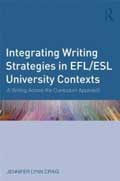 |
|
| Publisher: | New York: Routledge | ||
| Pages | ISBN | Price | |
|---|---|---|---|
| 187 pages | 978-0-415-89671-9 | $39.95 USD | |
In Integrating Writing Strategies in EFL/ESL University Contexts: A Writing-Across-the-Curriculum-Approach, Jennifer Lynn Craig sets out to provide straightforward teaching strategies that can be adapted to fit into developed lesson plans. Throughout the book, Craig effectively explains the relevance of Writing Across the Curriculum (WAC) pedagogy in EFL/ESL classrooms by providing a balance of theoretical background and examples of application. The text is not only a useful resource to EFL/ESL teachers, but to any university instructor. Craig addresses this practicality when she describes the constant increase in the number of international students enrolled at universities in the United States, which implies that faculty members will probably encounter many students whose first language is not English (p. 2). Overall, Craig accomplishes her mission to provide “practical advice” in an “efficient resource” (p. i). The language used is accessible and the pedagogical strategies seem easy to select, adapt, and implement.
The book is divided into four main parts that together create a valid flow of reasoning to show readers the relationship between WAC and EFL/ESL teaching. Craig starts by discussing WAC’s background. She breaks WAC up into two facets that form a backbone for the rest of the book’s pedagogy: writing to learn and writing in the disciplines (p. 14). Then the majority of the book is dedicated to areas that could be improved within the classroom if WAC pedagogy is executed properly. Towards the end, Craig addresses some of the possible complications that could arise within the university after WAC is proposed. She adequately addresses the concerns of those who may oppose WAC and stresses the need for teachers to work together for the benefit and success of students. Finally, Craig concludes with a convincing call to action. She encourages teachers to adopt her strategies and then evaluate the new pedagogy for its effectiveness (p. 171).
Despite the designation of “writing strategies” in the book’s title, many of the examples mentioned in the chapters address oral presentations in addition to writing. The lack of conciseness is a little unexpected if readers intentionally select the book for the writing component and are bombarded by an almost equal amount of strategies about effective communication. However, the link between writing and oral presentations is apparent and teachers are encouraged to consider the addition of presentations as expansions of writing assignments. Craig suggests that creating a connection between writing and presenting is especially valuable (p. 95).
Although Craig reasonably establishes her credibility in the preface, she does not provide any personal examples of useful pedagogical strategies in the book. Instead, she chooses to include a few teacher profiles and examples of activities and assignments that have been implemented by other instructors. Despite the ultimate usefulness of these sections, Craig’s own experiences would have helped emphasize her credibility and make the text more relatable. Most pedagogical work seems to be a discussion of the successful strategies used in one’s own classroom, so this was a change from the norm that was somewhat difficult to overlook.
Even though Craig could have addressed some of her teaching practices, the variety of strategies in the text offers dynamic options for readers. One key feature in many of the chapters is the use of teacher profiles. The classroom practices of four teachers are included to discuss a range of student abilities. After the teachers are introduced, Craig continues to utilize their experiences during the subsequent chapters. The first two teachers, Celia and Robert, are EFL/ESL teachers with low intermediate and advanced students, respectively (p. 51). The next teacher, Alex, is a business professor who teaches in English (p. 54) and the final teacher, Sonal, is an engineering professor (p. 67). By dedicating a somewhat equal amount of time to EFL/ESL teachers and more traditional teachers, Craig again sufficiently shows that every instructor can benefit from the described strategies.
Another useful section called “in practice” is included at the end of almost every chapter. It provides a description of a specific activity or assignment that has already been utilized and deemed effective. A range of instructors from other countries and numerous disciplines provide each of the examples. Some of the international professors are from universities in Mexico and Israel, while the U.S. instructors are from universities like MIT, Penn State, and Columbia. Since readers are expected to apply the strategies discussed in each chapter, they are given at least two specific examples that guide them in their own application of the material. When combined with the teacher narratives, readers are able to clearly understand the helpfulness of Craig’s proposed pedagogy and should be able to use it if desired.
While the text is approachable enough to be utilized by non-EFL/ESL teachers, it does include some valuable culture specific advice to consider when working with students who are not native speakers. One example of the way culture impacts writing is when students do not inherently organize their work in a way that is easily understood by readers (p. 33). Also, many students from other cultures are accustomed to a distanced relationship with professors, which makes it difficult to reinforce a mentor relationship (p. 152). Although the focus on EFL/ESL is not constantly at the forefront, it is always present and mentioned at least somewhere in each section.
Overall, Craig’s book is a practical piece of pedagogy that gives teachers detailed starting points to implement the described strategies. It demonstrates the importance of WAC as a necessity to produce successful graduates and examines the specific usefulness of WAC to EFL/ESL students in an increasingly globalized world. Teachers can all benefit from some component of the WAC pedagogy even if they do not believe they need to adapt their class for English language learners.
Reviewed by
Alyssa Miller
North Dakota State University, Fargo, North Dakota, USA
<Alyssa.Miller ndsu.edu>
| © Copyright rests with authors. Please cite TESL-EJ appropriately.
Editor’s Note: The HTML version contains no page numbers. Please use the PDF version of this article for citations. |