

June 2012 – Volume 16, Number 1
Teaching Reading to English Language Learners:
|
|||
| Author: | Kristin Lems, Leah D. Miller, & Tenena M. Soro (2010) | 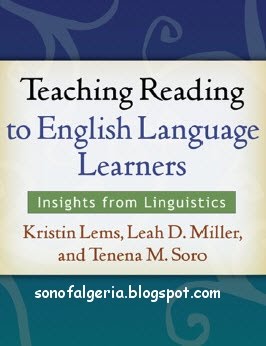 |
|
| Publisher: | The Guilford Press | ||
| Pages | ISBN | Price | |
|---|---|---|---|
| 256 pages | 978-1-60623-468-6 | $30.00 USD | |
Teaching Reading to English Language Learners: Insights from Linguistics is a practical user-friendly guide for reading teachers. It can be used to enlighten reading teachers from a diverse range of classrooms. The overall purpose of the book is to create a synthesis between researched theory and classroom applications. This process creates a compilation that succinctly illustrates what teachers should know about second language reading acquisition and how they can directly apply it in the classroom. The authors’ approach to writing can be easily understood by readers without explicit training in linguistic theory. The text could be a useful guide in various scenarios such as: graduate level reading methodology courses, K-12 reading classes, ESL courses of all levels, and adult education classes.
The book breaks down the generalized skill of reading into various sub-areas. These topics are as follows: Chapter 1: Fundamentals of second language acquisition, Chapter 2: First language transfer, Chapter 3: Second language listening and speaking, Chapter 4: The English writing system and the Roman alphabet, Chapter 5: Morphemes, Chapter 6: Word formation, Chapter 7: Reading fluency, Chapter 8: Reading comprehension, and Chapter 9: Second Language Writing.
Each chapter is introduced by a list of technical terms (e.g., audio-lingual method, derivational morpheme), which are expanded upon within the chapter. These terms are defined in a glossary at the back of the book. Then, the subject matter is thoroughly detailed through text, pictures, and tables. Additionally, a section in each chapter entitled “How Does This Look in the Classroom?” describes applicable classroom activities that reinforce the theories presented in the chapter. Also included are a variety of ready to use worksheets that can be directly implemented into applicable classroom lessons. The final section, “Questions for Further Development,” offers an opportunity for readers to reflect on the chapter and consider how the topics can apply to their own personal experiences. Lastly, the chapters often include personal anecdotes from teachers and language learners who exemplify their successes and failures. Many readers of this book can identify with these insightful and often humorous narratives while others will learn valuable lessons.
Chapters one and two specifically focus on summarizing key theories from second language acquisition (SLA). It introduces well-known SLA hypotheses, key terminology, and teaching methods. These chapters offer an overview on the most fundamental concepts of second language learning to teachers without formalized ESL training. Teachers with prior exposure to these theories may opt to skip ahead to other chapters.
The following chapters discuss the various interconnected factors that relate to the reading skill. According to the authors, successful mastery of the listening and speaking skills (i.e. oracy) is positively correlated with a strong reading proficiency. As oracy naturally precedes reading, it should be a foundation that contributes to successful English reading skills. Chapter 3 summarizes research relating to the acquisition of second language oracy and discusses how it can be applied towards reading comprehension. Chapter 4 introduces the challenges students experience when learning to read and write using the English system (i.e. orthography). This chapter compares the English orthographic system with other languages and explains the difficulties second language learners may face when utilizing a new alphabet. Chapter 5 introduces the importance of recognizing English morphemes and explains why they are of significance to second language readers. Chapter 6 discusses word formation, cognates, and collocations in English and enumerates how confusing they can be for ESL students. In short, chapters 2 through 6 offer a base upon which a successful reading curriculum can be built. After completing the first half of the book, teachers will be prepared to guide students away from some of the common pitfalls of second language learning; therefore, allowing students to increase their reading potential.
Chapters 7, 8, and 9 may be the most directly applicable to an ESL reading instructor. The content concentrates on reading related classroom activities that can be a central focus in daily plans. Chapter 7 discusses the development of reading fluency. Using research-based evidence, the authors suggest that teachers who incorporate reading fluency practice into their lessons can improve students’ reading rates. They recommend teachers implement techniques such as repeated readings, teacher modeling, choral reading, and reading rate charts. Chapter 8 deals with reading strategies to increase reading comprehension. According to the authors, these strategies can be sub-divided into the following categories: “word-learning strategies, phrase and sentence level strategies, paragraph and discourse level strategies, and metacognitive strategies” (p. 173). Word learning strategies emphasize the importance of second language vocabulary and consist of approaches such as word walls and visual image word associations. Phrase and sentence level strategies include instruction in recognizing common transition words (e.g., yes… but, although). Paragraph and discourse level strategies include using graphic organizers to visually illustrate text structures (e.g., letters, compare-contrast essays, problem-solution compositions). Metacognitive strategies describe how students can plan, examine, and appraise their own language use. It may include reading strategies such as teacher think-alouds (i.e., verbalizing cognitive processes in reading) or text rereading. Finally, Chapter 9 focuses mainly on writing skills. It highlights the scaffolding method of developing writing by beginning with simple expressive response essays and working towards more challenging expository writing. These strategies can enlighten any reading teacher and arm them with skills their students will appreciate.
Teaching Reading to English Language Learners: Insights from Linguistics sheds light on the full complexity of the reading skill. The topics covered in the text emphasize the interconnectedness of the reading skill with each of the other disciplines (i.e., listening, speaking, grammar, vocabulary, and writing). Although the inclusion of chapters that focus almost exclusively on listening, speaking, and writing within a reading text may seem superfluous at first, it ultimately emphasizes the interdependency of the skills. Readers can conclude that development of the four skills should proceed simultaneously.
This text also functions as a crash course for reading teachers who want to learn the fundamentals of second language learning in a comprehensible way. Research is presented in a clear way that becomes immediately relevant following direct links to classroom application. This combination of theory and practice within a single resource creates a real-life manual that any reading teacher can use.
Teaching Reading to English Language Learners: Insights from Linguistics is a practical guide that can be appreciated by ESL teachers, reading specialists, graduate students, and K-12 reading instructors alike. The language is concise, engaging, and easy-to-follow; the supplementary activities, images, appendices, and worksheets are useful, applicable resources. By activating lessons learned from this book, teachers can more effectively guide their students to achieve success as readers.
Reviewed by
Charlotte Remmel
Northern Arizona University
<cr224 nau.edu>
| © Copyright rests with authors. Please cite TESL-EJ appropriately.Editor’s Note: The HTML version contains no page numbers. Please use the PDF version of this article for citations. |