

June 2011 – Volume 15, Number 1
EZ Slang
| Title | EZ Slang (URL: http://www.ezslang.com) |
|
| Author | Randall Davis | |
| Type of product | Website to develop listening skills and enrich low intermediate to advanced learners’ slang vocabulary and familiarity with common idiomatic expressions for better communication | |
| Minimum hardware requirement | A personal computer with Internet connection and speakers or headphones | |
| Target language | English | |
| Target users | ESL learners and teachers at the intermediate level or higher |
Introduction
Innovations in technology take place every day. This causes almost everything else to evolve in response to those changes and affects how literacy is defined, expanding its definition so that “new literacies” are also considered to be a part of literacy today. Understanding the evolution of these new literacies helps teachers, learners, educators, researchers and web-designers to review language learning websites. Many scholars, such as Coiro (2003), Cummins, Brown and Sayers (2007), Lankshear and Knobel (2003), and Leu, Kinzer, Coiro, and Cammack (2004), have conceptualized a clear definition of new literacies and how it supports the evaluation of web-based learning environments. In their view, new literacies are a combination of skills, activities, and approaches aimed at helping learners to communicate effectively in the world. These skills differ by time and place. In other words, they are developed to keep pace with the technology existing in a certain period of time. These skills include social practice, reasoning and having an open mind merged with critical thinking, producing and exchanging meaningful inputs, useful employment of media and technology, respecting other cultures and contexts, building individual self-esteem, and facilitating and motivating learning, which is the ultimate goal. Taking these scholars’ views into consideration, the components described above provide a new literacy framework for evaluating the EZ Slang website. This evaluation first presents a general description of the website and then provides a critical evaluation of how the site supports the components noted below:
(A) Social practice
(B) Critical thinking
(C) Engagement
(D) Culture and context
General Description
The home page of the website EZ Slang (http://www.ezslang.com) includes the logo, site links, free activities and themes, and related advertisements provided by Google on the left side of the page. On this page (shown in Figures 1 and 2), viewers can access the different sections of the website such as About the Site, Design, Characters, Help, Frequently Asked Questions (FAQ), and Contact by clicking on the links. This design is user-friendly, and sections are denoted by different colors and fonts throughout the page. Also, the words are in a good, readable size that is in normal, bold, or italic fonts used for emphasizing certain parts of the site.
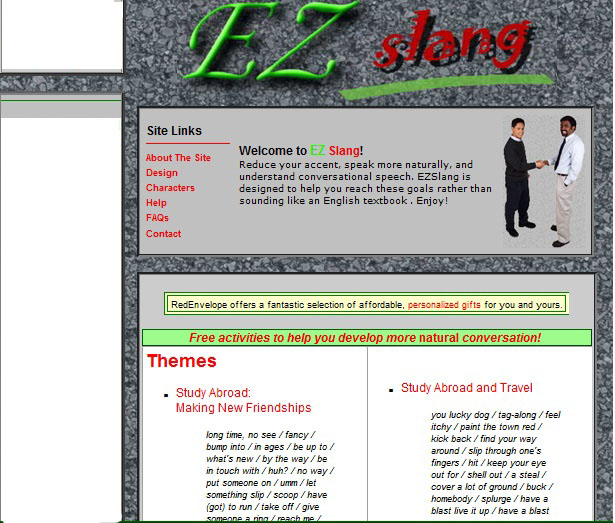 Figure 1. The top half of EZ Slang’s homepage
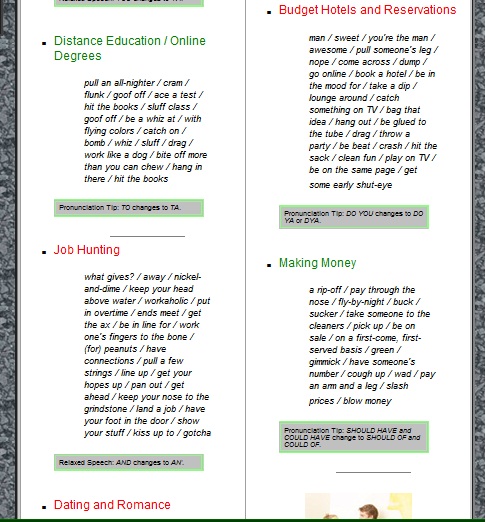
Figure 2. The bottom half of EZ Slang’s homepage
The designer of the website, Randall Davis, explains the purpose of his design in the page under the link About This Site (shown in Figure 3). Since he is an ESL teacher himself, he describes his own students’ frustration when dealing with native speakers in different settings outside the classroom. This frustration, as Davis explains, comes from the differences between what is said in real conversations and what is taught in classrooms.
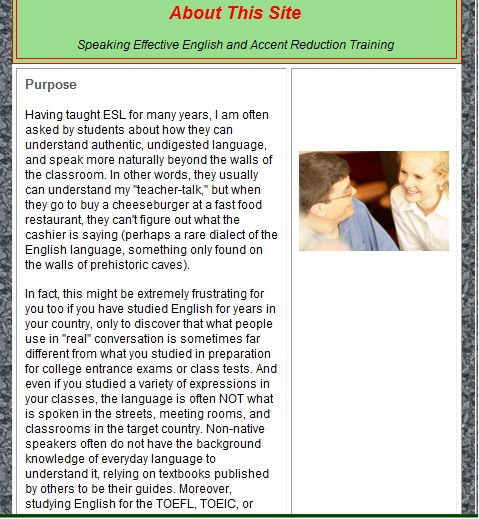 Figure 3. About this site page
On the Site Design page (shown in Figure 4), the designer describes some of the pedagogical issues pertinent to language instruction, particularly concerning the difference between idioms and slang. In terms of the technical issues (see Figure 6), the designer points out some potential problems such as difficulty in using the audio operating system as well as possible technical setbacks with the Internet connection.
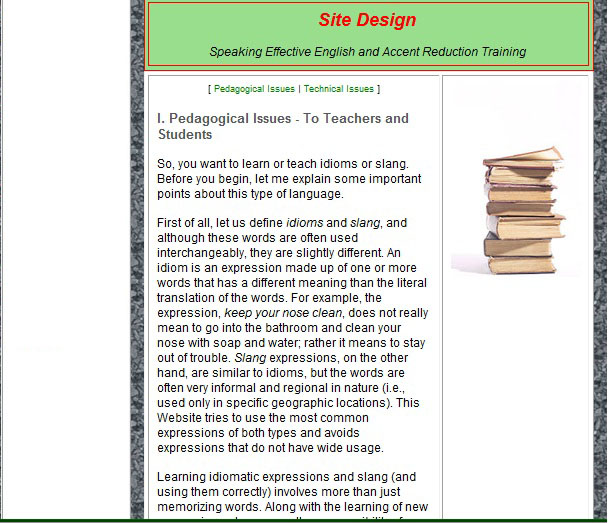 Figure 4. The top half of the Site design page
Also on this page (as in Figure 5), he clarifies how the units and activities are designed and divided into components within main parts. These components are: Warming Up, Relaxed Speech, Listening in Context, Catching the Gist, Filling in the Meaning, Retelling the Story, Expanding Your Learning.
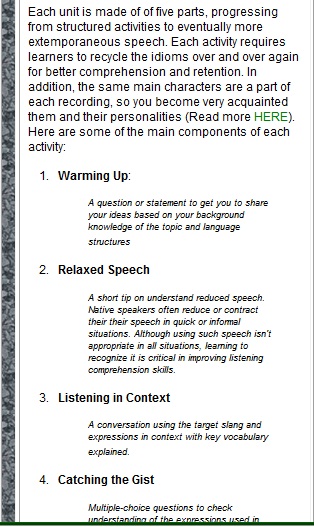 Figure 5. The middle part of the Site design page
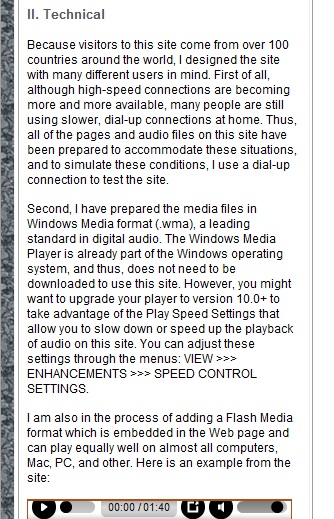 Figure 6. The bottom half of the Site design page
Moreover, the website contains designated pages for introducing the characters whose voices are heard in the conversations, frequently asked questions to help resolve possible problems, contact information such as an email address, and help.
Listening lessons are presented according to different common themes that can help users in an academic setting as well as outside the classroom. Some of the practical topics focus on preparing students to study abroad, with essential areas of concern such as making new friends, job hunting, distance education/online degrees, dating and romance, study abroad and travel, budget hotels and reservations, and making money.
Since it is mainly designed for independent study, the website allows users to start with the general written description of the topic and proceed to the following brainstorming task as a warm-up exercise (as shown in Figure 7). The second part opens with pronunciation tips and some background description about the characters and the situation of the conversation before it begins. An audio player and a transcript of the conversation are available within the section. Key vocabulary, including unfamiliar expressions, sample sentences, and the origin of some idioms mentioned, are also provided.
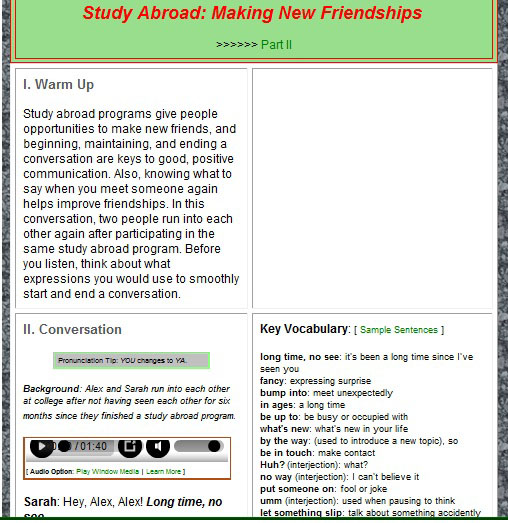 Figure 7. A sample of a listening lesson and the tasks that follow (top part)
The third section (shown in Figure 8) contains the first task titled Catching the Meaning. This task helps users consolidate the meanings of the expressions mentioned in the audio conversation by solving a multiple choice task. The task is followed by a self-score detector that gives scores and correct answers for the task.
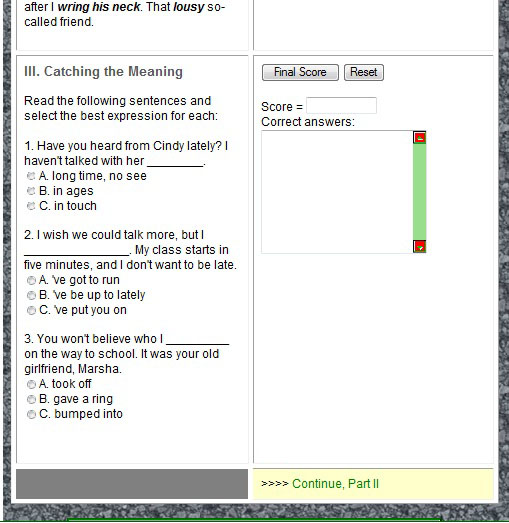 Figure 8. A sample of a listening lesson and the tasks that follow (bottom part)
By clicking on the “Continue Part II” icon at the bottom of the page (shown in Figure 9), the user can continue with the fourth task of Filling in the Meaning. This task requires the user to listen to another conversation that employs more of the previously presented expressions and then fill in the blanks in a paragraph. The correct answers are provided once the user clicks on the score-detecting icon. The lesson can be used alongside another task entitled Retelling the Story, which involves restating the situation mentioned in the previous task in the user’s own words. This task can be used in a classroom setting where students work in groups to discuss and share their thoughts. Instructions and extra activities for this task are also provided.
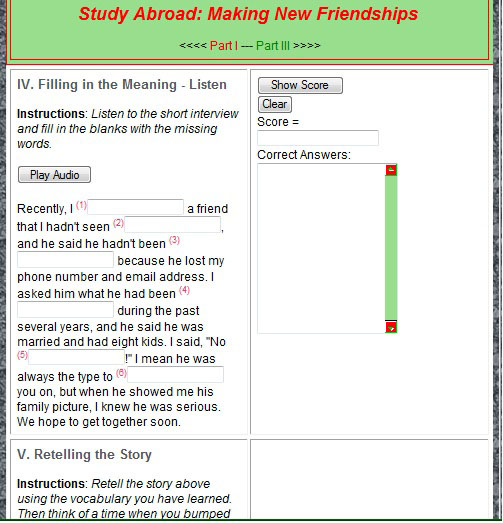 Figure 9. Some more tasks
The last exercise (shown in Figure 10) is Expanding Your Learning. This exercise can either be used independently or in a classroom setting. The page provides the user with additional activities and includes examples.
 Figure 10. Sample tasks on Expanding your learning page
Evaluation
New literacies have been defined to include a set of skills utilized to understand information in any way presented (Lankshear & Knobel 2006). The definition of new literacies involves the following components:
(A) Social practice
(B) Critical thinking
(C) Engagement
(D) Culture and context
Social practice:
The website supports collaborative engagement in learning and involves viewing and communicating others’ opinions and perceiving and employing knowledge with a critical awareness. As mentioned earlier, EZ Slang is mainly designed for self-access learning. However, the designer included some tasks that require collaborative work in a classroom setting. Also, tasks such as the warm-up activity can be used by teachers as part of a group discussion to brainstorm vocabulary, expressions, and predictions of what the students are going to hear. The designer’s suggestions effectively highlight the process of social practice.
Critical thinking:
EZ Slang involves several aspects of critical thinking described by Lankshear and Knobel (2003), such as conceptualizing, questioning, researching, acquiring information, evaluating, answering, synthesizing and communicating the result with others. EZ Slang gives users the opportunity to assess and differentiate between slang expressions and idioms. This assessment involves the use and the context of such expressions outside the classroom. Also, the site focuses on recycling these expressions in different tasks to help generate different contexts and uses of the expressions. This process gives the users the sense of when and how they can use these expressions in real conversations with native speakers. However, it would be more effective if the site included some suggestions to teachers on how to generate more critical thinking tasks while using the site.
Engagement:
Engagement occurs when learners are provided with appealing resources and tasks that make them want to work hard in the educational process. This is what EZ Slang accomplishes in several ways. First the site uses common topics that may interest second language learners. In addition, it uses expressions and idioms in different contexts along with explanations for each one. It also employs audio recordings with native speakers as a way for learners to understand the language as well as the speaker’s intended meaning via tone and pronunciation. However, it might be more efficient if the designer used video conversations instead of audio only. Seeing the speakers’ facial expressions and gestures while delivering their speech can help learners decode better and faster. It also supports their engagement with the content presented and may catch their attention more easily.
Culture and context:
Culture and context refer to the recognition of the identity of entities and how they are perceived by different cultures. These entities can be driven from “human elements …[and] include people’s ways of thinking, acting, feeling, moving, dressing, speaking, gesturing, believing, and valuing. Non-human elements … include such things as tools, objects, institutions, networks, places, vehicles, machines, physical spaces, buildings” (Lankshear, 2007, p. 3). This may be one of the ways cultures have developed to be recognizably different from one another and understanding them becomes interestingly essential for global communication. The main content in EZ slang is certainly culturally oriented. Learners recognize that mastering the language itself is an only part of the intended goal, since the rest of the goal is learning more about the culture. The language is widely represented through idioms and slang expressions that second language learners need to focus on. The site incorporates themes that address a wide variety of interests and needs for upper-intermediate and advanced English language learners.
Conclusion
Incorporating new literacies in the classroom setting can improve the transfer of information from the teacher to the learner and/or the website to the learner. Employing new literacies in classrooms often requires more effort from the teachers themselves; teachers must participate and engage with technology in order to understand how it can be helpful in schools. EZ Slang accomplishes the specific goals described above. The design, the layout, the content, and the function of the website successfully support its purpose of improving users’ communication with native speakers of English.
References
Coiro, J. (2003). Reading comprehension on the Internet: Expanding our understanding of reading comprehension to encompass new literacies. The Reading Teacher, 56(6), 458-464.
Cummins, J., Brown, K., & Sayers, D. (2007). Literacy, technology, and diversity: Teaching for success in changing times. Boston: Allyn & Bacon/Pearson.
Lankshear, C., & Knobel, M. (2003). New literacies: Everyday practices and classroom learning, 2nd Ed. London: Open University Press.
Lankshear, Colin. (2007). The “Stuff” of New Literacies. Retrieved from http://www.everydayliteracies.net/stuff.pdf.
Leu, Kinzer, Coiro, & Cammack (2004). Toward a theory of new literacies emerging from the Internet and other information and cmmunication technologies. Retrieved from http://www.readingonline.org/newliteracies/leu/.
About the Reviewer
Reima Abobaker is a doctoral student in Language and Literacy Education in the Department of Teaching and Learning at Washington State University, Pullman. Before beginning her doctoral studies, she taught Second Language Listening Comprehension for intermediate and advanced students in the English Department in the Faculty of Arts at the University of Garyounis for 3 years. She was awarded her Masters degree in Applied Translation from the School of Modern Languages at the University of Exeter, UK. Her research interest is incorporating engaging listening lesson plans with technology in classroom settings.
reima.abobaker email.wsu.edu
| © Copyright rests with authors. Please cite TESL-EJ appropriately. |