• Skip to primary navigation
  • Skip to main content

site logo
The Electronic Journal for English as a Second Language
search
  • Home
  • About TESL-EJ
  • Vols. 1-15 (1994-2012)
    • Volume 1
      • Volume 1, Number 1
      • Volume 1, Number 2
      • Volume 1, Number 3
      • Volume 1, Number 4
    • Volume 2
      • Volume 2, Number 1 — March 1996
      • Volume 2, Number 2 — September 1996
      • Volume 2, Number 3 — January 1997
      • Volume 2, Number 4 — June 1997
    • Volume 3
      • Volume 3, Number 1 — November 1997
      • Volume 3, Number 2 — March 1998
      • Volume 3, Number 3 — September 1998
      • Volume 3, Number 4 — January 1999
    • Volume 4
      • Volume 4, Number 1 — July 1999
      • Volume 4, Number 2 — November 1999
      • Volume 4, Number 3 — May 2000
      • Volume 4, Number 4 — December 2000
    • Volume 5
      • Volume 5, Number 1 — April 2001
      • Volume 5, Number 2 — September 2001
      • Volume 5, Number 3 — December 2001
      • Volume 5, Number 4 — March 2002
    • Volume 6
      • Volume 6, Number 1 — June 2002
      • Volume 6, Number 2 — September 2002
      • Volume 6, Number 3 — December 2002
      • Volume 6, Number 4 — March 2003
    • Volume 7
      • Volume 7, Number 1 — June 2003
      • Volume 7, Number 2 — September 2003
      • Volume 7, Number 3 — December 2003
      • Volume 7, Number 4 — March 2004
    • Volume 8
      • Volume 8, Number 1 — June 2004
      • Volume 8, Number 2 — September 2004
      • Volume 8, Number 3 — December 2004
      • Volume 8, Number 4 — March 2005
    • Volume 9
      • Volume 9, Number 1 — June 2005
      • Volume 9, Number 2 — September 2005
      • Volume 9, Number 3 — December 2005
      • Volume 9, Number 4 — March 2006
    • Volume 10
      • Volume 10, Number 1 — June 2006
      • Volume 10, Number 2 — September 2006
      • Volume 10, Number 3 — December 2006
      • Volume 10, Number 4 — March 2007
    • Volume 11
      • Volume 11, Number 1 — June 2007
      • Volume 11, Number 2 — September 2007
      • Volume 11, Number 3 — December 2007
      • Volume 11, Number 4 — March 2008
    • Volume 12
      • Volume 12, Number 1 — June 2008
      • Volume 12, Number 2 — September 2008
      • Volume 12, Number 3 — December 2008
      • Volume 12, Number 4 — March 2009
    • Volume 13
      • Volume 13, Number 1 — June 2009
      • Volume 13, Number 2 — September 2009
      • Volume 13, Number 3 — December 2009
      • Volume 13, Number 4 — March 2010
    • Volume 14
      • Volume 14, Number 1 — June 2010
      • Volume 14, Number 2 – September 2010
      • Volume 14, Number 3 – December 2010
      • Volume 14, Number 4 – March 2011
    • Volume 15
      • Volume 15, Number 1 — June 2011
      • Volume 15, Number 2 — September 2011
      • Volume 15, Number 3 — December 2011
      • Volume 15, Number 4 — March 2012
  • Vols. 16-Current
    • Volume 16
      • Volume 16, Number 1 — June 2012
      • Volume 16, Number 2 — September 2012
      • Volume 16, Number 3 — December 2012
      • Volume 16, Number 4 – March 2013
    • Volume 17
      • Volume 17, Number 1 – May 2013
      • Volume 17, Number 2 – August 2013
      • Volume 17, Number 3 – November 2013
      • Volume 17, Number 4 – February 2014
    • Volume 18
      • Volume 18, Number 1 – May 2014
      • Volume 18, Number 2 – August 2014
      • Volume 18, Number 3 – November 2014
      • Volume 18, Number 4 – February 2015
    • Volume 19
      • Volume 19, Number 1 – May 2015
      • Volume 19, Number 2 – August 2015
      • Volume 19, Number 3 – November 2015
      • Volume 19, Number 4 – February 2016
    • Volume 20
      • Volume 20, Number 1 – May 2016
      • Volume 20, Number 2 – August 2016
      • Volume 20, Number 3 – November 2016
      • Volume 20, Number 4 – February 2017
    • Volume 21
      • Volume 21, Number 1 – May 2017
      • Volume 21, Number 2 – August 2017
      • Volume 21, Number 3 – November 2017
      • Volume 21, Number 4 – February 2018
    • Volume 22
      • Volume 22, Number 1 – May 2018
      • Volume 22, Number 2 – August 2018
      • Volume 22, Number 3 – November 2018
      • Volume 22, Number 4 – February 2019
    • Volume 23
      • Volume 23, Number 1 – May 2019
      • Volume 23, Number 2 – August 2019
      • Volume 23, Number 3 – November 2019
      • Volume 23, Number 4 – February 2020
    • Volume 24
      • Volume 24, Number 1 – May 2020
      • Volume 24, Number 2 – August 2020
      • Volume 24, Number 3 – November 2020
      • Volume 24, Number 4 – February 2021
    • Volume 25
      • Volume 25, Number 1 – May 2021
      • Volume 25, Number 2 – August 2021
      • Volume 25, Number 3 – November 2021
      • Volume 25, Number 4 – February 2022
    • Volume 26
      • Volume 26, Number 1 – May 2022
      • Volume 26, Number 2 – August 2022
      • Volume 26, Number 3 – November 2022
      • Volume 26, Number 4 – February 2023
    • Volume 27
      • Volume 27, Number 1 – May 2023
      • Volume 27, Number 2 – August 2023
      • Volume 27, Number 3 – November 2023
      • Volume 27, Number 4 – February 2024
    • Volume 28
      • Volume 28, Number 1 – May 2024
      • Volume 28, Number 2 – August 2024
      • Volume 28, Number 3 – November 2024
      • Volume 28, Number 4 – February 2025
    • Volume 29
      • Volume 29, Number 1 – May 2025
      • Volume 29, Number 2 – August 2025
      • Volume 29, Number 3 – November 2025
      • Volume 29, Number 4 – February 2026
    • Volume 30
      • Volume 30, Number 1 – May 2026
      • Volume 30, Number 2 – August 2026
  • Books
  • How to Submit
    • Submission Info
    • Ethical Standards for Authors and Reviewers
    • TESL-EJ Style Sheet for Authors
    • TESL-EJ Tips for Authors
    • Book Review Policy
    • Media Review Policy
    • TESL-EJ Special issues
    • APA Style Guide
  • Editorial Board
  • Support

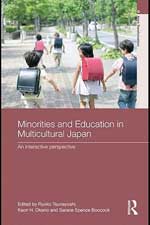
Minorities and Education in Multicultural Japan

March 2012 – Volume 15, Number 4

Minorities and Education in Multicultural Japan

Author: Ryoko Tsuneyoshi, Kaori Okano, & Sarane Spence Boocock (Eds.) (2010)  
Publisher: Routledge
Pages ISBN Price
272 pages 9780415559386 $44.95 USD

Minorities and Education in Multicultural Japan is a fascinating look at the Japanese public education system and its response to several diverse groups of students whom it serves.

While Japan is often viewed as a monoethnic nation, the authors who contributed to this volume discuss many multicultural groups that coexist with those who they term “majority Japanese”.  According to the authors, the long-embraced Japanese school goal of “education for international understanding” (kokusai rikai kyōiku) is insufficient because it implies that the Japanese are an ethnically and culturally homogeneous people and approaches multiculturalism as temporary intercourse with foreigners both inside and outside of Japan.  A newer educational mission of tabunka kyōsei kyōiku (“education for multicultural coexistence”) or dōwa kyōiku (“equalitarian/assimilation education”), has begun to teach students that Japan itself is indeed a multicultural nation.  This discussion may be of great interest to American educators who are looking for ways to promote multiculturalism or global education in their own schools.

Despite the obvious differences between U.S. and Japanese societies, many of the issues discussed in the book are shared concerns.  In both countries, there are many children in danger of being underserved by the public school system, such as those of foreign ancestry, those with low socio-economic status, and recent immigrants. Additionally, all students must learn the skills necessary to succeed in a multicultural world.  Learning about the ways in which Japan deals with these challenges can be very informative to American educators.

The book is divided into two parts, “Long-existing minorities”, which focuses on people whose ancestors have lived in Japan since before the 1970s, and “Newcomer groups”, which focuses on people who arrived in Japan in the 1970s-80s or more recently.The first part includes chapters on buraku (low caste), Okinawan & Amerasian, and ethnic Korean children.  Since these students were born in Japan, they do not generally require Japanese language or cultural classes, and thus by American standards, they would not generally be classified as TESOL students.   In many places in Japan, however, these students are provided with services rarely seen in U.S. public schools, such as instruction in the language of their ancestors and cultural study time, which teaches them about their ancestors’ native land and culture.  One common approach shared by many U.S. schools is offering an extracurricular club for these purposes, similar to a club for Hispanic children that would celebrate their cultural and linguistic heritage.  Other goals for these students discussed in the book are to increase school attendance rates, decrease bullying towards these students, and to increase high school graduation and college entrance rates amongst these populations.

The second part of the book presents information on “Newcomers”, including Brazilian, non-Japanese Asian, and ethnic Japanese children who were raised overseas, known as “returnees”.  American and European children who live in Japan temporarily are not included in this volume, since according to the editors, they rarely attend public schools.  The goals of the Japanese education system in regards to these populations are to provide Japanese language and culture classes and to help preserve the language and culture of the students’ home countries, as this is viewed as a crucial component of the students’ identities.   These missions are very similar to the goals that most American TESOL teachers would have for their own students.

The editors’ concluding remarks also discuss the significant role of the individual teacher in encouraging other students to either embrace or shun diverse members of their classes.  This is an important reminder to all educators that students take their cues on multicultural understanding and global education from us, and so we must practice what we preach in terms of inclusion and cross-cultural understanding. As a medium for considering issues of multiculturalism, global education, and TESOL challenges, this volume is a welcome addition to the existing literature.

Reviewed by
Cyndi Mottola Poole
University of Central Florida
<clpooleatmarkknights.ucf.edu>

© Copyright rests with authors. Please cite TESL-EJ appropriately.Editor’s Note: The HTML version contains no page numbers. Please use the PDF version of this article for citations.

© 1994–2026 TESL-EJ, ISSN 1072-4303
Copyright of articles rests with the authors.