

March 2012 – Volume 15, Number 4
Teaching College Writing to Diverse Student Populations |
|||
| Author: | Dana R. Ferris (2009) | 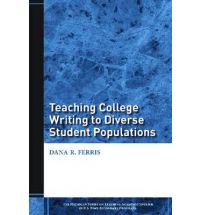 |
|
| Publisher: | University of Michigan Press | ||
| Pages | ISBN | Price | |
|---|---|---|---|
| 169 pages | 978-0-472-03337-9 | $27.50 USD | |
Teaching College Writing to Diverse Student Populations by Dana Ferris is an insightful work that explores the role college and university personnel must play in order to assist second language learners (L2) in their academic progression towards English proficiency. By placing responsibility back into the right hands, Ferris proclaims that second language specialists, composition specialists, program administrators, and developers in colleges and universities must work together and do their individual part to ensure that the needs of all L2 students in higher education are adequately met. In arguing her ideas, Ferris positions L2 students at the forefront of her book rather than at the margins, discussing how their respective and unique cultural and linguistic background should dictate curriculum and instruction. Her book is driven by a belief that higher education, though distinctly different from K-12 education, should continue to serve and meet the needs of a diverse student population. She argues against a college culture that ineffectively develops the academic writing and literacy skills of L2 students. Her book advocates for L2 students in post-secondary institutions, suggesting that a one-size-fits-all approach cannot adequately educate the diverse L2 student population and that such an approach prevents L2 students from matriculating and graduating from American colleges and universities.
The thesis of Ferris’ book is discovering the L2 learner in post-secondary education. From beginning to end, she posits that before a teacher can meet the academic writing needs of L2 students, teachers must first understand the complex and unique characteristics, backgrounds, motivations, strengths, and weaknesses of a diverse L2 student population. In order to situate L2 students at the center of her discussion, Ferris’ book is broken into three parts, each section building upon the previous chapter and addressing various ESL topics from the perspective of L2 students. Never deviating from her thesis, an awareness of L2 students’ academic needs unifies the numerous topics and subtopics that are explored within her book.
In Part 1: Foundations, Ferris unravels the multidimensional layers of L2 students, addressing their varied identities. She notes that with more students attending university, the linguistic, cultural, ethnic, and socioeconomic status of college students have expanded. Recognizing this trend, she identifies three different categories of L2 students: international students, late-arriving resident students, and early-arriving resident students. She describes international students as visa students who are pursuing an American degree with the intent of returning to their home country. Late-arriving resident students are defined as students that moved to the United States after completing high school in their home country. These students typically have minimal or no English foundation. Lastly, early-arriving resident students arrived in the U.S. prior to the age of ten and have resided in America for eight or more years, attending American public schools. The descriptions of these L2 students are not meant to be exhaustive; rather, Ferris is persistent in reiterating that there are multiple variations within these three categories of L2 students.
Furthering the idea of differences among L2 students, Ferris uses a description of real life students (John, Hector, Luciana) and a sample of their writing to represent international, early-arriving, and late-arriving resident students. Their distinct stories and writings reveal the varying degree of knowledge, experiences, motivations, and language skills among L2 students, and how these characteristics affect their mastery of academic language whether in reading, writing, or speaking. Ferris shows that the diversity (strengths and weaknesses) among the L2 student population needs to be taken into account as educators try to meet L2 students individualized needs throughout the teaching and learning process.
Part 2: Implications addresses the practical consequences of readers gaining an understanding of diverse L2 student groups. Ferris shows that with an awareness of L2 student characteristics, other issues that affect their writing development in higher education can be critically examined, revealing which institutional practices either assist or hinder L2 students. Part 2 guides the reader through a thorough discussion of all the institutional challenges and issues L2 students face as they struggle to gain a command of the English language while simultaneously moving through post-secondary education. Ferris argues that from curriculum, placement, assessment, and teacher preparation to course design and classroom instruction, all of these areas should be contingent upon the diverse needs of L2 students. She fervently argues against a formulaic approach that arbitrarily accommodates L2 students with little regards to their varying needs.. Instead, every aspect of an L2 student’s education in the post-secondary setting should be dependent upon that student. By not acknowledging differences among second language learners and grouping them into an all-inclusive educational pile, they are ill prepared for the journey ahead. Ferris provides ample suggestions and ideas to consider, assisting educators in better meeting the needs of all L2 student writers.
The last portion of Ferris’ book, Part 3: Applications serves as a continued guide, offering teachers direction. Restating the problem through the voices of John, Hector, and Luciana, Ferris brings a human quality back into her discussion. She helps her readers understand that these students are not nameless individuals and that the suggestions offered at the end of her book are only impactful if L2 students are at the center of the discussion and implementation process.
Ferris’ book has more strengths than limitations. The book’s strength resides in its ability to serve as a teacher’s guide for L2 instructors, containing many rich resources. An in-depth review of literature is initially conducted and presented throughout the book, providing research and excerpts from countless sources. This explanatory information not only strengthens Ferris’ claims but also adds to her readers’ level of understanding. In addition, at the end of each chapter numerous questions are posed to ensure that the reader grasps the main concepts and ideas as well as engages in a process of self-reflection. Figures are also included and used to outline and organize important terms, definitions, and information. Connecting theory to application, actual student writing is presented and critiqued to show variation among L2 students’ writing skills and to identify areas of need. Ferris also inserted her own personal experiences, observations, and thoughts about L2 students’ academic progression in the area of writing. All of these added resources aid in constructing a more complete guide for teachers as they attempt to understanding and properly educate L2 students. The only substantial limitation is the lack of a substantial historical frame of reference. Although a brief history of L2 students in higher education was provides in the first few pages of the book, an extensive historical account may add greater depth to the discussion.
Teaching College Writing to Diverse Student Populations is an insightful text. Ferris challenges prior assumptions about L2 students. Individual reflection is inevitable as one finishes the book having gained a new perspective and strategies on how to best assist learners. Educators who interact with L2 students will this text an informative piece
Reviewed by
Abiola Farinde
The University of North Carolina Charlotte
<afarinde uncc.edu>
| © Copyright rests with authors. Please cite TESL-EJ appropriately.Editor’s Note: The HTML version contains no page numbers. Please use the PDF version of this article for citations. |