

March 2012 – Volume 15, Number 4
Culturally and Linguistically Diverse Exceptional Students:
|
|||
| Author: | Elizabeth A. Grassi & Heidi Bulmahn Barker (2010) | 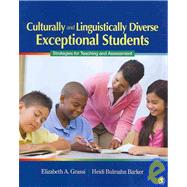 |
|
| Publisher: | SAGE Publications, Inc. | ||
| Pages | ISBN | Price | |
|---|---|---|---|
| 348 pages | 978-1-4129-5213-2 | $67.00 USD | |
Culturally and Linguistically Diverse Exceptional Students: Strategies for Teaching and Assessment is a textbook for pre-service and in-service U.S. teachers of students who have both language and learning exceptionalities. These types of students are referred to as Culturally and Linguistically Diverse Exceptional (CLDE) students. This population is often overlooked and has competing needs—English language acquisition and special education services. The Grassi and Barker text demonstrates how to consider CLDE student needs simultaneously.
The authors state in the foreword that this book is intended to address the mismatch between theory and practice for CLDE student through the organization of the book. The authors accomplish this goal by creating a text that is grounded in research, framed by real-life case studies, and followed-up with activities applicable in a variety of educational situations. The text includes a website that provides multiple resources by chapter. For example, there are additional case studies and activities, journal articles, and videos of specific strategies referred to in the text. However, the journal articles provided on the website are limited to SAGE publications. While this book provides well-known, research-based strategies that address the curriculum needs of CLDE students, it does not go beyond a strategies approach in addressing the sociocultural context in which students are learning.
The introductory chapter of the book provides an overview and key information about CLDE students. This information includes an overview of demographics, legalities, and teacher preparation in the United States. The rest of the text is divided into five sections that dig deeper into these previewed topics.
The first section, Understanding Student Backgrounds, consists of three chapters. The first describes how and why to collaborate with families. The next two chapters are dedicated to second language acquisition, breaking down the process into its essential components using text and charts. Some of these components include understanding interlanguage, relevant theories, and factors affecting language acquisition. The section concludes with a chapter devoted to understanding fluency. The content of this section helps the reader avoid mislabeling students by more clearly distinguishing between disability and appropriate language acquisition.
The next section, Strategies for Assessment and Planning for Instruction, includes four chapters. The first chapter describes the systems used in the United States for identifying students who need English as a New Language (ENL) or Special Education services. It clearly identifies the challenges of identifying a student who has needs in both areas. It becomes clear from the reading and by accompanying case studies that systems need adaptation when working with CLDE students. The authors suggest such adaptations as the use of multiple assessment measures. This chapter also discusses gifted and talented students, another often overlooked exceptionality for culturally and linguistically diverse students. The next two chapters break down options for co-teaching, working with paraprofessionals, applying differentiated instruction and Universal Design for Learning to CLDE students, and using backward design in lesson planning. The section concludes with a chapter on culturally relevant pedagogy.
Section 3, Strategies for Content and Language Acquisition, starts with a chapter focused on strategies that integrate language and content, for example, making content comprehensible and allowing students time to clarify in the first language. The next chapter discusses ways to promote participation by creating a comfortable environment, increasing classroom interaction, and encouraging extended participation. The final chapter provides strategies for explicitly teaching grammar. All three chapters in this section are organized in the same usable manner: naming of a teaching strategy, a description of that strategy from the perspective of language acquisition, a description from the perspective of special education, and finally a section that puts together both perspectives in ways that best serve CLDE students. An accompanying web site provides video clips of teachers implementing the strategies.
The Strategies for Literacy Instruction section comprises three chapters: teaching reading, teaching writing, and strategies for written error correction. These chapters contain important information that all teachers should know when working with CLDE students. They dissect literacy strategies, demonstrating how to use them specifically with students who have both language and learning challenges. The text does a good job of breaking each strategy into subparts and describing why it works. Then, the authors enhance understanding by providing concrete, real-life examples through case studies and video clips.
While the authors do briefly discuss classroom environment and student interactions, one of the limitations of the text is that it is mostly focused on strategies. Although the book presents the strategy information well and from the combined perspectives of the SLA and Special Education fields, it is less focused on classroom organization and underlying principles of learning that are effective with CLDE students. One approach that does focus on classroom organization and principles of learning is Standards for Effective Pedagogy from the Center for Research on Education, Diversity, & Excellence. It is within this structure that content is taught and strategies are used, making them more effective for learning. For example, one of the standards is the use of instructional conversations to teach both content knowledge and language. Instruction is dialogic, so by teaching through conversation students get the opportunity to talk through their learning with the teacher and other students. For students with language and special education needs this is an effective way to engage students and increase their understanding of content and use of English in authentic contexts. Another standard involves contextualizing new learning by connecting it to students’ lives. Often students that struggle with learning are easily frustrated because school is not only hard but also seemingly irrelevant. By intentionally connecting new learning to their lives beyond the classroom, students find meaning in and motivation for schoolwork. Attention to the Standards for Effective Pedagogy is just one example of how the authors could go beyond strategies to look at the whole classroom structure and context to promote learning.
Grassi and Barker’s Culturally and Linguistically Diverse Exceptional Students: Strategies for Teaching and Assessment is a much-needed resource for any teacher working with students from diverse cultural and linguistic backgrounds that also have exceptionalities. Though seven of the fifteen chapters are written using the United States, as its context, the strategies chapters would be applicable to any educational context with CLDE students. The text’s main strength is that it addresses the intersection of diversity and exceptionalities very well. It is important to note that the authors address exceptionalities mostly from a learning disabilities perspective, not a gifted talented perspective. The book successfully overcomes the traditional mismatch between theory and practice by using text, video, and case studies to present the information and providing activities at the end of each chapter to help teachers put the research into practice. This text works towards creating teachers who are true advocates for one of our most vulnerable student populations, culturally and linguistically diverse exceptional students.
References
Center for Research on Education, Diversity and Excellence. (n.d.) Retrieved from http://crede.berkeley.edu/.
Center for Research on Education, Diversity and Excellence. Five standards for effective pedagogy and learning. (n.d.) Retrieved from: http://crede.berkeley.edu/research/crede/standards.html.
Dalton, S. S. (2008). Five standards for effective teaching: How to succeed with all learners, grades K-8. San Francisco, CA: John Wiley & Sons, Inc.
Reviewed by
Catherine D. Bhathena
Indiana University School of Education, IUPUI
<cdfuller iupui.edu>
| © Copyright rests with authors. Please cite TESL-EJ appropriately.Editor’s Note: The HTML version contains no page numbers. Please use the PDF version of this article for citations. |