

March 2012 – Volume 15, Number 4
Interactions 2 – Listening/Speaking, Silver Edition |
|||
| Author: | Judith Tanka & Lida R. Baker (2008) | 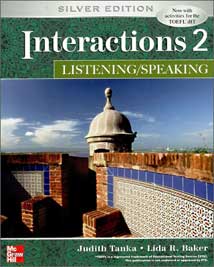 |
|
| Publisher: | McGraw-Hill Companies, Inc. | ||
| Pages | ISBN | Price | |
|---|---|---|---|
| 308 pages | 0077201574 | $45.00 USD | |
Interactions 2-Listening/Speaking, Silver Edition is a member of an 18-book series published by McGraw Hill for use with ESOL or EFL students. The series contains books ranging from beginner to advanced English proficiency across all four domains of language, with this particular text targeting specifically listening and speaking skills in the intermediate range. The text is designed to strengthen academic language skills required to effectively engage in studies at the university level, making it ideal for students transitioning into institutions of higher learning for both undergraduate and graduate studies in programs requiring English proficiency.
There are 10 chapters in Interactions 2-Listening/Speaking, each with a distinct and relevant theme: Education and Student Life (1), City Life (2), Business and Money (3), Jobs and Professions (4), Lifestyles around the World (5), Global Connections (6), Language and Communication (7), Tastes and Preferences (8), New Frontiers (9) and Ceremonies (10). Within each chapter there are four sections that contain activities that target various skills: Conversation, Lecture, Strategies for Better Listening and Speaking and Real-World Task. In addition, the book provides including paired-work activities, transcriptions of all audio clips used in the text, a glossary of target vocabulary and an index of skills introduced by or supported through the books lessons.
A key component of the textbook, the accompanying e-Course, is activated by a unique code issued to each student. Students most commonly purchase this code bundled with the book, or they may order it independently from the publisher. While access to the e-Course is not critical to using Interactions 2-Listening/Speaking, it greatly enhances the learning experiences of users by providing students access to the multitude of audio clips included within the chapters. This feature affords the flexibility for students to work at different paces in that they may listen to new audio or review audio used in class as many times as necessary to decipher the content of the lesson and master the outlined objectives. In addition, because the e-Course provides access to an interactive, online version of the book, students can complete assignments electronically and check their work for accuracy. By establishing a class code and inviting students to join, instructors gain access to students’ e-books and can monitor student progress, check for completed assignments and even leave private feedback or individualized messages within each student’s book. Instructors are given access to each student’s individual work as well as aggregate data to assess skill mastery and plan future lessons. One final benefit to employment of the e-Course is the ability it affords the instructor when it is displayed via LCD projector to model accurate completion of various lessons as well as note-taking skills for students during class sessions.
Teaching with Interactions 2-Listening/Speaking is further supported by the associated teacher’s edition. Included in the component is a placement test that can be used by instructors at the beginning of a course to determine strengths and weaknesses in students existing English skills. Each chapter of the teacher’s edition includes answers to exercises in the student book, expansion activities centered on the overarching themes and research-based guidance concerning best practices for working with ELLs (English Language Learners). In addition, black line masters with alternative activities, many of which involve interactive group work, are included for each topic. Finally, the text provides summative chapter tests and corresponding audio clips.
There is consistency across the chapters in terms of the various types of activities, allowing ELLs to develop familiarity with expectations for completion. In the Conversation section of each chapter, introduces students to to relevant vocabulary, including some idiomatic and expressive terms used in less formal oral speech. Typically, an audio clip of an interpersonal conversation follows with comprehension questions. In many chapters, informal dialogue is used as the basis of more targeted listening activities that focus on stress patterns or pronunciation issues. The second portion of each chapter is based on a short, academic lecture that relates back to the central theme of the chapter. Note-taking is emphasized during this portion of the book, which each lesson building on the previous one, which scaffolds this critical skill nicely for ELL students. Key academic strategies, like the use of graphic organizers, are incorporated throughout these exercises. Strategies for better listening and speaking skills comprise the third section of each chapter, with helpful hints related to tone, context clues and intonation. There is also a small exercise in each chapter that provides TOEFL practice and tips. The final portion of each chapter requires that the student apply the concepts and vocabulary to everyday situations, like reading a map and providing directions.
A primary strength of Interactions 2-Listening/Speaking is the global nature of the thematic chapters and relevance to students’ lives while equipping them with vocabulary that is necessary for success in the university setting. The introductory chapter deals primarily with common language used in higher education, laying a nice foundation for future lessons. Chapter six, Global Connections, focuses on technology used in education as well as modes of communication that are familiar to the population of students most likely to be using this book. In addition, many of the themes, such as chapter four, Lifestyles around the World, provide a context for cross-cultural sharing, promoting opportunities for genuine conversations which further strengthen student speaking skills. Overall, the book does an excellent job of infusing activities that are fun and engaging with more academically oriented lessons, providing a nice balance for students and instructors.
ESOL/EFL instructors might choose to work with Interactions 2-Listening/Speaking because it emphasizes research-based best practices for ELLs. Purposeful incorporation of academic vocabulary arranged around relevant themes provides ELLs the exposure to academic vocabulary that is more difficult to master than contextualized interpersonal communication (Cummins, 1979). In addition, many of the exercises incorporate activities, like discussions with peers and vocabulary previews, that are designed to activate prior knowledge that is thought to increase learning outcomes for ELLs (Echevarria, Vogt, & Short, 2008). Most importantly, perhaps, for developing speaking and listening skills among students learning a second language are the myriad of activities that require students to interact with one another as well as suggestions for collaborative projects and presentations.
There are very few drawbacks to Interactions 2-Listening/Speaking. Chapter 9, New Frontiers, is concerned with advances in medical research and innovations and incorporates discussions regarding cloning and stem cell research. In addition, the Chapter 5, Lifestyles around the World, while certainly relevant, bases many of the activities center around a conversation about being a single parent. While these topics are unquestionably timely and familiar to students, care should be taken when introducing controversial subject matter into classrooms where multiple cultures and religions are represented. Approaching these topics with forethought and sensitivity can help instructors avoid uncomfortable situations and transform uncomfortable situations into opportunities for cultural exchange and constructive debate.
Overall, Interactions 2-Listening/Speaking is a strong addition to any ESOL/ESL classroom with learners who are transitioning into an English-speaking university setting. The activities and lessons contained in the text will prepare students for the academic language they will encounter in course lectures and readings. The interactive support provided by the accompanying e-Course further enhances its user-friendliness and flexibility, making it a great tool for energizing language teaching and engaging learners in meaningful and beneficial instruction.
References
Cummins, J. (1979) Cognitive/academic language proficiency, linguistic interdependence, the optimum age question and some other matters. Working Papers on Bilingualism, 19, 121-129.
Echevarria, J., Vogt, M.E., & Short, D. (2008). Making content comprehensible for English language learners: The SIOP® model, Third Edition. Boston, MA: Allyn & Bacon.
Reviewed by
Michele Plaisance
University of North Carolina Charlotte
<mplaisan uncc.edu>
| © Copyright rests with authors. Please cite TESL-EJ appropriately.Editor’s Note: The HTML version contains no page numbers. Please use the PDF version of this article for citations. |