

June 2011 – Volume 15, Number 1
Business Result |
 |
|
| Publisher: | Oxford: Oxford University Press | |
| Elementary Student’s Book | Grant, David, John Hughes and Rebecca Turner (2009) | |
| Pages | ISBN | Price |
|---|---|---|
| 127 pp | 0194748006 | £25.00 paperback |
| Pre-Intermediate Student’s Book | Grant, David and Jane Hudson (2009) | |
| Pages | ISBN | Price |
| 159 pp | 019474809X | £27.00 paperback |
| Intermediate Student’s Book | Hughes, John and Jon Naunton (2007) | |
| Pages | ISBN | Price |
| 159 pp. | 0194768007 | £27.00 paperback |
| Upper-Intermediate Student’s Book | Duckworth, Michael and Rebecca Turner (2008) | |
| Pages | ISBN | Price |
| 167 pp. | 0194768090 | £27.00 paperback |
| Advanced Student Book | Baade, Kate, Christopher Holloway, Jim Scrivener and Rebecca Turner (2009) | |
| Pages | ISBN | Price |
| 167 pp. | 019476818X | £27.00 paperback |
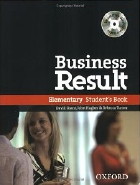
The Business Result series from Oxford University Press consists of five task-based course books that are applicable to most contexts of international business English teaching. The series is suitable for both general business English courses and for courses that prepare students for specific standardized exams, such as Cambridge University’s Business English Certificates or Trinity College’s Spoken English for Work exams. The universal application of the series is a direct result of the alignment to the Common European Framework of Reference for Languages. The Elementary book advances from A1 to A2, the Pre-Intermediate from A2 to B1, the Intermediate from B1 to B2, the Upper-Intermediate from B2 to C1, and the Advanced from C1 to C2. Yet unlike many recent language textbooks published in Europe, in which teaching to standards is discernibly forced, in this case the alignment to CEFR almost seems natural. Where many textbooks based on CEFR tend toward formalist and functional approaches that lose sight of the importance of sustained communicative context, Business Result almost seamlessly integrates the CEFR standards into units of interconnected communicative tasks.
The Business Result books are organized so that language is learned both through and for the sake of communication. Instead of structuring each unit around a grammar topic with complex formal explanations and unrelated and meaningless practice, all tasks are fully contextualized to relevant business themes, for example, Technology and Teamwork (Elementary), Travel and Green Initiatives (Pre-Intermediate), Logistics and Processes (Intermediate), Motivation and Outsourcing (Upper-Intermediate), Leadership and Values (Advanced). Furthermore, the series follows an intuitive organization based on the fundamental input-interaction-output model of second language acquisition. Each thematic unit is divided into five sections. The first section, Working with Words, begins with a text related to the unit theme. Each text is preceded by advance organizers and pre-reading Starting Points intended to help contextualize the topic and is followed by a comprehension check and brief discussion.
Students are by no means expected to passively acquire the language by simply reading and discussing. Instead, the text is relied upon for vocabulary building activities in which students are required to first deduce the meaning of individual words and phrases they encountered in the text before practicing them during listening and oral interaction tasks. Likewise, students are required to deduce grammar rules themselves using additional texts and dialogs in the section Language at Work prior to practicing the new forms. (For students who struggle with an inductive approach, each unit has a deductive grammar explanation in a Practice File in the appendix.) Similar to a mini discourse analysis, the section Practically Speaking then requires students to actively work with oral and written input to discover various verbal communication strategies—for example, for apologizing, interrupting and avoiding interruption, leaving voicemail messages, exiting a conversation, and expressing dissatisfaction—while the section Business Communication maintains the underlying inductive methodology when it treats useful expressions as formulaic chunks. Each unit gradually works toward a capstone Case Study for which students read and discuss a short text before engaging in a role-play/information gap activity—typically in the format of a business meeting—that requires the use of the lexis, grammar, skills and expressions reviewed in the unit.
The most appealing aspect of Business Result, however, is not that the texts, dialogues and tasks are so masterfully contextualized, but that they cover the most important trends and issues of global business: the impact of the internet and social networking sites, the pending energy crisis and economic sustainability, changing markets and workforces, recent technological innovations and cross-cultural encounters. The authors use real life examples from both huge multinationals and small start-ups and ask students to reflect upon how the themes relate to their own companies and jobs. As students progress through the series, tasks become more complex in terms of depth as well as language. The content becomes more and more intellectually stimulating. Articles about contemporary trends in the business world are gradually interspersed with summaries of major business theories, and starting with the Intermediate course book a panel of experts from the Cranfield School of Management offers its Expert View on the case studies. As a result, the books approach content-based instruction, and the Upper-Intermediate and Advanced tasks begin to resemble a mini MBA course.
Of course, every textbook has its imperfections. It is nearly impossible to perfectly contextualize each and every task across five books, and, understandably, some of the introductory texts or concluding case studies do not make much use of the grammar reviewed in the unit. Also, while reading, listening and speaking each receive more than adequate attention; there are few opportunities for writing. Students do occasionally encounter an outline or memo, and the accompanying CD-ROM does contain numerous email templates which students can download and use in their real lives, but there are no structured writing tasks, much less anything approaching an analysis of the many genre used for business. The CD-ROM and online resources are very practical in that they offer extra explanations and practice of the language covered in the book, but as the range and format of tasks could have just as easily been printed on paper, they hardly realize the full potential of computer assisted language learning and lag far behind current trends in blended and autonomous learning schemes.
But, perhaps the greatest fault of the series is the lacking intercultural element that is so crucial to both global business and 21st Century language teaching. Aside from a couple descriptions of cultural differences and a single text that stresses the importance of intercultural skills in the Advanced book, there is little substantial cultural content and no attempt to develop intercultural competence. This is particularly disappointing in consideration of the obvious effort the authors took to internationalize its business insights and assemble a diverse cast of national dialects and foreign accents to simulate English as lingua franca for the audio recordings. One could argue that since so many of the tasks pique the opinions and attitudes of students, intercultural issues would naturally emerge in a diverse classroom. But a multicultural group of students, even when taught at the largest multinational companies, is a rare situation in most parts of the world. In spite of these extremely picky criticisms, however, Business Result remains a truly excellent value for the price.
Reviewed by
Michael Ennis, University of Cincinnati
<ennismj mail.uc.edu>
| © Copyright rests with authors. Please cite TESL-EJ appropriately.
Editor’s Note: The HTML version contains no page numbers. Please use the PDF version of this article for citations. |