

December 2010 – Volume 14, Number 3
Work Hard. Be Nice:
|
|||
| Author: | Jay Mathews (2009) | 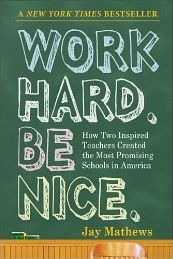 |
|
| Publisher: | Chapel Hill, NC, USA: Algonquin Books | ||
| Pages | ISBN | Price | |
|---|---|---|---|
| 328 pages | 978-1565125162 | $14.95 U.S. | |
Washington Post education correspondent Jay Mathews’s account of Mike Feinberg and Dave Levin’s founding of the KIPP or “Knowledge is Power Program” is broken into four parts, which he calls quarters to mirror the school year. The first quarter of the book details Feinberg and Levin’s first year as Teach for America teachers in Houston, TX – teachers who have undergone intensive summer training and are placed in low-income struggling schools – and their decision to start a new school program to better serve their students. The second quarter covers the first year of KIPP in Houston. The third follows the initial expansion of KIPP with Levin’s return to his native New York City. The fourth quarter discusses the expansion of KIPP to the nationwide program that it is today. Between each quarter he interjects the story of Jaquan, a Washington, D.C. student as his mother discovered the KEY Academy and enrolled him beginning in the fifth grade and his progress and difficulties throughout that year.
The KIPP Program currently runs 99 schools across the United States, including 17 new schools that opened in the summer of 2010. The model is founded on the belief that students who have been struggling in regular schools and have low test scores – students at risk of falling through the cracks – can be helped and brought up to grade level and beyond in all of their classes. Levin and Feinberg propose lengthening the school day to make sure that there is plenty of time to go over material in a number of ways and to integrate their subjects. They also hold students responsible for two hours of homework nightly and have high expectations for their work and their behavior in school. Before enrolling in KIPP the students and their parents are required to sign codes of conduct stating that they will attend school from 7:30am to 5:00pm, on every other Saturday and over the summer, that they will do their homework, respect their teachers and classmates, participate in class and always ask questions (89-91).
Mathews is openly admiring of the work that Feinberg and Levin have done; he believes that theirs is the best program in the United States right now. It shows in his writing and at times the reader may think him overly biased, but based on the evidence he presents, his admiration seems to be possibly well founded. In the prologue titled “Orientation”, Mathews states that among KIPP students who had completed grades 5 through 7 at the time of writing, they had “gone on average from the 34th percentile at the beginning of fifth grade to the 58th percentile at the end of seventh grade in reading and from the 44th percentile to the 83rd percentile in math” (pp. 2-3). The indication is that as the KIPP program grows to include more and more grades, these numbers will improve.
This admiring tone can become frustrating to read, as one begins to wonder if Mathews isn’t seeing the program through rose-colored glasses. However, he does not sugarcoat Feinberg and Levin’s shortcomings or their failings in the pursuit of their goal. He recounts the occasions in which they lost their temper with administrators, school boards, and students. He tells stories that the subjects of his book are embarrassed about and of their early reputations of tough classroom management, including questions of abusiveness, which were ultimately dismissed (pp. 202, 205).
As a graduate student in education, hoping to enter the teaching profession in the United States in the next year, this book is alternately inspiring and worrisome to read. On one hand, it shows all of the difficulty in dealing with red tape, in controlling a classroom as a new teacher, in helping your students to succeed, and in letting them move on to the next grade level where they may have a teacher who is less concerned with their success or simply may not subscribe to the same philosophy of teaching that you hold and have seen work for particular children. It shows how much some of the children struggle and how far behind many of them are, the story of Jaquan’s first year in KIPP shows that if a student starts well behind his classmates, it may take more than a year to get him up to grade level in reading and math and it’s hard not to think about the students who aren’t in KIPP and don’t have schools and programs that are willing to hold them back and give them the required extra attention. All of these are problems Feinberg and Levin faced in Houston and which led them to begin KIPP.
On the other hand, Mathews shows that school reform is an uphill battle, but that with innovative teachers and people willing to work really hard to make a difference it can be done. Levin and Feinberg’s program may not be perfect, but Mathews believes that it’s one of the best out there and does an excellent job of making his case. He describes a program that was started with difficulty and whose founders made mistakes along the way, but who improved the test scores of their students and ultimately created a program that parents and students believe in. The book is a long, but interesting read and challenges readers to think about education in the United States in a new way and to see what it could be.
As mentioned above, Mathews’ account shows that there are too many students in the United States who fall through the cracks and fall prey to just these kinds of situations. All teachers wish to reach all of their students and to keep any of them from failing and Mathews’s account made me wonder how I would possibly find the energy to wage a battle of the kind that Levin and Feinberg did. It’s the kind of detail and story that makes me nervous about entering a profession where I hope to make a difference, but question my own ability to achieve so much. However, it also engages in a conversation about the hard topics of education: how much work do our students need to do to become successful in their education? Is having time to “just be a kid” truly going to help our youth succeed in today’s world, especially if they live in a neighborhood that forces them to grow up too quickly anyway? How much of a role does a student’s home environment play in their school achievement? Does it harm a student socially to hold them back for a year or is it better to hold them back for that year in order to make sure that they are on grade level for reading, writing and math?
All of these questions are ones the U.S. education system is currently facing, and while I don’t believe that Mathews or the KIPP program necessarily has all of the right answers, I believe that they are an important voice in the national conversation. This is a program that is willing to question the traditional role of education in order to better serve those that schools are supposed to be preparing for the future. It is a perspective worth listening to and considering.
Reviewed by
Danielle M. Volker
Graduate Student
<dvolker1 uncc.edu>
|
© Copyright rests with authors. Please cite TESL-EJ appropriately.
Editor’s Note: The HTML version contains no page numbers. Please use the PDF version of this article for citations. |