

March 2009 – Volume 12, Number 4
|
|||
| Author: | Thom Hudson (2007) | 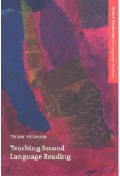 |
|
| Publisher: | Oxford: Oxford UP | ||
| Pages | ISBN | Price | |
|---|---|---|---|
| Pp. viii + 350 | 978-0-19-442283-3 | $25.95 U.S. | |
Teaching Second Language Reading is part of a series designed to provide a reference source for both language teachers and teacher trainers wishing to improve their practical strategies in teaching second language reading and their understanding of the reading process. Hudson surveys the background of second language reading while also discussing what research findings imply about teaching reading. The book is divided into eleven chapters. In this review I will briefly describe the contents of each chapter and point out what I consider each chapter’s highlights.
In Chapter 1, the author gives an overview of important issues in second language reading, including an examination of the reading process as well as a synthesis of the requirements for successful reading. What were particularly valuable for me in this chapter were the extracts used to present the complexities of the reading process. These extracts range from simple paragraphs with comprehension questions to the reading of web pages and tables of contents. Also, the questions on page 12 serve as a springboard for discussing much of the book’s contents.
Chapter 2, “Theories and Models of First Language Reading Processes,” traces research into reading processes and explains the models developed to explain those processes. More specifically, Hudson succinctly explains bottom up, top down, and interactive approaches to reading in the L1. His rationale for this is that “many of the concerns for SL reading have evolved from initial research into first language model building” (p. 31).
Key issues and perspectives that have been used to explain SL reading and instruction in it are explored in Chapter 3. One such key issue is the relationship between first and second language reading abilities. The author’s comprehensive, yet easy to understand, synthesis of the most notable findings in this area was extremely useful.
The focus of Chapter 4 is identifying reading skills, exploring their nature and deciding whether those skills are acquired within an ordered hierarchy. In this chapter, the author attempts to define what constitutes lower-level and higher-level reading skills, drawing on both L1 and L2 reading research. Along the way he cautions us that reading acts and literacy events are complex and involve multiple skills. I particularly liked the various taxonomies of reading skills included in this chapter, like those adapted from Munby (1978) and Hudson (1993).
As a follow-on from the previous chapter, the author in Chapter 5 explores reading strategies and what they imply for instruction. While the previous chapter focused on reading skills used by readers, this chapter details the role of reading strategies and metacognitive skills. The author begins this chapter by usefully defining key terms (skills, strategies and metacognitive skills) and goes on to concisely review the literature in these areas.
The next two chapters highlight schemata and background knowledge in second language reading comprehension. In Chapter 6, the author discusses the role cultural schemata and background knowledge play in interpreting reading texts while Chapter 7 looks at how formal schemata may interact with a reader’s comprehension process. More specifically, this chapter focuses on how surface-level manifestations such as orthography, syntax, cohesion, and text structure may aid or hinder the reading process. Hudson contends that these internal text elements can play a role in how the reader establishes the “coherence of a particular text” (p. 165).
The author sees Chapter 8 as an extension of the previous chapter. In it he focuses on two terms related to formal schema: genre and contrastive rhetoric. This chapter examines genre and rhetorical structures and their effect on reading as well as the issues involved with both within and across languages and cultures. I found Hudson’s in-depth explanation of genres a particularly valuable part of this book.
The most useful chapter for me as a teacher and teacher educator was Chapter 9, “Vocabulary in Second Language Reading.” It examines vocabulary research and how word knowledge affects reading comprehension. The author begins this chapter with the basics – what it means to know a word. Subsequent chapter content includes a brief description of vocabulary breadth and depth of word knowledge. The author’s review of reading research on first and second language vocabulary learning helpfully introduced me to what I consider the most important content of this chapter: the second language vocabulary and pedagogy section. This section explores (1) using dictionaries and how they impact learning vocabulary, (2) using marginal glosses and whether or not they facilitate vocabulary acquisition, and (3) the strategies used for learning vocabulary in context.
Chapter 10 explores links between reading and writing. In it, the author explains why reading and writing have been seen as distinct and why they have often been taught separately. Through discussing both first and second language literacy, Hudson convincingly argues that concentrating on the similarities between the two skills, rather than the differences, is a more productive endeavor.
In the final chapter, the author briefly summarizes the issues he has covered. In the next to last paragraph (p. 297) he points out that there is “no magic bullet, no single explanation for what teachers can do to ensure that their students learn to read a second or foreign language.” Despite the tenor of this statement, Hudson gives hope and support for teachers in the last paragraph by sharing what he thinks most important about the reading process and naming the factors that must be taken into account.
The strengths of Hudson’s Teaching Second Language Reading are numerous, the major one being its timeliness and topicality. Because much of the book’s content is synthesized from previous L1 and L2 research and applied to the second language context, the volume provides a unique perspective. To date, no book has provided as comprehensive a review of the second language reading literature as this one. Another valuable feature is the discussion and study questions at the end of each chapter. These questions can be used for self-study or as part of a graduate course, as they effectively ask readers to reflect on chapter content.
I was disappointed only by the book’s lack of content on reading assessment. In all fairness, however, the book’s focus is on teaching, as its title announces. Nevertheless, given Hudson’s expertise in language assessment, a chapter on reading assessment issues might have been very much appreciated by more than this reader.
In light of its complete treatment of its topic, Thom Hudson’s book is a “must read” for language teaching professionals. Underpinned by sound theory, the book is full of useful information from a historical, theoretical and practical perspective.
References
Hudson, T. (1993). Testing the specificity of ESP reading skills. In
D. Douglas & C. Chapelle (Eds.), A new decade of language testing (pp.
58-82). Alexandria, VA: TESOL.
Munby, J. (1978). Communicative syllabus design. Cambridge: Cambridge UP.
Christine A. Coombe
Dubai Men’s College, Higher Colleges of Technology, U.A.E.
<ccoombe hct.ac.ae>
© Copyright rests with authors. Please cite TESL-EJ appropriately.
Editor’s Note: The HTML version contains no page numbers. Please use the PDF version of this article for citations.