

December 2007 — Volume 11, Number 3
|
|||
| Author: | H.G. Widdowson (2007) | 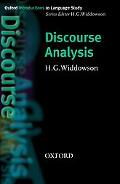 |
|
| Publisher: | Oxford: Oxford University Press | ||
| Pages | ISBN | Price | |
|---|---|---|---|
| Pp. xvi + 136 | 987-0-19-438921-1 (paper) | £ 9.25 GBP |
|
This book is part of the Oxford series of introductions to language studies, edited by H.G. Widdowson himself. More specifically, it is an introduction to discourse analysis. Here, discourse mainly refers to how language is used by people to make meaning and communicate, leaving out socio-cultural constraints. As the author pinpoints in the preface, the main purpose is to provide a useful and above all an accessible tool for an audience, academic or otherwise, approaching this subdiscipline of linguistics for the first time. Therefore, this book, like the whole series itself, aims at “preparing the conceptual ground” (p. xi), in order to support more academically oriented technical texts.
Discourse Analysis is organised into four intertwined sections:
- Survey: the core of the book, provides an overview of the analysed discourse topics as an area of language study
- Readings: various excerpts from the specialist literature which function as useful complementary information for the reader
- References: a selection of suggested readings accompanied by a series of comments that describe how a specific topic is dealt with and also point out the difficulty level of the suggested texts
- Glossary: the meanings of the technical terms highlighted in bold in the survey part; functions also as an index since the page on which terms appear is signalled
The survey section aims at introducing the key concepts of discourse analysis. The language used is easy and simple, but not simplistic, in that it achieves clarity but not at the expense of elucidating complex concepts. So while chapters are quite concise, they are also rich in fundamental notions. This section is subdivided into eight chapters.
- Chapter 1, “Language in use”, distinguishes between the fundamental notions of text and discourse. Text is defined as a communicative unit, whereas discourse as the meaning the text producer intends to communicate and the receiver has to interpret.
- Chapter 2 delves into communicative competence, describing its four characterising aspects identified by Hymes (1972): the possible, the feasible, the appropriate, and the performed.
- Chapter 3 is devoted to showing the tight connection between communication and context. Communication is said to be produced in a specific situational context that is supposed to be shared in some way by participants in a talk exchange.
- Chapter 4, however, points out that language is not produced by relying only on situational context, but it is also “part of the continuity of our individual and social lives” (p. 27). It is related to the mental context or schematic structures of knowledge. Some of the schematic conventions described in this chapter are frames of reference, interpersonal routines and adjacency pairs.
- Chapter 5 investigates how these schemata are actually put to work in the production of a text, thus exploring co-textual relations, of which cohesion and coherence are the chief principles.
- Chapter 6 is devoted to analyzing the mechanisms at play in the communication process to produce meaning, thus discourse. In this process, participants have to negotiate meaning and cooperate. Not surprisingly then, Grice’s cooperative principle (1975) and its four maxims—quality, quantity, manner and relation—are the main concern in this chapter. Widdowson also shows that violating one or more of the latter produces effects revealing that language is being used for the manipulation, control and/or persuasion of the other.
- Chapter 7 examines in detail this rhetorical aspect of language, focusing on the various strategies that may be employed by the text producer in order to persuade the addressee. In examining these manoeuvres the author points out the importance of critical discourse analysis: “revealing to the unwary language user the ideological influences they may be unwittingly subscribing to” (p. 72), ranging from lexical to grammatical choices, which must also rely on co-textual relations.
- Chapter 8, “Text analysis”, highlights the role played by corpus linguistics in enabling the analyst to discover other co-textual relations in real language, for instance collocation patterns.
In a small book serving as an introduction to a field, generalizations are to be expected; however, some items are treated in too general a sense. For instance, in Chapter 5 “Co-textual relations” the author deals with pro-forms and cohesive devices (pp. 44-47), not specifying the exact terms of the linguistic phenomena he is actually referring to, i.e., substitution, ellipsis and reference, and not drawing any distinction even when he gives examples. For instance, he states that “verb phrases can be copied into pro-forms” (p. 46), as happens in the following cases:
A: We went to Romania for our holidays last summer.
B: We did too.
A: We thought it was a wonderful place.
B: Well, we didn’t.
In this sense, the author uses the general term “pro-form” for both cases, but these are in fact examples of ellipsis.
The most interesting and original part of this book are the readings, substantive excerpts from suggested further readings on all the topics tackled in the book. Each excerpt is taken from the specialist literature so, as we might expect, they are often quite complex and sometimes highly technical. For example, there are excerpts from Labov’s Sociolinguistic Patterns (1972), Searle’s Speech Acts (1969), Sperber and Wilson’s Relevance: Communication and Cognition (1995)—among others. Widdowson provides a brief summary and explanation of the crucial points covered in each excerpt. These selections from more advanced texts serve as a preview to studying discourse analysis further. Reading samples from such resources challenge readers/students to improve their own knowledge and skills. A few reading comprehension questions after each text stimulate further thinking and entice the reader into delving into the various topics investigated in this book. Moreover, such samplings from the literature give the reader the chance to familiarise herself with how discourse analysis is performed in linguistics.
Discourse Analysis might serve as a preliminary exposure to discourse analysis. The use of examples in the survey section together with the innovative readings section make this volume thought-provoking and challenging for any reader curious about this branch of linguistics.
References
Grice, H.P. (1975). Logic and conversation. In P. Cole & J. Morgan (Eds.), Syntax and semantics.
Vol. 3, Speech acts. New York: Academic Press.
Hymes, D.H. (1972). On communicative competence. In J.B. Pride & J. Holmes (Eds.),
Sociolinguistics. London: Penguin Books.
Labov, W. (1972). Sociolinguistic patterns. London: Blackwell.
Searle, J. (1969). Speech acts. Cambridge, UK: CUP.
Sperber, D. & Wilson, D. (1995). Relevance: Communication and cognition. London: Blackwell.
Veronica Bonsignori
University of Pisa, Italy
<v_bonsignori yahoo.co.uk>
|
© Copyright rests with authors. Please cite TESL-EJ appropriately. Editor’s Note: The HTML version contains no page numbers. Please use the PDF version of this article for citations. |