

December 2007 — Volume 11, Number 3
|
|||
| Author: | Karen Batchelor (2006) | 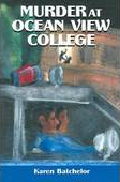 |
|
| Publisher: | Boston: Houghton Mifflin | ||
| Pages | ISBN | Price | |
|---|---|---|---|
| Pp. vii + 91 | ISBN 978-0-618-76947-6 | $11.07 US | |
Murder at Ocean View College is as simple as its title: a straightforward mystery story built along the lines of traditional mysteries à la Agatha Christie. A professor is murdered in her office at Ocean View College. Two students, a woman and a man, training at the college to become police officers, turn detectives although they have been forbidden to do so by their captain. They discover the truth, putting their lives in danger near the end by hiding on a narrow ledge of a college building seven floors above the ground, and in the final confrontation with the killer. Add to that a pinch of romance between the young protagonists and you get a mystery like dozens of others, as soon forgotten as read.
The motive for the murder is as follows: a group of students steals, copies and sells tests to football coach Kelly so that his players will get acceptable grades and be able to concentrate on this high-stakes sport. Ms. Ruby Quinn, the murdered English teacher who used to be engaged to the coach, hears about it and confronts him. Her present fiancé Harvey Taylor, the maths teacher, sees them meeting in dark corners and hallways and, out of jealousy, kills her by stabbing her in the heart with a pencil.
The two main characters, future police officers from different backgrounds, are nice enough, good kids, with good manners and religion, a bit bland. Their personal characteristics are both conventional and unconventional. Jade Lee, 19, lovely with a round face and long black hair, rather demure, is of Chinese descent (Hong Kong). Her father is dead and she lives with her mother, in a rather traditional way. Her mother refuses to see her boyfriend, Danny. Danny Soto, not yet 20, is tall and handsome, self-confident. His family is of Mexican origin: he has traditional, religious parents, two brothers and two sisters. His parents are not happy with Jade as their son’s girlfriend either.
The romance aspect of the story rests on Jade’s jealousy when Danny goes on a date with Amber (a pushy, overweight student who works in the duplicating office and has crush on him) to obtain information from her. Jade sees them and suspects the worst. Quite out of character, she uses her status as a self-appointed police officer to question Amber about the scam and shows she is not averse to using a little police brutality (for personal ends only). She gets over her jealousy when she realises that Danny was not cheating on her. In the end, both students become heroes and receive a plaque (Danny shows his off, Jade keeps hers at home) and the parents become reconciled to the idea of their relationship. All is well that ends well.
The novelette aims at political correctness. The women are referred to as Ms. The protagonists have equal roles in the book, neither being superior nor inferior to the other in terms of intelligence, daring, decision-making or physical strength. When their superiors start questioning them after Jade discovers the corpse, they ‘naturally’ turn to male Danny, who defers to Jade: she is the one who speaks. When Danny tackles the maths teacher, Jade intervenes and gets him out of a life-threatening situation. Still, Danny appears as a naïve young man, a bit of a show-off who does not think very far and tends to act before he thinks, whereas Jade is portrayed as mature, poised and clever. Danny fails miserably where Jade succeeds, for instance at interviewing people. Danny plunges headlong into the maths teacher’s office and is totally unable to improvise and find a good line of questioning. On the other hand, Jade’s interview of Amber is quite successful:
[Amber] started to walk away. Jade grabbed Amber’s pulled Amber’s shirt-tail and pulled her back. . . . Quickly, and without warning, Jade grabbed Amber’s wrist with the tattoo and twisted her arm behind her back. Amber squeaked again. Jade put her mouth to Amber’s ear and almost whispered this time. She spoke slowly and deliberately, but quite calmly. “If you ever get near Danny again, this snake is going to bite you in the backside.” She released the wrist abruptly and walked out of the building, head held high (p. 56).
There are unrealistic bits that wouldn’t convince even a teenage reader: the stabbing with a pencil, the episode when the maths teacher squashes a spider on his desk and Danny reads into it the proof of great cruelty and therefore guilt. And the story is not exempt from stereotyping: the character of Amber, the evil woman, is a stereotype of the fat girl who is also a terrible flirt, as well as a crook (she is involved in the scam). On the other hand, other secondary characters stand out as individuals: Crystal Jackson, the crime-unit leader, is tall (taller than Danny), black and beautiful. She also had trouble with her family because she was dating a white man. The man broke off with her. There is a strong parallel between her personal problems and Jade’s and Danny’s.
This book is not a run-of-the mill detective novel but a reader for foreign students learning English though nowhere does it say so on the book cover, front or back. There is just, in the acknowledgements page, rather cryptic thanks to, last among other people, “students who have suffered through several drafts, and who have enthusiastically asked again and again when the book would be finished and where they could buy it” (p. iii).
Karen Batchelor, the author, writes:
For years I tried to find material that was both linguistically accessible to my students, and interesting enough to hold their interest. Difficult. After trying several novels with my classes, I decided that they really needed something that did not yet exist. So, I started writing an ESL novel. (It is also appropriate for remedial and reluctant readers.) It took me several years, and I used my own students as guinea pigs. When I finally had a draft complete, I asked other teachers to try it with their students. I got very positive feedback. . . . The intended audience is high school and community college students. The reading level is approximately sixth grade.
(http://www.easyenglishtimes.com/teachers_tutors.html).
Karen Batchelor started teaching ESL at City College in San Francisco in 1975. She has published a great number of books: Discovering English (Newberry House, 1981), In Plain English (Addison-Wesley 1985), More Plain English (Addison-Wesley, 1986), The Writing Challenge (Macmillan, 1990), a four-book series The English Zone Book (Dominie Press, 1998-2000). She has also published articles and poetry. This seems to be her first published attempt at crime fiction.
The book offers no teaching aids or even tips. A reader is a reader, granted, but I, personally, would be at a loss to do anything with it (mostly because I don’t teach reading) except recommend it for reading at home. And yet, it has potential as class material. This 91-page book is divided into 32 chapters, each chapter being between one and a half and four pages long, a length which is manageable in one hour of class. In her review of the book, Darcy Meijer has more ideas. To her, each chapter
has a neat, discussable chunk of action and dialogue. Batchelor does not digress, and the vocabulary is well-chosen and embedded in plenty of context. Sentences are clear and direct, and most verbs are in the simple past tense. The action progresses evenly. Batchelor uses light comic touches and subplots to relieve the growing suspense. (http://peacecorpswriters.org/pages/2006/0607/607rv-murderocean.html)
She also describes how she would use the novelette with her students:
Batchelor has included lead-ins for classroom exercises throughout her mystery. Chapter 3 ends with Jade wondering who could have committed the murder. I would ask my students to list their suspects, along with motives and means. As chapter 16 closes, Danny is brainstorming how to deal with three other characters. My students would discuss this orally or in writing, using the new terms. Chapter 27 is a pure narrative, which students could act out, retell or do as a cloze text. In chapter 32 we learn that the murderer has confessed. Students could write out the statement or speak it before the class.
To me, the strong point of the book for EFL (and not ESL) students is that it reads like an introduction to life on an American college campus and, as such, may be of interest from a cultural point of view to foreign students. Pointing out differences and similarities between university campuses in France (or any other country) and the USA, for example the relative importance of sport, the training of police officers, inter-ethnic relationships—all this and more would make good topics for intercultural conversation.
Nicole Décuré
University of Toulouse, France
<decure cict.fr>
© Copyright rests with authors. Please cite TESL-EJ appropriately.
Editor’s Note: The HTML version contains no page numbers. Please use the PDF version of this article for citations.