

June 2007 — Volume 11, Number 1
|
|||
| Author: |
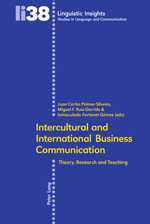
Juan Carlos Palmer-Silveira, Miguel F. Ruiz-Garrido & Immaculada Fortanet-Gomez, Eds. (2006) |
 |
|
| Publisher: | Bern: Peter Lang | ||
| Pages | ISBN | Price | |
|---|---|---|---|
| Pp. 343 | 978-3-03910-954-8 (paper) | £ 37.00; $62.95 U.S. |
|
This volume reflects the need for Business English (BE) to develop to meet the future challenges of international business communication by incorporating the teaching of Intercultural Business Communication (IBC) into its pedagogy. One thing I noted particularly about this volume was the natural merging of fields and specializations contained within it. Indeed, I believe that the majority of chapters could provide valuable insights into corporate and intercultural communication not just for ESL teachers and trainers, but also for other professionals in fields such as Human Resources, Branding, Marketing and Corporate Communications. Another key strength of the volume is its breadth. By tackling the topic from the perspectives of theory, research and teaching, and by covering a variety of different genres of international business discourse in different European, Asian and Middle Eastern cultural settings, the volume offers a comprehensive overview of some of the present day challenges that individuals and corporations face when communicating in an ever globalising world.
The volume itself, standard in its layout and easy enough to navigate, consists of the following sections:
- Introduction: Facing the Future of Intercultural and International Business Communication (IIBC)
- Part 1: English in Intercultural and International Business Communication
- Part 2: Analyzing the Genres of International Business Communication
- Part 3: Intercultural Business Communication from a Sociolinguistic Perspective
- Part 4: Teaching Intercultural and International Business Communication.
Each section contains various chapters in which individual research projects are described and the findings reported.
Not surprisingly, as a compilation of research articles this book is more theoretical than practical in nature and is designed to be dipped into according to the reader/researcher’s needs. The Introduction provides a short but informative introduction to Intercultural Business Communication (IBC), English as a lingua franca, intercultural and international communication in a business context, as well as a very comprehensive overview of the volume’s contents.
The first two chapters of Part 1 highlight the importance and relevance of English as the current lingua franca. Leena Louhiala-Salminen and Mirjalisisa Charles in their paper “English as the Lingua Franca of International Business Communication: Whose English? What English?” refer to this phenomenon as BELF (Business English Lingua Franca), and provide both an overview of the emergence of this term as well as specifying some of the distinguishing linguistic features of BELF. A large part of their paper is dedicated to the authors’ study on BELF usage in a merger between a Finnish and Swedish bank, the results of which are positive when BELF is used by speakers to interact, but which also significantly points out that native language and culture conventions may also impact the use of BELF.
Bertha De-Babcock and Richard Babcock in “Developing Linguistics and Cultural Competency” focus on how international business communicators make use of both linguistic and cultural competencies to communicate effectively. The authors identify four kinds of international business communicators (full bilinguals, partial bilinguals, unilinguals, and first-language speakers), according to their abilities to exchange information in different language environments. The model is completed with the concept of culture corridors, where messages falling outside the boundaries of a person’s culture corridor cannot be accurately interpreted. What I found particularly readable about this chapter were the authentic examples of business communication between Chinese and French business people and the explanation of how these communication exchanges fitted into the authors’ model.
Part 2 is the longest section and consists of five chapters covering various aspects of IBC genre analysis. Aud Skulstad in her “Genre Analysis of Corporate Communication” provides an overview of three traditions of genre analysis, as well as a complete explanation of the Move-Step model, an analysis of rhetorical moves that writers or speakers conventionally make. She extends that model into business discourse through her RECON (Relations and Confidence) model of chairmen’s statements in annual reports. She also identifies Multisemiocity as a key feature of new genres in the 21st century. In the last chapter of this section Hilkka YLI-Jokippi tackles the issue of corporate genres from the point of view of translation. In this paper the author focuses on the characteristics of chairman statements in annual reports and new genres appearing either on the Internet or involving electronic media. The author puts forward the argument that translators need to have knowledge and understanding of the various characteristics of a particular genre to be able to translate it.
In the middle chapters of this section, Belinda Crawford investigates as a hybrid genre conference calls reporting corporate earnings. The results of this study show that although their communicative purpose is different, there are striking similarities between this genre and other genres of spoken discourse such as conference presentations. Frank Meurs, Hubert Korzilius and Adriënne Den Hollander analyze the impact of using English in on-line job advertisements in contrast to the job searcher’s native language, in this study Dutch. The use of English is claimed by many to enhance prestige or the image of a company or product in many countries, however this particular study appeared to contradict popular wisdom, its results showing that using English did not appear to have any effect on the respondents when they were considering on-line job adverts. In the following chapter, Yunxia Zhui promotes cross-cultural genre research and reports the findings of a comparative study of English and Chinese professional genres. The author concludes by arguing the need for a dual perspective in the contrastive study of genres, in this instance one that compares traditional (Western) genre theories with Chinese ones.
The third part of the book looks at intercultural business communication from a sociological perspective. The first chapter, “The Exclusive Groups–Expatriates Working against Corporate Goals," uses ethnographic methodology to describe how Danish expatriates in Saudi- Arabia interact amongst themselves and with other nationalities. On a different theme, Britt-Louise Gunnarsson’s “Swedish Companies and their Multi-lingual Practice” explores the language practices of large international companies from a critical socio-linguistic point of view. One finding revealed that although “good English” was seen to be necessary for brochures and presentations, the same level of language was not deemed necessary for internal communications such as email. The closing chapter, “Corporate Identity and Generic Integrity in Business Discourse," by Vijay Bhatia and Jane Lung, shows how corporate identities are constructed, maintained and interpreted in business discourse, and how corporate communicative practices support identity construction.
The final section of the volume is shorter and more practical. It begins with Julio Giménez arguing that too much emphasis is often placed on teaching learners the technicalities of letters, faxes, emails as discrete genres, whereas it would be more effective to teach the overarching basic principles of effective business communication. Giménez also identifies four communication demands that IBC learners need to be able to cope with: (1) language impact, (2) active listening, (3) conflict management and (4) uncertainty reduction. He also presents several class activities he has designed to help learners develop strategies to cope with these varied demands. In the final chapter, Gina Poncini discusses issues to consider when evaluating spoken and written business discourse, and suggests various ways to apply this focus to teaching intercultural business communication.
Despite being quite dry reading at times, this collection is undoubtedly a useful reference and research tool for anyone teaching English for (International) Business Communication or for Business Communication specialists.
Fiona Cromarty-Lawtie
Université Libre de Bruxelles
<Fiona.cromarty ulb.ac.be>
|
© Copyright rests with authors. Please cite TESL-EJ appropriately. Editor’s Note: The HTML version contains no page numbers. Please use the PDF version of this article for citations. |