

June 2007 — Volume 11, Number 1
Perspectives on Community College ESL Series Volume 1:
|
|||
| Author: | Marilyn Spaventa, Ed. (2006) | 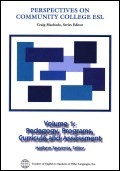 |
|
| Publisher: | Alexandria, VA: TESOL, Inc. | ||
| Pages | ISBN | Price | |
|---|---|---|---|
| Pp. vi + 242 | 978-193118534-9 | £ $37.50 U.S. | |
Perhaps Perspectives on Community College ESL, this series’ title, is its weakest aspect, or at least the weakest of the compilation under review here. It simply does not do justice to the outstanding collection of chapters in this book that collectively provide an overview of the dynamic scope of ESL education occurring in community colleges around the world. For educators at any level interested in tapping into a wealth of creative ideas to inspire themselves or to use as models, Volume 1, in what is slated to be a three-part series, offers a substantial amount of intellectual stimulation. This four-part text covers Pedagogy (Part 1), Programs (Part 2), Curricula (Part 3), and Assessment (Part 4).
To my mind, Pedagogy contains both the most sophisticated and theoretical topics (a college/museum collaboration and a post-critical approach to language learning). Moreover, while these first two chapters of Part 1 are quite powerful and invigorating, they may also be the two chapters least likely to be duplicated by those teaching in community colleges where fighting to keep up with the significant workload limits the number or kind of ambitious projects one can undertake. However, the topics are quite sexy and were undoubtedly chosen as lead-off chapters based on their ability to raise the general opinion and profile of community college ESL programs and their faculty (in other words, their innovation and sophistication would make them appropriate for four-year as well as community college settings).
Though the volume starts out with an inspiring article about how a community college/museum collaboration transformed the pedagogical perspective of many faculty, the scale of such a project might dwarf those collaborative projects planned or previously executed by the average community college ESL instructor. While the authors convey contagious enthusiasm in their descriptions of how faculty from Montgomery College (Rockville, Maryland) engaged in a series of seminars with professionals from the Smithsonian Institution, many readers may ultimately be slightly depressed by the narrative of such a major undertaking that is beyond the resources of most cc’s. After the faculty’s orienting seminars, students were taken on one or more visits to the museum where they began work on projects associated with specific exhibits and were guided towards expanding their ability to analyze and critique the world around them. Though the authors promote the viability for other community colleges of similar projects with local institutions, such a project unquestionably requires a great deal of time and institutional support. Nonetheless, through its discussion of the mediation of culture and knowledge, the article certainly helps generate ideas that readers could adapt and adopt in their own classrooms.
In Chapter 2, “Caminante Si Hay Caminos: Toward a Postcritical ESL Approach for Community Colleges,” J. Andres Ramirez promotes action research and the dismantling of the status quo in the ESL classroom. In his classroom, Ramirez established a “co-constructed” learning community and guided his students toward an exploration of topics centered on social justice. Though Ramirez rightly points out the unspoken political framework of the more typical ESL classroom, many professors, human as they are, will resist the notion that their classrooms are ideological in nature, especially when the ideology is not openly expressed. Moreover, a project-oriented classroom, while rewarding, is more time-consuming for an instructor than simply following the more routine textbook-centered class. Nonetheless, I hope that readers will consider putting into action the rich model that Ramirez presents.
The Programs section covers the wide range of program types that can be found in community colleges depending on the needs of specific communities. Chapter 3, “ESL for a New South,” for example, describes how the ESL program at Gainesville College in Georgia has evolved from an intensive English model to a content-based program and finally to a more technologically focused information management model based on the needs of a Generation 1.5 student population. The author, Harriet Allison, emphasizes the need to help students develop the skills to become independent learners and researchers. She describes an ESL reading classroom focused on developing the ability to analyze and interpret information obtained from the Internet and a class structured on group work in which members teach each other as well as the instructor. Along the way, Allison debunks the common student fallacy that professors exist primarily to provide students with correct answers. Combining a New Literacy Studies perspective with a practical application, this article can serve as a model for programs searching for change.
Other chapters in Part 2 are equally thoughtful. Chapter 4, “Effectiveness of Community in Building College Success” promotes the use of learning communities for NNS of English. At Kingsborough Community College of the City University of New York, Marcia Babbitt writes of the effective linking of Sociology, Speech, and ESL courses to develop students’ abilities to read deeply and to collaborate. Babbitt supplies enough detail to make such a project seem both worthwhile and achievable.
In “Workforce Education in the Pacific Northwest Seafood Industry,” Lenhardt, Purcell, and Tyson describe the learning that can take place even in a project that does not entirely succeed. The project was an attempt by Clatsop Community College to establish workforce education in the local seafood industry. The participating instructors note that though the project was a short-lived one, their persistence did result in achieving some important objectives. One seafood plant ultimately permitted during work hours an onsite bilingual class (bilingual in this setting, to avoid the impression of special treatment, meaning native and Spanish speakers) that a selected group of employees attended. Importantly, NS workers who learned a little Spanish gained appreciation for the challenges their NNS coworkers face, and, for once, workers from all sectors who participated were on essentially equal footing. This article is particularly important because, while many community colleges currently find themselves tempted to focus on academically better prepared students, Clatsop reminds readers of the important inclusion of not only the word but the reality of “community” in two-year colleges.
In Curricula, authors discuss curricula in a variety of contexts ranging from analyzing uses of technology in the classroom to a vocational training program in Japan. Chapter 6, “Whose Technology is it Anyway?” covers the authors’ realization that online courses (even hybrid ones) do not provide enough learning support for many students, a significant percentage of whom have not yet developed the independent learning skills professors sometimes take for granted. Instead Brutza and Hayes promote the use of programs such as Academic Systems, which provides a variety of content readings as well as the support structures and processes of academic essay writing.
In Chapter 10, “Variety is the Spice of Life–and English Classes,” Lieske describes a program designed to improve the English ability of Japanese students in a vocational program focused on health and medical welfare. In the course of their English class, students engaged in multiple activities and projects which introduced many students to the Internet for the first time as well as guided them through preparing and delivering a presentation. Whereas initially many students expressed antipathy to the study of English, at the end they admitted an increased interest because of activities they judged relevant to their professional lives. Like previous chapters, these two effectively communicate what works and what does not while providing readers with insight into the successful design and structuring of curricula for a broad range of programs and needs.
The weak link in this section is “Curriculum Renewal in a Canadian Context: What, Why, and How.” Covering curricular reform at Queen’s University School of English in Kingston, Ontario, the article rather mundanely describes the move from a skills-based to an integrated language approach. Much of the text focuses on material compiled from a variety of other resources: a literature review, the conceptual background, and a needs assessment. While important, this information does not compensate for the lack of specifics. At the end one does not have a sense of what the curriculum actually is. Moreover, it is unclear how the Queen’s University program fits into a text on community colleges. Is there a community college housed within Queen’s University?
Without hesitation, however, Volume 1 of Perspectives on Community College ESL can be recommended as a book that successfully combines the theoretical and practical issues that face not only community college faculty but ESL practitioners at any level. Its focus and clarity are complemented by many instances of inspiration. It also sparks admiration for the thoughtful and grounded approaches to teaching constantly being implemented and revised around the world. Reading this book will be a rewarding experience for anyone committed to the processes of teaching and learning.
Kevin Hinkle
Raritan Valley Community College, New Jersey, U.S.A.
<rhinkle raritanval.edu>
|
© Copyright rests with authors. Please cite TESL-EJ appropriately. Editor’s Note: The HTML version contains no page numbers. Please use the PDF version of this article for citations. |