

June 2007 — Volume 11, Number 1
Technology and English Studies: Innovative Professional Paths
|
|||
| Author: | James A. Inman & Beth L. Hewett, Eds. (2006) | 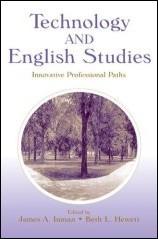 |
|
| Publisher: | Mahwah, New Jersey: Lawrence Erlbaum Associates | ||
| Pages | ISBN | Price | |
|---|---|---|---|
| Pp. xv + 250 | 0-8058-4589-5 (paper) | $29.95 U.S. | |
To a varying degree, technology has become part of many educators’ practice. As this book’s title announces, the focus here is on the stories of some of the innovators who have put technology to use in English education and research. English educators trace their involvement with technology, often from typewriter to the World Wide Web in engaging and reflective first person accounts. Although only one writer specifically addresses ESL/EFL, ELT educators will find encouragement and perhaps shared experiences to consider while they themselves try to creatively incorporate technology in their classrooms. If these revelations are typical, then it seems innovators follow rather crooked paths in their efforts toward making the best use of technology.
This collection of essays is divided into four sections:
- The Past as Future
- Searching the Academy
- Pushing Boundaries
- Forging Beyond.
The book moves from inside the classroom outward to the worlds of art and business.
In Part One, four writers in different styles recount how their educational and academic paths interwove technology and English research and/or writing. Eric S. Rabkin’s essay, “Democracy, Real Work, and Falling in Love With the Net,” reveals his fascination with technology from childhood, specifically a communication device made of cans and wire connecting him to a friend, to presently enabling his students to put their work on the Internet. Throughout the essay Rabkin streses the importance of collaboration in building skills and communication. Another narrative, “Chip of the Old Board” by Nelson Hilton, describes a fascination a son inherited from his father: cataloging knowledge and making it accessible. The son then takes the practice into the 21st century, moving from key cards to markup language to online databases, which shift the form and requirements of composing.
These narratives do not prepare the reader for the narrative challenge of “Circe’s Mirror: Professing Liminality” by Wendy Morgan, who uses different short rhetorical stylings that sometimes reference previous sections and sometimes not. The narrative traces the development of a woman who began her adult life traditionally enough as helpmate (wife, homemaker, part-time teacher) to her spouse’s career. And then moved on to become a high school classics teacher and eventually–as of this writing–a university professor devoted to expanding the boundaries of textuality. The essay incorporates postmodern stylistic elements–switching from third person to first, not following a linear progression, allowing the reader options on what section to read next–in exploring Morgan’s thoughts, experiences, and reflections on her unusual career path.
Part 1 concludes with John Barber’s chapter on “All About . . . Eclecticism as a Professional Path to English Studies,” which details his various work experiences as video journalist, park ranger, copywriter, radio announcer, freelance writer, and finally writing teacher. Barber’s encounters with technology in his highly varied work experiences support his point that seeking and gaining a variety of experiences enhances one’s professional development.
Part Two, Searching the Academy, focuses on challenges faced by the various writers in their evolving use of technology in university settings. The middle two chapters concern teachers trying to incorporate technology into classrooms or writing programs in the face of resistance from departments or schools. Preceding the two chapters is Joanna Castner’s, “The Importance of Belief,” where she shows the power of collaboration in innovating by describing her participation in a graduate school technology group that led to the type of continued growth that her English graduate program fostered. This chapter provides some contrast to the next two, in which the writers describe their struggles to move away from the margins.
“Moving in from the Periphery: Exploring the Disciplinary Labyrinth” follows Douglas Eyman’s path from marginalized technorhetorician to tenure track professor. Eyman found support through virtual communities that enabled him to pursue his interests and research in the face of institutional and departmental resistance. Keith Dorwick’s story begins with his studies of “literature informed by religion” and follows his attempts to make his work meaningful to his students, eventuating in student-centered teaching, which in turn led to cyberspace. As he has since moved on from a writing center professional to a tenure track position as a professor of rhetoric and writing, he concludes that loving what one is doing is necessary to continue such explorations. In the final chapter, Dene Grigar shows how computers opened up new passions for literature, research, and writing. Her road like many others led through a strong competence in computers that at first marginalized her from the mainstream community of English teachers, but which then provided new ways to expand her research and writing: an example described is her hypertextual short story.
In Pushing Boundaries, the third part of this collection, the chapters deal with the risks involved in trying to do something beyond traditional practices. While this chapter begins with “Taking Risks: How to Keep the Juices Flowing” by Pamela B. Childers, which describes her professional growth through the practice of consistently reaching higher, the subsequent chapters deal with specific challenges. Jude Edminster recounts his pioneering digital dissertation experience in the face of institutional resistance. The next chapter traces the path of John M. Slatin as he first resisted the technology that would later help him use the computer as he became blind. He chronicles the development of accessibility tools from their limited beginnings till when they became more accessible for a larger number of users after actual users became involved in the design of the new technologies. Concluding this section is “Networking the Nile: Technology and Professional Development in Egypt,” in which Mark Warschauer recounts a large internet based professional development project he worked on, and how he came to see the greater importance of the humanware in conjunction with the software and hardware.
The final part of the collection, Forging Beyond, takes the reader out of the classroom to the library, the freelance world, industry, and the web-art world. James Elmborg tells readers how a dual path to a Ph.D. in English and a degree in library science led him to find new ways to use technology for writing and accessing literature, thus making him a humanist in the library. With “My Freelance Life: Curiosity Versus Professionalization,” Diane Greco describes her dissatisfaction with the limits of academic study that led her to working as a freelance writer, while acknowledging how some of the skills gained from writing a dissertation prepare one for life outside the world of academic ritual. Beth Hewitt argues for the interdependency of the academic and the business worlds based on her work with Smarthinking, Inc. Mark Amerika concludes the book by answering questions frequently asked him by the many audiences for his different types of web art. Thus a book that began in the ‘real’ classroom ends in a virtual art studio.
Here then in sum are stories of language professionals engaged and engaging with technology at different points in their careers or transitioning between them. It shows that the paths these people took actually took them away from the traditional paths many of their colleagues chose and how the writers grew through these experiences. Chapters end with short summaries of lessons learned, so the reader can reflect with the writer on her or his story and perhaps find common ground with some if not all of the writers. The lessons learned often reflect on the need for humility and collaboration, as none of these writers advanced by going it alone. The writing surprises at times, as different writers use different styles, from straightforward autobiography to a postmodernist text shift with the narrator as both third and first person.
From the previous description, the question arises: What does this book have for second language teachers? Several things come to mind. The writers all took the road less taken. They took the road of increasing use of technology in education when their colleagues shied away from it and took the “safe” career paths. Present and future innovators may take heart from how the writers overcame the challenges of isolation, exclusion, and doubt they faced. For many of us, the language teaching profession has gone through challenges similar to those faced by technorhetoricians, in particular ESL teacher- training programs in U.S. universities. Reflecting on these educators’ strategies for success might prove beneficial and reassuring even when yet another innovative proposal is turned down. Lastly, ESL/EFL teachers already engaged in incorporating technology in their classrooms might find inspiration from the stories of these pioneers and trendsetters.
Those seeking a book about applying the latest Web 2.0 applications or techniques for using various technologies in the classroom will need to look elsewhere. Inman and Hewett have compiled a book for those educators who ask “what if?” and try to do something about it. While those interested in technology in the classroom will no doubt find this book appealing, those interested in how innovative educators think and go about innovating will also find a great deal of guidance and encouragement in these pages as well. As Pamela Childers concludes, “The biggest lesson I have learned during my career is to take risks. I have experimented, developed new visions, and failed at some ideas, but grown as a professional from those failures" (p. 130). These words sum up the thrust of this collection of autobiographical essays on technology and innovation most aptly.
John M. Graney
Santa Fe Community College, Florida, U.S.A.
<john.graney sfcc.edu >
|
© Copyright rests with authors. Please cite TESL-EJ appropriately. Editor’s Note: The HTML version contains no page numbers. Please use the PDF version of this article for citations. |