

June 2007 — Volume 11, Number 1
Listen and Do |
|||
| Author: | Hana Švecová (2006) | 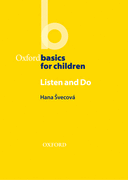 |
|
| Publisher: | Oxford: Oxford University Press | ||
| Pages | ISBN | Price | |
|---|---|---|---|
| Pp. 71 | 978-0-19-442240-6 | £ $9.25 U.S. | |
Once again users of the Oxford Basics series are fortunate to encounter a new resource text by Hana Švecová. In 2003, she authored Cross-curricular Activities[1] in the series, and three years later she is back with Listen and Do from Oxford Basics for Children. With all the experience this teacher and teacher trainer from the Czech Republic has accumulated, we shouldn’t be surprised that she has come up with a book which provides a solid collection of activities for learners aged four to ten.
The book is primarily aimed at the classroom teacher and except for a few pages that serve as an introduction, the 30 activities comprise the book’s content. There are no references or appendices. Although a couple activities may be used for two different age levels, the distribution is as follows:

The activities help learners develop their listening comprehension by providing opportunities for a physical response to the input provided. By listening to instructions and following them, learners make the most of their input and intake stages before they start producing language. These activities stimulate learners to do things, so motivation should be high for completing each activity. The author’s method is closely related to James Asher’s TPR theories (1952) that focus on the positive role played by movement, games or any other psychomotor reaction that may follow as a response to the instructions given to the learners.
The book is well structured and activities follow the same pattern. Each one begins with a sort of introduction, in which a set of entries provide essential information to implement the task:
- the target language entry informs the user of the vocabulary or structures that are at the core of the activity
- the resources entry makes reference to the objects, materials and realia (balls, jump ropes, a string, marbles, clothes pegs, toothpicks, a dice, etc) needed for the task
- the preparation instructions and illustrations exemplify the activity
- the time guide provides an approximation of the time the exercise may consume in the classroom. This is understandably the least precise piece of information because of the different paces classes have.
Right after this introduction, all the steps to follow are given so that the activity can be carried out in the classroom. Sometimes, for example in activities 6 and 8, there is an additional section that suggests variations to the activity.
Listen and Do is designed for both young and very young learners of English. It may be a helpful resource to supplement our course design, provide more listening comprehension practice, as a filler or ice-breaker, or as a way to introduce a touch of fun in our lessons. I predict it’s a resource that will trigger learners’ motivation for acquiring more English.
Švecová’s book should prove a useful resource for teachers because (a) it provides opportunities to carry out activities both inside and outside the classroom, (b) it links the world to the classroom because of the many objects that help us perform the activities, (c) it anticipates possible variations for the proposed activity, (d) it fosters cooperative learning because of the many pair and group arrangements necessary to do the activities, and (e) it can be considered as a set of ready-to-use activities or as a source of inspiration to modify and generate new learning tasks.
What is missing from this book is some indication of the outcomes of at least some of the activiites. Such reporting might have helped instructors choose what might work best for the age level and aptitudes of their students. For this reason my fellow teacher-trainers and I asked some student teachers to try out some of the activities during their in-school practicum.
What follows is the substance of some of the comments the student teachers made:
- sometimes, activities for the same age level show a certain variation of difficulty: some are easily attainable but others are not for the same group of learners; for example, activity 1 is very appropriate for learners aged four, but not activity 2, which is aimed at the same age level;
- several activities require very active participation from learners: for example, activity 3, in which learners play a game with marbles; activity 18, with the blindfold walk or number 24, where rope jumping is the key of the activity. It seems that these activities were very successful among my learners precisely because of the active response demanded;
- a few activities also resembled some games that are part of our repertoire of infant games, for example, the blindfold walk;
- in other cases, the opportunities for learners to bring their own objects, such as marbles, balls or even cell phones (activity 26), adds an extra motivation to the activity;
- variations in an activity, for example in 21 and 22, have also been welcomed by the learners.
Lastly, if I were asked to single out a few noteworthy aspects of the book, the first would be that the book has been written with the practising teacher in mind. It has nothing to do with scholars or researchers and the user-friendly tone of the introduction welcomes us to the content of the pages that follow. The other feature is the large number of illustrations that help teachers understand the way the activity has to be implemented.
Listen and Do has been published at a very opportune moment–when there is a special interest in the area of young learners (YL). A clear proof of that is the publication by most publishers of titles on the topic (e.g., van Oort, 2005) as well as the number of YL Special Interest Groups active in many teachers’ associations.
Note
[1] Reviewed by Thinan Sangpanasthada in 2004, for TESL-EJ, Vol. 8 No. 3.
References
Asher, J. (1952). Learning another language through actions: The complete teacher’s guidebook. Los Gatos, California: Sky Oaks Productions.
Van Oort, H. (2005). Challenging children. Peaslake, Surrey: Delta Publishing.
Dr Antonio R. Roldán Tapia
University of Córdoba, Spain
<ff1rotaa uco.es>
|
© Copyright rests with authors. Please cite TESL-EJ appropriately. Editor’s Note: The HTML version contains no page numbers. Please use the PDF version of this article for citations. |