

June 2007 — Volume 11, Number 1
|
|||
| Author: | Jayme Adelson-Goldstein & Lori Howard (2006) | 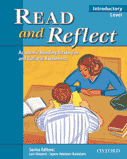 |
|
| Publisher: | New York: Oxford Univ. Press | ||
| Pages | ISBN | Price | |
|---|---|---|---|
| Pp. iii + 138 | 0-19-437731-8 | £ $21.75 U.S. |
|
Read & Reflect, Introductory Level is an EFL/ESL textbook for beginner young adults planning to pursue a college education in the U.S. The four main objectives are to develop students’ awareness and use of reading strategies, increase academic vocabulary, provide a forum for students to learn about and discuss American culture, and increase students’ enjoyment of the reading process.
Read & Reflect seems appropriate for the identified audience. It focuses on developing skills that proficient readers and especially students planning to use English in an academic setting will need, such as metacognitive reading strategies and vocabulary development. The topics have appeal for a wide range of different learners since they incorporate several types of reading documents, ranging from movie reviews, advice, and personal anecdotes to conflicting viewpoints. The large number of charts, pictures, and cartoons are also likely to appeal to young adults.
The textbook has answer keys and teacher’s notes in the back. The authors discuss their teaching approaches in the teacher’s notes and also provide tips on using the text. Their beliefs about reading pedagogy include the use of authentic texts, a focus on silent reading rather than reading aloud, the importance of vocabulary development, using context to determine word meaning, and student engagement through opportunities for learners to express opinions and values.
The text is organized into eight thematic units, each tied to a theme such as happiness or family communication, and including several reading selections and activities focused around the theme. This organization is suitable for an EAP curriculum, as it simulates the demands of academic courses and builds in complexity by introducing new, though related, information as the units progress (Grabe & Stoller, 2001). This organizational method also addresses the authors’ objective of providing a forum for students to discuss American culture.
Each unit contains texts and graphics that the authors state are adapted from or modeled after authentic sources. Readings range in length from a paragraph to a page. All but two lack citations, suggesting most are models rather than adaptations. There are many benefits to using authentic materials, including exposing students to real language and the vocabulary that informs it, increasing motivation, and acknowledging that not all words need to be understood to comprehend a text. As a beginning level book, it is understandable that not all materials would be authentic since readings should complement the students’ small vocabulary and entry level linguistic ability, but one would still expect more authentic pieces than are cited, especially considering the authors’ stated belief in the importance of them.
Texts are preceded by pre-reading activities, have comprehension questions to consider while reading, and are followed by processing activities. This arrangement is in line with reading theory which suggests that a curricular framework be based upon pre-, during-, and post-reading instruction (Grabe & Stoller, 2001). Each unit includes the following sections.
The get ready sections have students consider pictures, questions, and words related to the upcoming reading while discussing graphics or filling in organizers. These methods assist students through schema building and activating background knowledge.
The reading skills sections introduce strategies practiced in the use-your-reading-skills sections and address the authors’ objective of developing students’ awareness of reading strategies. Examples include previewing and predicting. Each new unit continues to practice previously introduced skills. Since academic reading instruction aims to not only equip students with a range of strategies but also the knowledge of when to use them, additional explicit instruction as to when to use the strategies would complement this textbook well.
The understanding the reading sections include matching or multiple choice questions and a writing or discussion prompt related to the text. The sharing sections require students to pick one of two readings and then work with a partner who read the same selection to answer comprehension questions or complete graphic organizers. The pair then shares information with a pair that read the other passage and discusses their comprehension questions as well as some reflection questions based on the common themes in both passages.
The words you need sections introduce about five words at a time, which are then practiced through multiple choice and fill-in-the-blank exercises. The working with vocabulary sections provide similar practice activities in addition to practice using the words in comparisons or different tenses, introduction of noun or adjective variants of words, and other activities such as writing sentences and guessing meaning from context. Developing a large vocabulary base is closely related to reading ability, and Read and Reflect provides ample opportunities to develop vocabulary while presenting an appropriate number of words at a time.
Although the authors indicate that students should be encouraged to determine meaning of new words from context rather than using a dictionary, research demonstrates that second language readers frequently misidentify words and that guessing from context may be overrated (Bernhardt, 1991). An alternative method, or one an instructor may wish to use to complement the guessing strategy, is to allow the use of dictionaries through task-induced involvement. As described by Laufer and Hulstijn (2001), (1) a student needs to find a word or definition; (2) searches for the word or definition in a dictionary or thesaurus; and (3) after finding it, evaluates it against other possible words to deduce meaning or nuances.
The final section of each unit asks students to read a passage written as a response to several writing prompts on a particular topic, to discuss the opinion questions that follow with a small group, and lastly to respond in writing to the prompts with the passage as a model. Since reading is typically used to carry out other language tasks, it is beneficial to integrate reading skills with writing and the speaking and listening that comes with group work. These activities reflect the authors’ belief that student engagement is increased by providing opportunities for learners to express opinions and values.
Read and Reflect, Introductory Level is a textbook that presents students with ample opportunities to develop reading strategies and vocabulary skills. It is congruent with the authors’ stated objectives and approach and suitable for the target audience. Although I think that more authentic materials would benefit the book, I would still recommend it thanks to its strong reading-strategy, comprehension, and skill-integration activities. Combined with longer texts to give extensive reading exposure and a task-induced-involvement vocabulary approach, Read and Reflect would be a beneficial resource for EAP teachers and students as well as any beginner learner wishing to develop reading skills.
References
Bernhardt, E. (1991). Reading development in a second language: Theoretical, empirical, and classroom perspectives. Norwood, NJ: Ablex.
Grabe , W., & Stoller, F. (2001). Reading for academic purposes: guidelines for the
ESL/EFL teacher. In M. Celce-Murcia (Ed.), Teaching English as a Second or
Foreign Language (pp. 187-203). Boston: Heinle & Heinle.
Laufer, B., & Hulstijn, J. (2001). Incidental vocabulary acquisition in a second
language: the construct of task-induced involvement. Applied Linguistics, 22(1), 1-26.
Laura Carrion
Michigan State University
<carrionL msu.edu>
|
© Copyright rests with authors. Please cite TESL-EJ appropriately. Editor’s Note: The HTML version contains no page numbers. Please use the PDF version of this article for citations. |