

June 2007 — Volume 11, Number 1
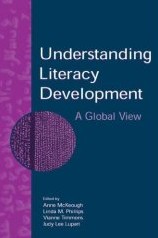
Understanding Literacy Development: A Global View |
|||
| Author: | Anne McKeough, Linda M. Phillips, Vianne Timmons & Judy Lee Lupart, Eds. (2006) |
 |
|
| Publisher: | Mahwah, N.J.: Lawrence Erlbaum Associates | ||
| Pages | ISBN | Price | |
|---|---|---|---|
| Pp. x + 248 | 0-8058-5115-1 (paper) | $27.50 U.S. | |
Global statistics demonstrate the prevalence of low literacy rates, and despite the financial efforts of international governmental agencies and the people-power of non-governmental organizations, the number of illiterate children, adolescents, and adults continues to rise worldwide. In a response to the lack of successful international literacy reform, the editors of Understanding Literacy Development: A Global View set out to further explore literacy in a global context. This comprehensive book focuses broadly on the literacy issue, expanding upon debates both inside and outside the classroom and raising critical questions about literacy development from infancy to adulthood. The editors’ purpose is to provide a global, theoretical, and practical literacy resource for faculty, students, practitioners, and administrators in literacy education. While the editors successfully present current research on literacy development, they fail to define and to refine the notion of “global,” resulting in a volume that simultaneously tackles too many issues and answers too few international questions.
The book is divided into three sections, each of which contains three to four chapters. Part One focuses on young children’s acquisition of literacy skills, Part Two examines literacy development outside of school, and Part Three offers specific areas for teacher development. Due to the wide range of topics covered, however, the chapters do not fall neatly into these three sections. Instead, three key themes that transect the parts unify the eleven-chapter volume: literacy reform, diversity in the literacy classroom, and the importance of literacy research.
The first theme, literacy reform, is discussed in several of the chapters in the book. Chapters Three and Seven in particular combine research and practical suggestions for change. In Chapter Three, Nicholson, writing from the perspective of literacy education in New Zealand, argues for better initial phonemic awareness instruction not limited by the school day, but also extending to after-school hours and into the community. While he concludes with useful and detailed strategies to teach phonemic awareness in the classroom, Nicholson does not directly address the parents’ role in teaching phonemic awareness. This point is especially critical when the complexities of a family’s cultural background and the diversity of attitudes towards literacy shape the literacy practices in the home.
In Chapter Seven, Gosse and Phillips offer a useful discussion of family literacy in Canada that includes country-specific information, theoretical background and a clear overview of current challenges in the field. Similar to Nicholson, the authors argue for reform in developing and implementing literacy programs. The authors’ six-year longitudinal study of a family literacy program produced valuable conclusions, demonstrating that curriculum developed with the input of families for whom the programs are designed will have more successful outcomes.
The second theme, learner diversity, is most apparent in Chapters Six, Nine, and Ten. In Chapter Six, Alvermann views adolescent literacy through a cultural lens. She argues that readers are often labeled as “struggling” because of culturally constructed standards that are imposed upon all students. She maintains that a shift away from these norms and an understanding about the ways in which learners “develop competencies as literate beings will vary according to the demands of their particular cultures” (p. 99). Alvermann engages readers in a lively discussion about culture and literacy and lays the groundwork for later chapters that illustrate how these assumptions play out in the classroom.
Comparable to the work of earlier researchers such as Purcell-Gates (2002) and Harste, Woodward and Burke (1991), Seda-Santana’s study in Chapter Ten shows that conceptions of language are shaped by teachers’ pre-existing assumptions. The author’s research with third grade students and teachers in Mexico provides a concrete example in which to ground her argument. She concludes that to understand the diversity of both literacies and identities in the classroom, teachers need to recognize their own beliefs about literacy and also recognize how literacy is defined within the culture of their school. Similar to Seda-Santana, in Chapter Nine, Ng finds that learner and teacher roles and assumptions must be negotiated in order to create a successful literacy learning environment.
While Ng’s chapter presents the widest range of topics under the heading of diversity, the author only delves deeply into a few of the issues introduced. The strength of this chapter lies in Ng’s presentation of the challenges in English acquisition programs in Singapore, Brunei, and Hong Kong. Ng initially depicts the classroom environment as entirely teacher-centered with minimal student-teacher interaction. However, once teachers encountered diversity in the students’ academic levels and ethnic backgrounds, a more student-centered classroom became a necessity. Student involvement in the learning process required a change in “teachers’ fundamental beliefs regarding their roles as teachers and their expectations of the children and of classroom discipline” (p. 169). Based on these programs and others, Ng stresses that while research in the area of diversity has been valuable, a stronger focus on the relationship between research and practice is the key to facilitating educational change.
The connection between research and practice is the third issue addressed by the editors and is most prominent in Chapters Five and Eight. In the former, Anderson and Li argue that research on the commonalities and differences in literacy development across languages will better inform literacy education practice. Their comparison of metalinguistic awareness in Chinese and English is fairly technical, although their overall argument for greater cross-linguistic research resounds quite clearly by the chapter’s end.
Hamilton, in Chapter Eight, offers a more accessible chapter on the significance of research in practice. She focuses on ethnographic research in Lancaster, England, to better understand the social context of literacy and how learners engage daily in what Brice Heath (1982) defined as “literacy events.” Hamilton’s chapter ends on a realistic note: she does not claim to have the answers on how to improve upon or how to develop adult literacy practices. Yet Hamilton does not leave the reader without hope; she offers recommendations for future directions in the field, including increased research on the multiple notions of literacy within groups of adult learners.
The three key themes discussed here are only a few of the concepts addressed in this comprehensive look at literacy development. While the editors have collected studies that offer a theoretical–and occasionally practical–perspective on literacy development, the book’s weakness is its claim to provide a global view of literacy development. In the eleven chapters, only six elaborate on literacy research outside the U.S.A.; and three out of these six chapters focus on countries where English is the majority language. Also, due to its thematic organization, the book may best be used by piecing out individual chapters depending on an instructor’s area of interest or practice. Despite these reservations, the book will certainly shed light upon the many and diverse critical issues in literacy education and upon the multitude of areas in which reform is needed.
References
Brice Heath, S. (1982). What no bedtime story means: narrative skills at home and school. Language in Society, 11(1), 49-76.
Harste, J., Woodward, V., & Burke, C. (1991). Personal histories and professional literacies. In B. Miller Power & R. Hubbard (Eds.), Literacy in process (pp. 39-48). Portsmouth, NH: Heinemann.
Purcell-Gates, V. (2002). “… As soon as she opened her mouth!” In L. Delpit & J.K. Dowdy (Eds.), The skin that we speak: Thoughts on language and culture in the classroom (pp. 121-141). New York: The New Press.
Heather Bobrow Finn
New York University
<heather.finn nyu.edu>
|
© Copyright rests with authors. Please cite TESL-EJ appropriately. Editor’s Note: The HTML version contains no page numbers. Please use the PDF version of this article for citations. |