

June 2007 — Volume 11, Number 1
Open Forum:
|
|||
| Author: | Angela Blackwell and Therese Naber (2006) | 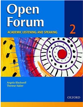 |
|
| Publisher: | Oxford: Oxford University Press | ||
| Pages | ISBN | Price | |
|---|---|---|---|
| Pp. vii + 110 | 0-19-436111-X (paper) | £11.50; $22.50 U.S | |
Research has found that many ESL/EFL students’ academic listening and speaking skills in English are not strong enough to cope with their academic study in English-medium universities, in particular understanding English lectures and expressing opinions and comments. Such students have not gained sufficient English language skills for their academic study (Banerjee, 2001 and Bamford, 2006). Open Forum: Academic Listening and Speaking, Book 2 aims to offer opportunities to help students improve their listening and speaking skills in preparation for their future academic study. As one of a three-level series, Open Forum: Book 2 is for the intermediate level and it consists of Student Book and Audio CDs. It also provides MP3 files with listening exercises on the Open Forum website (http://www.oup.com/elt/openforum) for students to download for practicing outside the classroom.
The book comprises 12 chapters covering a variety of academic topics, such as environmental studies, psychology, visual art, social studies, business and education. Each chapter emphasises practising a specific listening skill and one speaking skill within a theme. Students can listen to various texts, including a lecture, an interview or a news report, and then they can practise recognizing main points or specific details in their listening through answering multiple-choice and open-ended questions. In speaking tasks, students discuss with partners what the speaker said and express their opinions.
Each chapter contains eight sections. To illustrate each, I’ll use Chapter 1 as a paradigm:
- It begins with an introduction to the topic and contains a survey for students to gain background knowledge.
- Before listening, students read a description of the lecture and discuss that overview with partners to develop new vocabulary. Then, students listen to a lecture and note main ideas throughout. After that, they listen again to note details through completion exercises.
- In "Thinking and Speaking," students work with their partners or in a group to practise speaking by explaining the listening segment and having an extended discussion on a similar topic. Students are called upon to express their own views in the discussion. In this section, students can learn key vocabulary and compound nouns related to the main topic. Furthermore, it provides students opportunity to practise using the new vocabulary with peers.
- Students listen to an interview, again noting the main features and meaningful details. Then, students have another opportunity for group discussion, in this case to describe and solve the puzzle in three photographs.
- In the pronunciation section, students can practise stress or intonation in spoken English.
- In this speaking practice section, an extended activity asks students to practise with a partner describing two plans of parks and then deciding which plan is better.
- In the speaking skills section, learners discuss in a group their experiences speaking English and also learn language strategies for speaking.
- The last section offers suggestions for practicing speaking after class. It also provides a website for students to conduct extra listening practice around the same topic of this chapter. It is made up of a listening selection, worksheet, transcripts and answer sheet.
One of the best things this book provides is the focus on various listening skills, such as getting main points, note-taking and summary, because students need to take notes as well as record details in their academic listening. The authentic listening materials, such as lectures and interviews, are what students will listen to during their academic study. Listening to different accents from a variety of speakers is also helpful for students to become familiar with variations they are bound to encounter in lectures and discussions or on radio.
Quite often pair work or group work is involved in listening and speaking tasks in each chapter, particularly useful for students to improve speaking skills, especially in an academic situation. Moreover, the discussions in "Thinking and Speaking" can develop students’ critical thinking skills, crucial in academic study, by asking them to identify and discriminate among expressed opinions and to participate in arguments. In other speaking activities, students learn to prepare for presentations through some typical steps. While these steps are no doubt helpful in giving a good presentation, they do not draw upon typical language structures found in presentations. If such an aid were included, students might develop greater confidence in their spoken English when orally presenting.
Stress and intonation within spoken sentences are also crucial for academic students to practice, because pronunciation is often a weak point for EFL/ESL learners. This book pinpoints the problems that students often encounter in pronunciation, such as word and sentence stress, intonation, and the linking of the two: for example, some tasks focus on mastering intonation to express interest or enthusiasm, so important for conveying the feeling behind words and expressions.
Angela Blackwell and Therese Naber have written a wide-ranging book for students to practise academic listening and speaking skills–such a book often being not easy to find. It provides good resources and activities for teachers to work with in the EFL/ESL classroom. The tasks replicate what students will do in their future academic study in English-medium colleges and universities. Students conscientiously working with their instructor throughout this textbook are likely to solve at least some of the weaknesses in academic study which Banerjee (2001) and Bamford (2006) found in their studies.
References
Bamford, J. (2006, 12-14 Dec.) International students and their experiences of UK higher education. Paper presented at the Society for Research into Higher Education Annual Conference, Brighton, UK.
Banerjee, J. (2001) The interpretation and use of language proficiency test scores in the university admissions process. Unpublished doctoral dissertation, Lancaster University. UK.
Bin Zou
University of Bristol, UK
<bin.zou bristol.ac.uk>
|
© Copyright rests with authors. Please cite TESL-EJ appropriately. Editor’s Note: The HTML version contains no page numbers. Please use the PDF version of this article for citations. |