

March 2007 — Volume 10, Number 4
|
|||
| Author: | Kathleen M. Bailey (2005) | 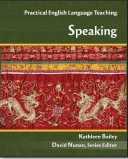 |
|
| Publisher: | New York: McGraw-Hill ESL/ELT | ||
| Pages | ISBN | Price | |
|---|---|---|---|
| Pp.vii + 199 | ISBN 0-07-310310-1 (paper) | $27.70 U.S. | |
This book is part of a series entitled Practical English Language Teaching. While the main volume in the series offers a broad overview of various aspects of language teaching methodology, this volume explores the teaching of speaking in greater depth, in both ESL and EFL contexts. The book offers a broad array of activities, all with emphasis on practical application; however, the organization of the material is confusing.
Speaking is divided into five chapters: (1) What is speaking? (2) Speaking for beginning level learners, (3) Speaking for intermediate level learners, (4) Speaking for advanced level learners, and (5) Key issues in teaching speaking. Content is generally supported by current literature. Additionally, there are authentic sample dialogues to support and illustrate points. Each chapter begins with a Goals page that tells the reader what s/he should be able to do by the end of the chapter. Each chapter ends with suggestions for further reading and URLs of pertinent web sites. Within each chapter, there are Reflection boxes and Action boxes. Words that appear in bold letters in the text are compiled in a comprehensive glossary.
Chapter 1 offers an introduction to teaching and assessing speaking, along with basic terminology and definitions. It includes an overview of the evolution of methodologies for teaching speaking. A weak point in this section, though, is that only the strong version of communicative language teaching (CLT), where attention is largely centered on meaning, is discussed. This version has become outmoded, though, as the value of other important elements, such as form or context (Bax, 2003), have gained currency. Current methodology calls for a more moderate form of CLT with combined attention to form and meaning (e.g., Nassaji, 2000).
Chapters 2, 3 and 4 address teaching speaking by level (beginner, intermediate, and advanced). Levels are identified per ACTFL (American Council on the Teaching of Foreign Languages) guidelines. Syllabus design is used as the starting point in each chapter. Next are principles for teaching the language level in question, discussion of tasks and materials – with complete descriptions of many activities and their applications – guidelines on teaching pronunciation, and a section on assessing the particular language level.
Chapter 5 addresses a variety of common classroom situations, such as learners’ use of their L1, learners’ reluctance to speak (or dealing with a dominant class speaker), different learning styles, responses to oral errors, activities with large classes, activities with multi-level classes, and technology’s role in teaching speaking.
The author has intended the book for in-service as well as pre-service teachers and it is designed for use as a textbook in a teacher training course or as a reference for individual professional development. However, while the book is sound in terms of methodology, it is questionable how well the book succeeds in being a useful resource for all targeted readers and uses. For a novice teacher, the book has much to offer. The language is clear. There are step-by-step guidelines for developing teaching materials. As an example, something as straightforward as how to compile a picture file (p. 60) is explained. There are also detailed instructions for carrying out classroom activities. Basic concepts, such as “pairwork.” and “groupwork” (p. 38) and “simulation” (p. 140), are elucidated.
For a seasoned teacher of speaking skills, the book has nothing new to offer. The author does not advance any new theories; there are no original ideas. The activities described are tried and true staples (e.g., information gaps, jigsaws, role plays). In fact, seasoned teachers may feel frustrated by the simplistic manner in which some of the material is dealt with. For example, in discussing the value of teaching formulaic expressions to beginner learners, Bailey states, “Some useful formulaic expressions for beginner learners include, ‘I dunno,’ . . . (Be careful though! A British friend tells me that ‘I dunno’ might be considered rude in England or Canada.)” (p. 32). Be it used in England, in Canada or in the States, the expression may be rude or polite depending on, for example, context, register and intonation. But the author does not address these factors here.
Intonation and other features of pronunciation are addressed in various sections of the book. While the intent to cover this aspect of speaking is laudable, the presentation and content are weak for several reasons. First, the phonetic symbols used are not those of a commonly used phonetic alphabet. (The alphabet Bailey uses does not appear among six commonly used systems cited by Celce-Murcia et al., 1996, p. 371). A lesser-known phonetic alphabet will not have much practical application for teachers or learners. Second, in the explanation of vowel production, it is stated that the vowel chart is often “superimposed on a profile of a face, looking to the left” (p. 66). However, this book only mentions the illustration without actually including it. Such an illustration, which explicitly shows where in the mouth vowels are produced, is useful as it is common for learners to have difficulty just feeling where vowels are produced. Omitting this illustration is a shortcoming for a book otherwise so explicit.
Finally, including at the beginner level the teaching of segmental phonemes specifically is questionable for two reasons. First, at the beginning of each chapter, the author cites the ACTFL guidelines that characterize the language proficiency level. These guidelines for beginners (p. 30), however, do not specifically reference pronunciation, though the intermediate ones do. So, why is pronunciation introduced in the beginner chapter? Second, whether or not to teach segmentals is often determined by the learners’ L1 and age rather than by language proficiency level. For instance, a young adult learner may be able to produce sounds accurately without having much vocabulary. Thus, introductory information on pronunciation might have been better in a general chapter pertinent to all levels.
The only possibly novel approach to the material is in its organization, namely, by language proficiency level, but the rationale for this organization is unclear. Chapters 2, 3 and 4 identify principles for teaching speaking at the three levels (pp. 36, 96, 124). However, a look at these principles shows that they are broad enough to apply at all three levels, and it remains unclear how the author has determined these delineations. “Encourage learners to take reasonable risks in speaking English” falls under the advanced learner principles, but surely a case could be made for encouraging that advice at all levels. Similarly, the intermediate level principle “Personalize the speaking activities whenever possible” could apply as well to beginner and advanced learners.
Altogether, there is tremendous overlap in material. This is confusing for the reader. Why, for example, is self-evaluation only introduced at the advanced level (p. 154)? Particularly with adult learners, even at a beginner proficiency level, it is good practice to introduce self-evaluation (perhaps in a simpler format than the book illustrates) so that learners develop independence in their language learning from the start. Similarly, the explanations of different kinds of speaking tests (placement, diagnostic, progress, achievement) appear in the “beginner” chapter even though this information is relevant at all language proficiency levels. The same type of overlap is apparent with the description of activity types across levels. For instance, all three sections include picture-based activities. Bailey is perhaps attempting to show scaffolding, (i.e., how the same activity type can be applied at different levels by building on existing knowledge), but this is not explicit. It might have been clearer to organize the material by activity type and illustrate how one concept can be applied at different levels.
It is equally unclear for which type of learner the activities are designed. To illustrate, one picture-based activity (p. 58) consists of describing photographs to learn lexical items for expressing size and shapes. It is intended for beginner learners, but we do not know the age of the learners and what learning goals they might have. The activity seems juvenile and devoid of an explicit communicative purpose (which should be fundamental at all levels). Although there may be a linguistic challenge, a cognitive challenge is lacking, and the activity therefore seems an unlikely choice for adult learners. Similarly, a Total Physical Response (TPR) activity (p. 62) which calls for coloured paper for mastering shapes, and presumably prepositions, may be appropriate at a beginner linguistic level, but it does not take into account any other characteristics about the learner.
Practical English Language Teaching: Speaking is a comprehensive volume addressing the most salient issues for teaching learners to produce oral language. The book is complete, with practical ideas supported by theory. The simple language and clear explanations will likely be most appreciated by novices to teaching speaking. The book’s shortfall is its organization, which leaves the reader confused about the overlap of material from level to level. In fact, the author could have enhanced the book by developing the notion that choice of activities should be dictated by a combination of broader considerations, such as learners’ age, cognitive level and learning needs/goals, in tandem with language proficiency level.
References
Bax, S. (2003). The end of CLT: a context approach to language teaching. ELT Journal, 57(3), 278-287.
Celce-Murcia, M., Brinton, D.M. & Goodwin, J.M. (1996). Teaching pronunciation: A reference for teachers of English to speakers of other languages. Cambridge: Cambridge University Press.
Nassaji, H. (2000). Towards integrating form-focused instruction and communicative interaction in the second language classroom: Some pedagogical possibilities. Modern Language Journal, 84(2), 241-250.
Carolyn Samuel
McGill University, Montreal
<carolyn.samuel mcgill.ca>
|
© Copyright rests with authors. Please cite TESL-EJ appropriately. Editor’s Note: The HTML version contains no page numbers. Please use the PDF version of this article for citations. |