

September 2006 — Volume 10, Number 2
Second language acquisition: An advanced resource book |
|||
| Author: | Kees deBot, Wander Lowie & Marjolijn Verspoor (2006) | 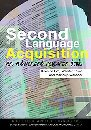 |
|
| Publisher: | New York: Routledge | ||
| Pages | ISBN | Price | |
|---|---|---|---|
| Pp. xvi + 303 | 0-41-533870-0 | $29.95 U.S. | |
Introduction
DeBot, Lowie, and Verspoor have produced a well-written textbook/resource that covers important areas of second language acquisition (SLA). Although the title has the word “advanced” in it, this should not frighten any reader with an interest in how languages are learned and with questions such as whether form-focused instruction is beneficial to the learner. This text can profitably be read as a second book in the field, perhaps after starting with Bill VanPatten’s excellent slim text From input to output: A teacher’s guide to second language acquisition (2002) or Lightbrown and Spada’s How languages are learned (2006).
Second language acquisition: An advanced resource book is divided into three sections. Unit A covers the field of SLA research in a manner similar to other textbooks. The chapters in this unit are as follows:
A1) Defining the field
A2) Dynamic aspects of SLA
A3) Historical perspectives
A4) The multilingual mind
A5) The developing system
A6) Learners’ characteristics
A7) The role of instruction.
Unit B extends all of these topics by providing hallmark SLA articles along with annotations, commentary, and follow-up and reflection questions. Unit C further explores the same topics and in the process encourages the reader to think about, reflect upon, and do their own research on such topics in SLA.
In Unit A key terms and concepts are explained that define the field. Examples of bold print headings in these seven chapters are: “Implict v. Explicit Learning”, “Instructed versus non-instructed SLA,” “Dynamic Systems Theory,” “Interacting Systems,” “Is L2 Acquisition like L1 Acquisition?” and “The Role of Form-Focused Instruction.”
The authors’ goal in Unit B is to actively involve the reader through the careful study of key SLA articles. At its best, this method is similar to readers discussing the article with experts such as deBot at their side. On the other hand, a lot of space is wasted in reprinting the entire article when every topic may not be of high interest to the reader. In his role as expert, deBot could have simply summarized or highlighted the articles, thereby saving a lot of print space and reading time. However, the authors imply it is better for readers to read – in their entirety – fewer, well-chosen articles than it is to read for breadth (since it is now impossible for applied linguists to read everything published in the field).
Kees deBot is an expert on and proponent of Dynamic Systems Theory (DST), a relatively new theory for SLA originally developed for biology but also finding a place in the social sciences. DST is a blend of chaos and catastrophe theory and seeks to explain complex systems where variables interact with each other and the system continually changes. Classic examples of dynamic systems are weather and traffic patterns. The first article relating DST to SLA, according to deBot, was by Diane Larsen-Freeman in 1997. Since then, little has been written on SLA from a DST perspective. Hence, this compendium is an excellent way to become acquainted with this new paradigm.
DST appeals to me because I see in the model a way to explain many things in SLA. For instance, language learning, especially when one looks at individual data, is not a linear process. In SLA, U-shaped curves exist where language learners appear to regress before advancing (e.g., learners using irregular past went, then go’ed, before finally internalizing the use of went again). Even language fossilization, which at first glance appears to be counter-evidence against DST, can be included in the DST paradigm as an “attractor state” – a state where great effort must be made to move the system. Or as Diane Larsen-Freeman explained fossilization at the 2006 TESOL convention (personal communication), “Mountains can be stable for twenty years before a pebble starts an avalanche.”
After becoming familiar with the DST paradigm, one can often find dynamic systems in other areas. For example, in two areas of my own research dynamic systems seem to appear: (1) learning disabilities (LD) in SLA, and (2) preservice teacher attitudes towards multiculturalism. Although many articles on LD focus almost exclusively on the LD, a DST approach would view LD as simply one factor (albeit a potentially powerful one) interacting among many variables (e.g., classroom method, motivation, language attitudes, language anxiety, self-confidence, learning strategies, etc.). What also appears to operate as a dynamic system are attitudes towards multiculturalism, with many studies showing conflicting results for multiculturalism instruction, e.g., Tatum (1998), Zhou (2002), Zygmunt-Fillwalk (2003), and Rosenthal and Jacobson (1992). Since attitudes towards diversity are complex, they may be difficult to change for some students, whereas other students may suddenly “get” multiculturalism, even in a short workshop. These attitudinal changes are extremely difficult to predict with any degree of certainty. We’re also reminded in the bestseller Chaos (1988) that most systems we’re familiar with in the real world are nonlinear.
DST may be compatible with other second language learning theories. The authors assess the components of Krashen’s research, finding some of them totally compatible with DST (e.g., the importance of input for second language acquisition), others partially compatible (e.g., the role of the affective filter), and still others incompatible with DST (e.g., Krashen’s learning v. acquisition dichotomy in its strong form).
The authors’ over-the-shoulder interrupting their readers’ reading could have failed badly or, more likely, been considered a distracting nuisance if it had not been done deftly. It is obvious that a lot of time, thought, and effort went into the structure and content of this text. DeBot, Lowie, and Verspoor refuse easy shortcuts and they do not burden the reader with routine, boring end-of-chapter questions. Instead they have written the rare advanced SLA text: very readable, yet intriguing and challenging. This is a text for anyone with an interest in second language acquisition, applied linguistics, or Dynamic Systems Theory, and undoubtedly is a text that can profitably be read numerous times.
There is also an accompanying website to the book at: http://www.routledge.com/textbooks/0415338700.
References
Gleick, J. (1988). Chaos: The making of a new science. New York: Penguin.
Larsen-Freeman, D. (1997). Chaos/complexity science and second language acquisition. Applied Linguistics, 18, 141-165.
Lightbrown, P. M. & Spada, N. (2006). How languages are learned. Oxford: Oxford University Press.
Rosenthal, R. & Jacobson, L. (1992). Pgymalion in the classroom: Teacher expectation and pupils’ intellectual development. New York: Irvington Publishers.
Tatum, C. Y., (1998). Preservice teachers’ attitudes and awareness of multicultural education. Unpublished doctoral dissertation, Wayne State University, Detroit.
VanPatten, W. (2002). From input to output: A teacher’s guide to second language acquisition. New York: McGraw-Hill.
Zhou, P. J. (2002). Students’ attitudes, knowledge, and commitment to implementation of multicultural education in a teacher education program. Unpublished doctoral dissertation, West Virginia University, Morgantown.
Zygmunt-Fillwalker, E. M. (2003). Potential for change: The effects of curricular interention on preservice education students’ attitudes toward multicultural teaching and learning. Doctoral dissertation (UMI No. 3080473).
Wolf Kozel
Fort Hays State University, Kansas
<wolfk2 yahoo.com>
|
© Copyright rests with authors. Please cite TESL-EJ appropriately. Editor’s Note: The HTML version contains no page numbers. Please use the PDF version of this article for citations. |