

September 2006 — Volume 10, Number 2
Reading for a Reason: Expanding Reading Skills Series |
|||
| Author: | Laurie Blass and Elizabeth Whalley (2006) | 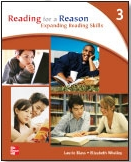 |
|
| Publisher: | New York: McGraw-Hill | ||
| Pages | ISBN (paper) | Price | |
|---|---|---|---|
|
Pp. xviii + 221 (Book 1) Pp. xviii + 252 (Book 2) Pp. xviii + 221 (Book 3) |
0-07-294211-8 0-07-294214-2 0-07-294217-7 |
$21.00 U.S. each | |
Researchers have claimed that reading is one of the best learning strategies to boost one’s vocabulary knowledge (see for instance, Cho, Ahn, & Krashen, 2005; Krashen, 1989, 1997). Additionally, there is general agreement among vocabulary specialists that the heart of communicative competence is lexical knowledge (Coady & Huckin, 1997). Because reading does play this important role in a language learner’s lexical development, ESL teachers need a textbook series like Reading for a Reason that addresses both skills.
This three-level series is based on academic themes, moving readers from high-beginning to high-intermediate levels. It aims at developing a Òstudent’s independence, confidence, competence, and comfort in reading in English and in learning new vocabularyÓ (p. xvi, all three books), because these are requisite skills for an ESL learner’s academic success. Unit headings reveal a broad range of fields/academic themes addressed in this series:
Book 1
- psychology
- food and nutrition
- physics and history of sports
- biology
- literature
Book 2
- student success
- history
- business
- physical science
- the arts
Book 3
- critical thinking
- business
- film studies
- human geography
- biology
Each level of this series comes with one student book, one teacher’s manual, and audios. Each student book is organized into five themes, ten chapters (two chapters per theme), and chapter sections. Each chapter is divided into fourteen sections: two pre-reading activities, two reading activities, timed reading, reading skills development, two post-reading activities, expressions, internet research, writing, speaking activities, wrap-up, and a crossword puzzle. Each teacher’s manual has three sections: ten chapter quizzes, an answer key to chapter quizzes, and an answer key to the student book.
One of the major advantages of this series is that it integrates many skills: reading, writing, vocabulary, listening and speaking. Additionally, some of the readings have other aims. In Book 3, one of the readings promotes critical thinking while another offers a key to creative problem solving. Readings on world cultures and cultural diversity can be found in Book 2. Activities follow logical structures, making the text easily navigable. The content is current and accurate; topics are developed to appropriate length and depth depending on the English proficiency level. For example, reading passages at the first level range from 150 to 600 words, at the second 425 to 950, and at the third 550 to 1500. One could label this series ÒconsiderateÓ, because it provides activities that Òsupport students’ learning by using vocabulary and language structure appropriate to their experience and abilityÓ (Reiss, 2005, p. 65).
Audio tapescripts are read aloud by both women and men in a tone and manner appropriate to the subject matter and at a pace that fits learners’ English proficiency. These supplemental audios allow English learners to listen to a native speaker of English as they follow the texts in their book. Each reading passage has an audio clip. I would only make one addition to the audios. As is the case with some other series such as Top Notch (Saslow & Ascher, 2006), transitional instrumental music between the vocalized readings might smooth the way and set the tone for those that follow.
This series is user-friendly. The kind and right number of graphics used makes the textbook attractive. Chapter length, style, typeface, the amount of the white space on each page, and the colors cater to the English proficiency of the target audiences.
As an ESL curriculum specialist in a new university ESL program, I have been trying many textbooks with the pilot group of ESL students for more than a month now. The group is made up mostly of university students majoring in various fields. All have Spanish as their native language, and most of them are highly motivated to learn English.
According to my informal observations and results of quizzes and other assignments, Reading for a Reason has ranked second – so far – in appealing to and motivating our ESL learners. Top Notch presently holds first place, perhaps because it has the advantage of audiovisuals and highly colorful textbooks. Its audiovisuals, with subtitles, have helped struggling beginner ESL learners understand what would have been difficult to understand by just listening to the audio CDs or audiotapes. The range and brilliance of the colors in Top Notch make the graphic illustrations quite vivid.
I can think of four additions to these books:
- developing audiovisual programs
- providing a glossary for each student book
- covering all proficiency levels
- providing interactive activities either on CD-ROM or online.
An ESL learner might be encouraged to read a text knowing that he or she can access the glossary if no dictionary is available. Also, ESL program coordinators or ESL curriculum specialists generally prefer to adopt one series for the whole program; therefore addressing all proficiency levels in the series should increase its likelihood of being adopted. A final recommendation for this series is to provide either an interactive CD-ROM or online program for computer. External links to online activities are provided for each chapter, but activities specifically designed by the authors will be more appropriate.
Even though there is room for improvement, this series is highly recommended for university academic reading classes, chiefly because it makes reading enjoyable for ESL learners. For teachers, there is very little to add to this series to reach their goals for ESL reading instruction.
References
Cho, K.-S., Ahn, K.-O., & Krashen, S. (2005). The effects of narrow reading of authentic texts on interest and reading ability in English as a foreign language. Reading Improvement, 42(1), 58-64.
Coady, J., & Huckin, T. (Eds.). (1997). Second language vocabulary acquisition. New York, NY: Cambridge University Press.
Krashen, S. (1989). We acquire vocabulary and spelling by reading: Additional evidence for the input hypothesis. The Modern Language Journal, 73(4), 440-464.
Krashen, S. (1997). Does free voluntary reading lead to academic language? Journal of Intensive English Studies, 11, 1-18.
Reiss, J. (2005). Teaching content to English language learners: Strategies for secondary school success. White Plains, NY: Longman.
Saslow, J. & Ascher, A. (2006). Top notch: English for today’s world. White Plains, NY: Longman.
Safary Wa-Mbaleka
Antillean Adventist University, Puerto Rico
<safaryw uaa.edu>
|
© Copyright rests with authors. Please cite TESL-EJ appropriately. Editor’s Note: The HTML version contains no page numbers. Please use the PDF version of this article for citations. |