

December 2005 – Volume 9, Number 3
Writing |
|||
| Author: | Tricia Hedge 2005 (2nd edition) | 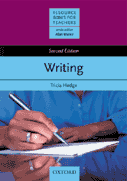 |
|
| Publisher: | Oxford: Oxford University Press | ||
| Pages | ISBN | Price | |
|---|---|---|---|
| Pp xi+154 | 0 19 442190 2 (paper) | £14.25 | |
Writing, by Tricia Hedge, is a resource book mainly designed for teachers who need to train their classes in the activity of writing, one which is neither an easy nor a spontaneous one. The book is generated from the assumption that good writing skills are essential for effective communication. Yet, learning to write well takes time and practice. It is a complex task, with “difficulties [being] exacerbated when writing in a second language” (p. 7), where writing conventions may differ considerably from one’s first language. In response, the author aims at offering a collection of practical activities and suggestions for those interesting in the topic.
Taking into account feedback from teachers worldwide, Hedge offers a number of good reasons for learning the art and craft of writing, and gives suggestions on the possible uses it lends itself to. She also gathers material, techniques, and ideas for class activities and offers teaching suggestions tailored for each activity.
The activities are organized following a similar pattern. Some or all the following headings are used to give relevant information about the activity: level, time, aims, topic, preparation, procedure, comments, and variations (p. 18). Nevertheless, each can be adapted by the teachers according to their needs and objectives. Activities are designed to cater for students whose proficiency level in English ranges from elementary to advanced, and they are grouped according to their immediate aim–that is 1. Communicating, 2. Composing, 3. Crafting and 4. Improving.
Communicating represents the first stage of the writing process itself. The activities suggested under this heading are designed to instruct the learner in writing within a specific context and for a specific audience. Thinking of the target reader should encourage the writer to think about the appropriate writing style to use. Communicating activities include the following, all precisely targeted and stimulating the class in a dynamic use of language for real purposes: (1.1) Exchanging letters with your students, (1.2) Sharing journals with students, (1.3) Keeping a reading journal, (1.4) Sharing cultural information, (1.5) Making a class magazine, (1.6) Carrying out mini-projects, (1.7) Giving directions, (1.8) Asking for and giving advice, (1.9) Jigsaw story writing, (1.10) Writing a newscast, (1.11) Internet greetings, (1.12) Using emotive language, (1.13) Changing style.
The second stage of the writing process is that of composing. This second chapter is devoted to a series of pre-writing, drafting, redrafting, and editing activities that encourage the learner to gather and organise ideas before actually composing a piece of writing. Planned writing is not a linear process, which requires constant rethinking of one’s own ideas and mental outlines. The activities suggested by the author encompass (2.1) Making mind maps, (2.2) Using a diagram of ideas, (2.3) Pyramid discussion, (2.4) Brainstorming, (2.5) Making linear notes, (2.6) Imagining dialogues, (2.7) Working from opening sentences, (2.8) Freewriting, (2.9) Cubing, that is, a technique that makes students consider the same topic from six points of views (2.10) Using visuals to focus a description, (2.11) Writing poetry, (2.12) Using opinionnaires, (2.13) Using journalists’ questions, (2.14) Reporting interviews and finally (2.15) Conducting a survey. All activities are designed to motivate the class and to facilitate the provision of contents for future individual writing.
Crafting activities guide learners into the structuring phase and are aimed at making them produce well-structured written work. Putting ideas together requires a good knowledge and an active awareness of how written language is organized and what its main features are. In order to do so Patricia Hedge suggests (3.1) Describing a person, (3.2) Writing a biography, (3.3) Developing an argument, (3.4) Organizing a contrast and comparison essay, (3.5) Writing a book review, (3.6) Writing instructions, (3.7) Developing a cause and effect argument, (3.8) Organizing a classification, (3.9) Using connectives of addition, (3.10) Using connectives of concession, (3.11) Time sequencing in a story, (3.12) organizing general and supporting statements, (3.13) Working with language using dictogloss. Organization is the focal point of each activity. Students are asked to organize their ideas and contents according to different registers and tasks. They are given the chance to practice connectives, which is an important stage preceding that of systematizing paragraphs, and developing their ideas by improving their sense of direction.
The last group of activities focuses on the collaboration between the teacher and the class, often highlighted in the book. This is aimed at improving the quality of writing through (4.1) Raising awareness about writing, (4.2) Raising awareness about text quality, (4.3) Evaluating plans, (4.4) Writing in a group, (4.5) Conferencing, (4.6) Reviewing a draft for content, (4.7) Using taped comments on first drafts, (4.8) Peer conferencing on drafts, (4.9) Reformulating, (4.10) Peer editing using an editing code, (4.11) Self editing for language accuracy, (4.12) Making your own dictionary, and (4.13) Keeping a language notebook.
Overall, the book is well structured and easy to use, especially thanks to a clear and detailed index of the activities, which enables the teacher to pick the most suitable ones for his/her contingent aim. Photocopiable worksheets are often available. I appreciated the central role given to the teacher who has to introduce students to sources of help and to assure they know how to exploit them at their best. Touching on punctuation and presenting the most common errors for each type of writing stage would also have been interesting and useful.
Elisa Perego
University of Pavia, Italy
<maperego tin.it>
| © Copyright rests with authors. Please cite TESL-EJ appropriately.
Editor’s Note: The HTML version contains no page numbers. Please use the PDF version of this article for citations. |