

June 2009 – Volume 13, Number 1
Catalyst: Writing from Reading 2 |
|||
| Author: | Marianne Brems (2008) | 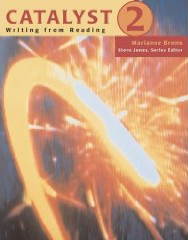 |
|
| Publisher: | Boston: Heinle Cengage | ||
| Pages | ISBN | Price | |
|---|---|---|---|
| Pp. xv + 224 | 978-0618549740 |
$26 text; $36 audio CDs; $99.75 assessment CD-ROM with exam view |
|
The ability to write academically correct English is a required skill in US colleges and universities. In order to write good English, it is necessary to read a range of texts that expose learners to varied uses of academic English so that they are provided with “more focused teaching and learning with cross-learning opportunities” (Hudson, 2007, p. 286). In order to develop a connection between reading and writing skills, Catalyst 2 has students read and write about various types of academic texts closely connected to their experience of the world. This second volume is primarily aimed at intermediate level English students.
Catalyst 2 is thematically organized into eight chapters and includes three reading texts in each chapter. Most of the chapters discuss the experiences of immigrants to the United States. According to the Introduction, most of the reading texts were written by the author, with a few of them drawn from other sources (p. vii). An overview of the book follows:
| Chapter | Title | Sources |
|---|---|---|
| 1 | The Remittance Life | |
| 2 | Discrimination | Includes the essay “A Land of Diversity” by Emily Strauss |
| 3 | Bridging the Gap Through Athletics | Includes an excerpt from the book Swimming to Antarctica by Lynne Cox |
| 4 | Family Issues and Marriage | |
| 5 | Stereotypes and Stereotyped | Includes an excerpt from the book Asian American Dreams: The Emergence of an American People by Helen Zia |
| 6 | The Process of Assimilation | Includes excerpts from the books Serving and Silence by Margarethe Cammermeyer and Assimilation, American Style by Peter Salins |
| 7 | Refugees: A Place to Call Home | Includes excerpts from the books Becoming American: Personal Essays by First Generation Immigrant Women, edited by Meri Nana-Ama Danquah, and Secrets of the Universe: Discov- ering thae Universl Laws of Science by Paul Fleisher |
| 8 | American Values |
The first chapter, “The Remittance Life,” deals with the issue of U. S. immigrants remitting part of their earnings to family members in their native country. The author claims that a remittance economy is good for both host and developing nations: the host countries get cheap labor for some types of work while the developing countries benefit from money sent back by those laborers. The second chapter, “Discrimination,” comprises U. S. immigrants’ narratives from both past and present. In the third chapter, “Bridging the Gap Through Athletics,” the author focuses on athletics in an attempt to show how competition in sports has encouraged fairness and equality among all people living in the U. S. Family and marriage as sites of cross-cultural differences are covered in Chapter Four: specifically the author talks about differing wedding traditions in North American and Asian contexts. With the chapter “American Values” Brems concludes her textbook by elaborating on differences between North American cultural values and those of non-American cultures.
In the beginning of this textbook, there are clear instructions (in separate sections) for both students and instructors explaining how they can use Catalyst 2 best. The book also provides clear content details in the “scope and sequence” section at the start of each chapter. The template is pretty much the same for each chapter. Following each reading, the author includes exercises and activities that aim to develop the student’s skill at using what she’s learned through the readings to improve her writing ability. Immediately after reading a text, students are supposed to discuss the questions based on that text. Also, the author has tried to make vocabulary and grammar an inherent part of the link between acquiring improved reading and writing skills. There are fill-in-the-blank and matching exercises, among others, for using “academic words” in various contexts. Grammar exercises (e.g., use of gerunds, passive voice) in context are also provided. These vocabulary and grammar activities build upon the reading texts in the book. In the back of the book are appendices giving extra but very useful information (e.g., composition evaluation sheet, a list of transition words, punctuation summary).
Two activities in each chapter are particularly significant for making a connection between reading and writing skills. The first is “composition analysis,” where students are expected to carefully read the texts, penetrate the details, and explore how the content is organized, particularly focusing on thesis/topic sentence, supporting details, examples and explanations, cause and effect relations, and conclusions. Students are also expected to read a text intensively to see how transitional devices have been used, then try to use them in their own writing later. Each chapter ends with a writing checklist where students compare their writing with the set criteria.
The chief strength of this book lies in its author’s approach, i. e., her goal to develop students’ understanding of academic writing and its attendant skills by exposing them to readings that encourage a link with their life experience. Though it seems ambitious, Brems’s attempt in a single volume to have students connect the skills of reading and composing through guided discussion and practicing the academic words and grammatical patterns various writers use should be successful. The readings “serve as a ‘catalyst’ to stimulate reaction in writing” (p. viii). It appears the author has selected the readings following the notion of comprehensible input (i+1) proposed by Krashen and Terrel (1983, p. 80). The visuals provided should contribute to that comprehension.
What many instructors might also appreciate is that, according to Brems, the reading material included was tried out in various classroom settings, including her own, before being incorporated into her book for a wider audience (p. vii). However, in making her choices Brems assumes that her wider audience will comprise students from the “urban working-class” (p. vii); if so, the link between the readings and students’ everyday lives might be direct. I say ‘might be’ because there is an assumption that readings about illegal immigration, working illegally, sending remittances back to poor relations, doing unskilled labor like cleaning and construction are relevant to such a subset of immigrants.
Also, though students usually like readings that have a bearing on their lives beyond the classroom, such lack of variety, I believe, becomes monotonous for them. Including more diverse readings that could provide targeted students with experiences beyond their immediate surroundings, experiences and issues they might be curious about, e.g. the environment, science and technology, animals and geography, could increase motivation and interest.
Despite this shortcoming, the book can be a useful resource for teachers and students in an ESL context. By including stories of immigrants living a hard life at low wages, this textbook might be particularly useful in ESL contexts where students are members of working class immigrant communities. In such a context as well as in different ones, the book can be used in conjunction with other texts so that students’ reading materials reflect a larger range of experience students might also relate to.
References
Hudson, T. (2007). Teaching second language reading. New York: OUP.
Krashen, S., & Terrel, T. (1983). The natural approach: Language acquisition in the classroom. Oxford: Pergamon.
Bal Krishna Sharma
University of Hawaii
<bsharma hawaii.edu>
© Copyright rests with authors. Please cite TESL-EJ appropriately.
Editor’s Note: The HTML version contains no page numbers. Please use the PDF version of this article for citations.