

March 2009 – Volume 12, Number 4
|
|||
| Author: | Sandra Lee McKay & Wendy D. Bokhorst-Heng (2008) | 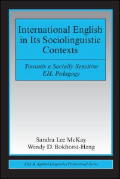 |
|
| Publisher: | New York: Routledge | ||
| Pages | ISBN | Price | |
|---|---|---|---|
| Pp. xvii + 209 | 978-0-8058-6338-3 (paper) | $39.95 U.S. | |
In Sandra Lee McKay’s (2002) practical book, Teaching English as an International Language: Rethinking Goals and Approaches, she outlines standards for teaching English as an International Language (EIL), discusses culture in teaching EIL, and suggests methods for teaching EIL, based on the requirements of an international language. In this book, McKay and Wendy D. Bokhorst-Heng go a step further by arguing that in teaching English world-wide, the particular social, political, and educational context in which English learning is taking place should be taken into account. In addition to examining the sociolinguistic contexts of present-day English use and learning, this timely book aims at exploring “how the teaching and learning of English can be undertaken in such a way as to maintain linguistic diversity while providing equal access to the acquisition of English” (p. 21). The book discusses several theoretical issues related to EIL teaching and learning and provides specific case studies from various English teaching and learning contexts.
The opening chapter, “English in an era of globalization,” discusses the role of English in globalization by outlining reasons for the spread of English and discussing the effects this spread has had on both English and other languages. An equally interesting focus in this chapter is the authors’ examination of what they consider two potential dangers of the spread of English, namely monolingualism among many native English speakers and economic inequality in access to English learning, illustrating the latter with examples of language policy and planning in China, Hong Kong, and South Korea. As for monolingualism, the authors argue that the spread of English can result in a sort of complacency and self-sufficiency among native English speakers towards learning other languages. This growing monolingualism among such English speakers may also promote the view that an English-only classroom is desirable and discount the benefits of using students’ other languages in facilitating the learning of English.
Chapter 2, “Social contexts for EIL learning,” continues to highlight the book’s emphasis on the diversity of English learning contexts and the inequality in socio-economic spread of English by discussing the social attitudes and educational policies that can influence the teaching of English in each of the three contexts of English use in Kachru’s (1985) model of concentric circles (see table 1).
Table 1: Adaptation of Kachru’s (1985) Model of Concentric Circles
| Inner Circle | Outer Circle | Expanding Circle | |
|---|---|---|---|
| Use of English | Primary language | Second language in a multilingual society | Widely studied as a foreign language |
| Examples | U.K., Australia | Singapore | China |
| Critical issues according to McKay and Bokhorst-Heng (2008) |
|
|
|
Careful to point out that the lines separating these circles have become more permeable since Kachru first presented them, the authors nevertheless analyze issues relevant to each circle (as outlined in Table 1). Although the authors provide diverse case studies from the U.S., U.K., South Africa, and Asia Pacific countries, an examination of English language learning (ELL) and teaching in the Arab world would have added even more diversity to the richness of contexts analyzed, particularly in light of the continuing expansion of ELL in the Middle East.
Similarly, chapter 3, “Multilingual societies,” explores the social and sociolinguistic context of English use today by examining (1) incentives and support for learning English, (2) type of English input, (3) status of the mother tongue, and (4) support for maintaining the mother tongue in both diglossic and non-diglossic multilingual contexts. India and South Africa serve as case studies of diglossic countries. However, the Arab world also presents a typical case of diglossia, where the native language, Arabic, has two forms: Modern Standard Arabic, used in formal domains across the Arab world, and various local colloquial varieties. Moreover, some countries in the Arab world, such as Lebanon, are characterized by Arabic, French, and English multilingualism and the wide use of English and French as media of instruction. Exploring this trilingual phenomenon within a diglossic mother-tongue context might have provided an opportunity for further insights. The non-diglossic multilingual contexts analyzed in the chapter are speech communities in the U.S.A. and the U.K. In this section, in line with the rest of the volume, the authors clearly advocate designing English learning and teaching environments that promote the use of the learners’ other languages and support the development of bilingualism rather than monolingualism.
Chapter 4, “Language planning and policy,” focuses on how language “politicking,” such as designating official languages, affects EIL learning and teaching. The authors use case studies focusing on Singapore, the U.S.A., China, and South Korea to examine the consequences of official language designation on social attitudes towards particular languages, on language-in-education policies, and on the setting of linguistic standards. The authors thoroughly discuss the issues involved and conclude that the view of EIL as Standard English without any ethnic or national markers is highly problematic and may promote inequality and marginalization of those who speak only non-standard varieties.
Chapters 5 and 6, “Linguistic variation and standards” and “Interactional sociolinguistics,” supplement the discussions in earlier chapters on the social factors involved in learning and teaching EIL by analyzing specific features of the structure and pragmatics of EIL. Chapter 5 focuses on the diversity of English use today and the development of World Englishes. The authors discuss issues such as standard language ideology, intelligibility, and criteria for determining whether a linguistic innovation is a norm. Examples illustrating these issues are provided from Nigeria, Singapore, South Africa, and India. Chapter 6 examines how interactional sociolinguistics has been beneficial in providing insight into EIL issues, mainly research on English as a lingua franca (ELF), code-switching behavior, and attitudes towards code-switching.
In the final chapter, “Towards a socially sensitive EIL pedagogy,” McKay and Bokhorst-Heng argue that in designing such an EIL pedagogy, the following factors should be taken into account:
- the extent of multilingualism
- language policies and practices
- linguistic features of the local varieties of English
- how individuals make linguistic choices indicating their affiliation with speech communities and ideologies
The chapter presents an interesting discussion of globalization and “othering” in ELT materials and methods, and concludes by outlining several givens in designing such a curriculum: providing equal access to English, recognizing other languages spoken by English speakers, and respecting the local culture of learning.
Although this book is directed to “teachers of English whose students will be using English for international purposes” (p. xi), it may appeal to a much wider audience. In addition to TESOL professionals, sociolinguists and applied linguists may find many of the issues raised in this book pertinent. Finally, similarly to and perhaps supplementing related books such as McKay (2002), Kirkpatrick (2007), and Phan (2008), this book can be used in professional development as a valuable resource on EIL for pre-service and in-service teachers of English worldwide.
References
Kachru, B. B. (1985). Standards, codification, and sociolinguistic realm: The English language in the outer circle. In R. Quirk & H. G. Widdowson (Eds.), English in the world (pp. 11-30). Cambridge: Cambridge UP.
Kirkpatrick, A. (2007). World Englishes: Implications for international communication and English language teaching. Cambridge: Cambridge UP.
McKay, S. L. (2002). Teaching English as an international language: Rethinking goals and approaches. Oxford: Oxford UP.
Phan, L. H. (2008). Teaching English as an international language: Identity, resistance, and negotiation. Clevedon, UK: Multilingual Matters.
Rula L. Diab
Lebanese American University, Beirut
<rula.diab lau.edu.lb>
© Copyright rests with authors. Please cite TESL-EJ appropriately.
Editor’s Note: The HTML version contains no page numbers. Please use the PDF version of this article for citations.