

June 2008 — Volume 12, Number 1
|
|||
| Author: | Dave Willis & Jane Willis (2007) | 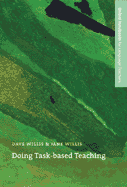 |
|
| Publisher: | Oxford: Oxford University Press | ||
| Pages | ISBN | Price | |
|---|---|---|---|
| ISBN 978-0-4422109-9 | Pp. xv + 294 | £17.00 GBP | |
According to the authors, Doing Task Based Teaching was written for "language teachers who want to gain a better understanding of how task-based teaching (TBT) works in practice" (p. xiii). With contributions from over thirty teachers in twelve countries, for me the real value of the book is that on top of providing a thorough introduction to and overview of TBT, it also offers 257 pages of practical advice and guidance on how to design, create, teach and evaluate task-based lessons and activities.
The book is practical in its content and in its design. It is extremely easy to read and navigate, and the table of contents is so detailed that if you have a specific question, such as, "how to prepare students for form focused examinations using a task-based approach," you can go directly to a section that deals with that within seconds, for example, English for Examination purposes (p. 181). Other useful features of the book are:
- the reader activities
- the commentaries
- the review sections
- the further reading lists
Each chapter has several reader activities, which engage readers in the text and encourage readers to reflect and think about what they have just read. Usually the activities are then followed by a commentary, which gives detailed explanations, solutions or answers to the reader activities. These reader activities, as well as the commentaries and review sections, would lend themselves well to incorporation into teacher training materials.
The book’s introduction gives a very concise overview of the book chapter by chapter. In brief, chapter one explores the beliefs and misconceptions that surround TBT and hosts a lively debate on why classes should begin with a focus on meaning and not on form. It also explores the definition of the term "task" itself.
Chapter 2 onwards, as the book itself states, places "the emphasis"–very much on doing task-based teaching." Chapter two describes four practical sequences of meaning-focused activities that lead to a focus on form, and then refers back to them to give a practical illustration of some of the basic theories and principles that underlie TBT.
Chapters 3, 4 and 5 focus on various aspects of task design, specifically on how to create, grade, appraise and evaluate tasks. Chapter threes deals with tasks based on written and spoken texts, chapter 4 on designing tasks based around specific topics or themes, and chapter 5 explores several ways of generating tasks: specifically problem-solving, projects and storytelling tasks. What is fresh about these chapters is that each task type described in the book is accompanied by a task example described by a teacher who has used that task in her classroom.
Chapter 6 differentiates between a focus on language in use and a focus on form in isolation. It also illustrates how different items can be identified from texts and spoken language and then used as the basis for form-focused activities.
Chapter 7 tackles the disparity between classroom discourse and the outside world and explores how closely the two can be brought together. It argues that the use of tasks "opens up a far wider potential for real-world language use, especially when teaching students with specific needs" (p. xiii). It then explores the role of the teacher in TBT, describing it amongst other things as "manager of discourse and purveyor of knowledge."
Chapter 8 shows ways that tasks can be tailored to the needs of specific classes to make them more engaging and motivating. It also explores the decisions made in planning task sequencing, as well as highlighting the importance of devising clear instructions for tasks.
Chapter 9, "Designing a Task-Based Syllabus," looks at different meaning-based approaches to syllabus design, including a discussion of task-based syllabuses for ESP, general, examination and course-book based courses. It also includes a set of procedures for syllabus design.
Chapter 10 tackles ways of integrating TBT into course books as well as responding to commonly raised objections against raised TBT via a section on FAQ about TBT. Two such questions I could personally relate to were "How can I motivate my students to do more than just the minimum?" (section 103.6, p. 217) or "How can I find time to design tasks and plan TBT lessons?" (section 10.3, p. 212) I am sure many teachers using TBT will find something in this chapter that relates to them personally as well, and if not, the tried and tested "Teacher’s Tips for Task-Based Teaching" (pp. 228-229), written by practicing teachers, serves well as a constant source of TBT inspiration and motivation.
In some ways, it is almost as if this entire book was written to answer all my–and your–practical questions or allay doubts that critics have raised about TBT over the years. Whether you are a newbie to TBT or whether you have been incorporating it into your teaching for years, this book will more than likely have something that will reach out to you, as well as give you something practical that you can take away and try out in class the next day. The appendix is particularly useful for providing materials and creative classroom ideas, with, amongst other things, sample task-based lessons, sample projects and scenarios, handouts on how to design and use communicative tasks, and a sample task-based course plan.
As for the book’s limitations, for some it may just be too practical and not have enough research citings. For me it was a breath of fresh air, something readable and usable. Now it has a priority position on my desk for frequent dipping into and reference. Its only limitation for me perhaps was its trying to cover all levels of learner and all teaching situations in one book. Although the book shows how the principles of TBT remain the same when applied across the full spectrum of learners and teaching situations, it is arguably still hard at times to relate to activities such as "make a list of things that cats do," when you are teaching at a tertiary institution. Granted there were several examples of more advanced activities in the book, still perhaps scope remains for more focused follow-up books, such as doing TBT with beginners or doing TBT with advanced learners. That said, all in all a highly useful and practical book and a must for anyone involved in, or interested in, TBT.
Fiona Cromarty-Lawtie
ULB – Free University of Brussels
<Fiona.cromarty ulb.ac.be>
|
© Copyright rests with authors. Please cite TESL-EJ appropriately. Editor’s Note: The HTML version contains no page numbers. Please use the PDF version of this article for citations. |