

December 2006 — Volume 10, Number 3
In the Know: Understanding and Using Idioms
|
|||
| Author: | Cindy Leaney (2005) | 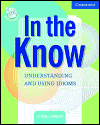 |
|
| Publisher: | Cambridge: Cambridge University Press | ||
| Pages | ISBN | Price | |
|---|---|---|---|
| Pp. ix + 208 | 0-521-54542-0 (paper) | £13.95 | |
Language texts–be they written or spoken–are the result of a large number of complex choices and eventual commitment to the first choice made (Sinclair, 1996). However, when we speak we choose, apparently simultaneously, more than one word at a time, that is, we speak in chunks rather than in words, and resort to stretches of language with a single meaning. Indeed, “a language user has available to him or her a large number of semi-preconstructed phrases that constitute single choices, even though they might appear to be analyzable into segments” (Sinclair, 1991, p. 110). Idioms are just one out of the several multi-word units (or complex lexical items) that make up (the English) language.
Idiomatic meanings make up a very large part of everyday English, be it formal or informal in register. This suggests the need for EFL–and to a certain extent also for ESL–learners to master at least a core assortment of idioms in order to understand the language they are exposed to, and to use it conveniently and successfully. The main focus of In the know, a textbook for foreign speakers, is idiomatic English, or rather, as the book’s subtitle announces, Understanding and using idioms. The idea to focus on this area of the English language stems from the necessity to sound natural, to use language in a colourful way, and to understand more of what one reads or hears (p. vi).
The book is divided into 40 four-page units grouped into three parts–Contexts, Concepts, Key words–and it includes Reference and Answer key sections.
The Contexts units contain idioms used in a selected range of specific situations or to discuss specific topics, such as
- Agreeing and disagreeing
- Communicating
- Eating and drinking
- Feelings
- Expressing emotions
- Fighting and arguing
- Health
- Home and family
- Learning and studying
- Money
- Negotiations and decisions
- Personality and character
- Problems and solutions
- Relationships
- Time
- Travel
- Understanding
- Work.
So, Unit 12, for instance, dealing with the idiomatic language used to talk about someone’s personality and character, makes sure learners are presented with a selected range of expressions used to refer to positive character [e.g., (have) a heart of gold], negative character [e.g.,(have) a chip on your shoulder], or character that can be negative, positive or neutral [e.g., not have a friendly or honest/ bone in your body; not have a selfish bone in your body; (something that is) in your blood].
The idioms in each of the Concepts units are linked by a common theme. Cindy Leaney has chosen to focus specifically on
- Ability
- Age
- Criticism
- Danger
- Easy/difficult
- Search and discover
- Failure
- Good and bad
- Honesty
- Knowledge
- Memory
- Responsibility and control
- Risks and opportunities
- Strength and weakness
- Success
- Value.
In Unit 28, for instance, the author selects knowing vs. not-knowing idioms (e.g., know something inside out vs. what beats me is …) and after presenting them in conversation, she arranges them into opposing groups for the sake of clarity.
Lastly, the Key words section groups idioms by similar words within the idioms themselves. We have idioms which contain words belonging to the semantic fields of
- Animals
- Colours
- Fire and smoke
- Hands and shoulders
- Feet and legs
- Water and waves.
Unit 36 groups its idioms into red/rose/pink, black and white, green, and blue types (e.g., in the red, roll out the red carpet, etc.).
Units have a consistent structure. Each opens with a dialogue which embeds idioms in a short conversation, one which can be listened to on the audio CD included. Idioms are then grouped according to their specific function, situation or type, and an explanation of each is given in English. The threefold activity section of each unit is meant to allow learners to practice the idiomatic expressions and, specifically, to “Focus on meaning”, “Focus on form” (grammar, spelling, pronunciation), and “Focus on use” (register and appropriateness).
The first two activity sections provide learners with a broad range of reinforcing exercises: matching, grouping, sentence completion, sentence transformations, scrambled dialogues that need to be rearranged, concept maps that need to be completed, odd-one-out exercises, role plays, crosswords, and much more.
The last activity section, “Focus on use”, is particularly important and best exploited if learners are guided by a teacher, since it leaves room for reflections on both language and pragmatics, and for hint-based production tasks: e.g., (1) Have you ever “learned something the hard way”? What did you learn? How did you feel?; (2) In what circumstances would you “wash your hands” of someone?). Here is where linguistic commentary is dropped and challenging tasks are given. After fixing the merely linguistic aspects of idioms, students are led to reflect on them metalinguistically and cross-culturally, with constant reference to their mother tongue:
- Is there a common phrase in you language that means the same as “pick a fight”?
- In a social conversation in your culture, is it polite or impolite to ask direct questions about a person’s financial situation? Which idiom in this unit would be acceptable in your culture?
- Some of the idioms in this unit–“show your hand”, “put your cards on the table”, “up the ante”–come from card games. Can you think of any negotiating idioms in your language that come from games?
- What are some “fire” or “smoke” idioms in your language? What do they mean? Are any similar to the idioms in this unit?
Learners are also stimulated to reflect on and practice different levels of formality, appropriateness and naturalness in language by means of re-phrasing activities: e.g., (1) This e-mail from Jack to his friend Charlie sounds too formal. Replace the words in blue with idioms from the box to make it sound more natural; (2) This letter of application is intended to be formal, but the writer has used some informal idioms. Replace the idioms so that the style of the letter is more appropriate.
The Reference section acts like a glossary of idiomatic expressions: idioms are listed alphabetically, given a definition and a usage example, and readers provided with the reference to the unit where the idioms are covered in the body of the book. The Answer key makes it possible for students to use at least part of the book independently.
The book’s organization allows learners to exploit it conveniently, either focusing on only a few specific idioms or going through all of them. It is designed to comply with the needs of students interested in refining their proficiency in EFL and could be integrated easily with any standard grammar book. Activities which push learners to re-use the same expressions in different more or less open contexts allow those learners to become confident with the idioms’ actual meaning.
In the know‘s only fault, if any, is the much too loose sense in which the technical term “idiom” is used. Different levels of idiomaticity exist, and apparently Cindy Leaney hasn’t selected idioms in the strictest sense of the term (cf. Gramley & Pätzold, 1992; Benson et al., 1997). “In linguistics, idiom is defined [ . . . ] as a complex lexical item which is longer than a word form but shorter than a sentence and which has a meaning that cannot be derived from the knowledge of its component parts” (Gramley & Pätzold, 1992, p. 71). Nevertheless, Leaney’s selection occasionally includes multi-word units which would be more accurately identified as grammatical or lexical collocations (e.g., to take advantage of; to drink to someone; to bend the rules; to refresh one’s memory) and more or less idiomatic binomials (e.g., black and white; day and night; fair and square; crash and burn; on the up and up). She also includes expressions which might easily fall into the category of commonplaces (to call a spade a spade) or pragmatic/situational idioms, also referred to as social formulae, i.e., fixed expressions whose use and meaning is determined by a particular social situation (e.g., you bet; you can say that again as informal ways to express strong agreement in conversation).
Casting such a wide net may be the result of Leaney’s definition of idiom as simply “a group of words. As a group, the words combine to form a new meaning. The words work as a team [ . . . ] The idiomatic meaning [ . . . ] is not obvious” (p. vi). In fact, the idiomatic meaning is not simply “not obvious”. Since the idiom’s constituents do not make an isolable contribution to the meaning of the whole, learners of English cannot anchor themselves to any word belonging to an idiomatic expression to guess its meaning. Given this lack of semantic transparency, idiom comprehension (which apparently is not an easy task for native-speaker children either) is related to the combination of learners’ knowledge of the world, context clues and common sense. Citing as “idioms” different types of language combinations, even the more transparent ones, allows the author to include a wider range of items in her selection and to offer students easier examples of “idioms”. The latter might be viewed either as a learner-oriented device purposely chosen to make some expressions less difficult to acquire, or, at times, as a confusing one which could mislead learners who might frustrate themselves searching for an idiomatic meaning in expressions which simply aren’t idiomatic.
References
Benson, M., Benson, E., & Ilson, R. (1997). The BBI dictionary of English word combinations. Amsterdam: Benjamins.
Gramley, S., & Pätzold, K.-M. (1992). A survey of modern English. London: Routledge.
Sinclair, J. (1991). Corpus, concordance, collocation. Oxford: Oxford University Press.
Sinclair, J. (1996). The search for units of meaning, Textus IX: 75-106.
Elisa Perego
University of Trieste, Italy
<elisa.perego scfor.units.it>
|
© Copyright rests with authors. Please cite TESL-EJ appropriately. Editor’s Note: The HTML version contains no page numbers. Please use the PDF version of this article for citations. |