

September 2006 — Volume 10, Number 2
Effective Academic Writing 2: The Short Essay |
|||
| Author: | Alice Savage & Patricia Mayer (2005) | 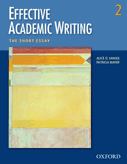 |
|
| Publisher: | New York: Oxford University Press | ||
| Pages | ISBN | Price | |
|---|---|---|---|
| Pp. viii + 168 | 0-19-430923-1 (paper) | $22.95 USD | |
It is satisfying to encounter a textbook that recognizes and supports the step-by-step developmental path that most students must follow to become proficient writers. Effective Academic Writing 2 helpfully fills that important space between paragraphs and full length essays. Designed to introduce intermediate students to three and four paragraph essays, each chapter of Effective Academic Writing 2 is divided into five parts. Beginning with Unit 2, these parts are Stimulating Ideas, Brainstorming and Outlining, Developing Your Ideas, Editing Your Writing, and Putting It All Together.
Unit 1, “Paragraph to Short Essay,” which serves as a transition from Effective Academic Writing 1: The Paragraph, begins by reviewing a basic paragraph and proceeds to a discussion of how to write a three paragraph essay. This chapter nicely scaffolds the review of paragraph basics including giving students the opportunity to practice both identifying and writing topic sentences. Though it is impossible to include everything in a text and please everybody, it would be nice to see some of these fundamentals woven throughout the text, as students often struggle with them for a long time. Such reiteration makes even more sense when we recognize that students may test into an intermediate language class based on general fluency even though they may be missing critical basic concepts. In particular, the authors devote only three pages to thesis statements, whereas students need extensive opportunities, ideally at intervals, to practice them.
Throughout the text, definitions of key terms are clear and concise. These key terms serve as a helpful reference for students who may need clarification as they write. In later units, the authors cover familiar but important territory such as simple and compound sentences, how to identify and correct run-on sentences, adverbs of frequency, and connectors. The text does a good job of introducing these language issues in suitable contexts. For example, the narrative unit introduces time adverbs and time clauses while the comparison and contrast unit details the use of appropriate connector words. Each unit also provides specific writing assignments. Some of these assignments are quite broad. This is where the instructor must step in to guide students in narrowing down the possibilities for an essay. For example, writing about a cultural tradition (Unit 2) sounds easy since students generally come from different cultural backgrounds, but many students will struggle to narrow down the topic appropriately.
One notable and effective feature is Editing Your Writing (part 4 in each unit). In each instance, the authors present a challenging language issue, such as dependent and independent clauses, followed by a few exercises that move from identifying the structure, to producing it in a guided exercise, to editing a paragraph. An Editor’s Checklist is the last task, providing an effective way for students to focus on what each essay should contain. It requires a student to review what a classmate has written and serves as the basis for a dialogue about a specific essay’s strengths and weaknesses.
One helpful change would be to make some of the questions wh-questions rather than yes/no questions because students would then be obliged to provide more thoughtful answers. For example, “Does the body paragraph contain enough descriptive detail?” is a highly subjective question that students may have difficulty answering. Wh-questions could be structured to elicit critical analysis and engage students in the kind of thinking and writing that are the backbone of academic discourse.
In terms of organization, the book is quite confusing because numbers are overused. First the student encounters Unit 1, then Part 1. Numerous exercises as well as steps are also sequentially numbered, though at each level of numbering the font size is reduced. Even so, navigating the text would be much easier if letters as well as numbers were used. In addition, though the cover is attractive, the pages are overly gray and monotonous.
To me, by far the most glaring weakness of this textbook may be viewed as a strength by others. Though paragraph and essay models are plentiful, to my regret they are far too heavily weighted toward first person narratives. Though the text acknowledges the existence of a more academic style of writing through some thesis statements (“There are several ways to reduce stress” and “Not getting enough sleep can have negative effects on a student” being two examples), there is a dearth of third person essays.
Heavily favoring first person essay models suggests that narrative writings are the most essential and common type of writing students will do in their academic careers. This is simply not true. Moreover, there seems to be a common misconception that students can write only about personal experiences. Students would benefit from opportunities to practice many styles of writing that should help them develop as both critical thinkers and writers with a broader range.
Beyond my disagreement with the book’s emphasis, there are a few mildly disconcerting errors. For instance, one common error of non-native speakers is writing sentence fragments beginning with because. On p. 66, the authors give the following example of adding details to essays: “Because he was completely exhausted.” While most native speakers would realize that this example is not a complete sentence, a tendency of non-native speakers is reinforced. Because it begins with a capital letter, ends with a period, and appears in a textbook, the example cited might be seen as an acceptable sentence.
Using student writing samples is a good way to make students aware of their peers’ writing and also point out to them that their writing does not have to be flawless to be acceptable. This strategy helpfully brings writing to students’ level and does not position it as the domain of professional writers only. However, in an essay in “Comparison and Contrast Essays,” the student writer states, “Everyone knows that New York is ‘the Big Apple.'” “Everyone knows” is a phrase students should edit out of their writing. Because overgeneralization is one of the topics the authors discuss, it is surprising they chose a sample essay that included this type of error. Perhaps in the Analyzing the student essay exercise, the authors could simply add a question asking students to identify inappropriate language in the paragraph as a way of verifying whether they understood the previously presented concept of overgeneralization. This would reinforce the point while not eliminating the many benefits of authentic writing samples.
Lastly, there is one sentence, on p. 113, that simply does not make much sense: “Now that I live in Houston, Willowbrook Mall is the place where I go to see people on Sundays for their afternoon walk.” The main clause’s subject complement is an extremely awkward phrase and calls into question the selection of this particular student essay. In the book’s introduction, Savage and Mayer maintain that they have “adapted” student essays as models. All the more reason to edit out obviously incorrect phrasing.
Overall, this textbook’s content is good, the format is solid, and the authors thankfully do not try to do too much within the confines of one text. Moreover, unlike many other books, they manage to maintain their focus on the intermediate student and do not wander ahead of the appropriate developmental stage. I can recommend Effective Academic Writing 2 as a very good choice for instructors who share the authors’ view that intermediate students should predominately be writing about their own experiences. Those of us who believe that students’ experiences should be the catalyst rather than the goal of student writing, at whatever level, will continue to look for that elusive text.
Kevin Hinkle
Raritan Valley Community College, NJ
<rhinkle raritanval.edu>
|
© Copyright rests with authors. Please cite TESL-EJ appropriately. Editor’s Note: The HTML version contains no page numbers. Please use the PDF version of this article for citations. |